
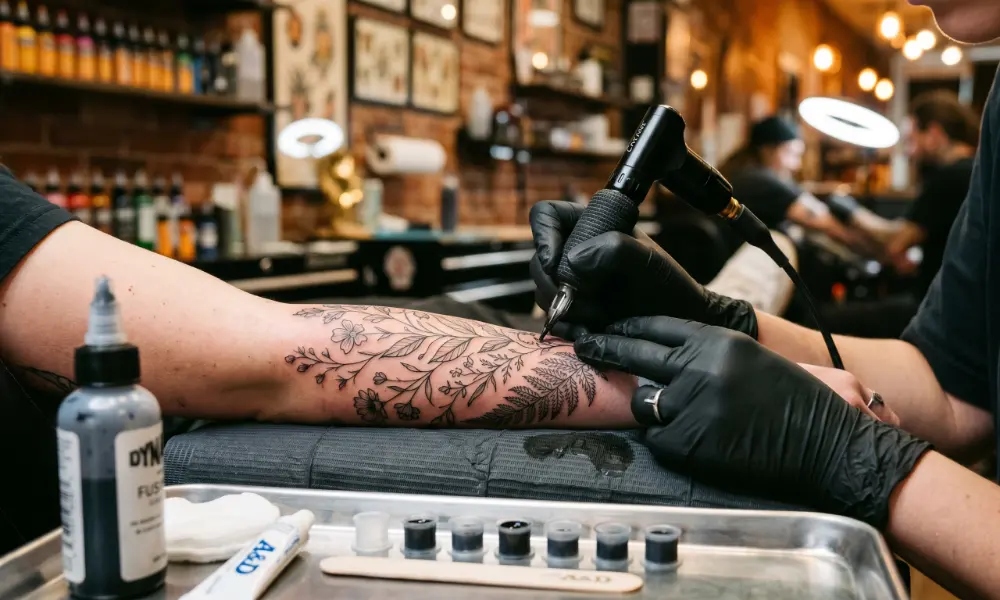
Getting your first tattoo is one of those decisions that sits with you forever. Not just on your skin, but in your head. You want it to be right. Not rushed. Not something you picked off a flash sheet because the needle was already loaded. This guide will walk you through everything a first-timer needs to know before sitting in that chair.
Before You Start Browsing Designs
Most people open Instagram and start saving pictures. That is actually the wrong first step.
The real starting point is a five-minute conversation with yourself. Ask three questions:
- Why do I want a tattoo right now?
- Is this tied to something in my life, or is it purely aesthetic?
- If I imagine this on my skin ten years from now, how do I feel?
These are not deep philosophical exercises. They are filters. A lot of people regret their first tattoo not because the artist did bad work, but because they got something generic when they actually wanted something personal.
If you answer those questions and realize you just want something that looks great, that is completely valid. A purely aesthetic tattoo is a legitimate choice. Knowing that before you walk in is what saves you from the regret.
Different Types of Tattoo Styles
This is where most beginner guides fail you. They list styles with a two-sentence description and call it done. Let us go deeper, because the style you choose affects not just how your tattoo looks today but how it holds up in ten years.
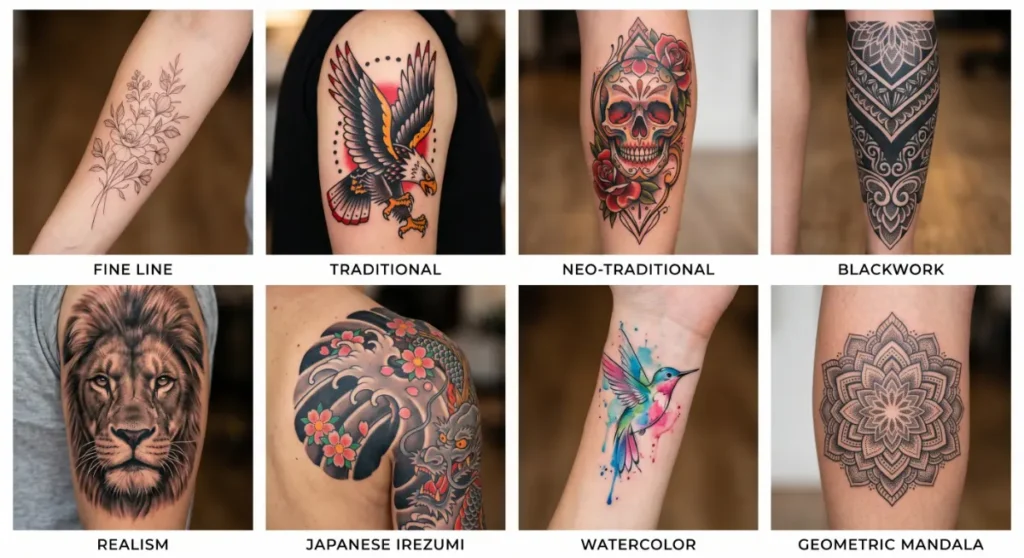
Fine Line
Delicate, minimalist, single-needle work
Popular for first tattoosTraditional (Old School)
Bold outlines, solid fills, classic motifs
Ages exceptionally wellNeo-Traditional
Classic structure with richer detail and shading
Great middle groundBlackwork / Dotwork
Bold black ink, geometric or illustrative
Strong visual impactRealism / Portraiture
Photo-quality depth and shading
Requires specialist artistJapanese (Irezumi)
Flowing compositions, mythological subjects
Best for larger piecesWatercolor
Painterly, vibrant, soft edges
Fades faster without black baseGeometric / Mandala
Symmetric patterns, precise line work
Clean and timelessWhich style is right for a first-timer?
Fine line and traditional are the two most forgiving starting points. Fine line works because the designs are subtle and placement is flexible. Traditional works because bold lines age predictably. You will not wake up in five years and find your tattoo has blurred into an unrecognizable smudge.
Watercolor tattoos look stunning in photos, but here is the honest truth most studios will not tell you upfront. Without a strong black line outline underneath, watercolor ink disperses into the skin over time. What starts as crisp washes of color can look like a bruise by year five. If you love the watercolor look, ask your artist to build a blackwork foundation underneath the color. The best watercolor artists already do this automatically. If a studio does not mention it, that is a red flag.
Realism and portraiture are impressive but demanding. They require a specialist. Do not pick a realism portrait just because you saw a great example on Pinterest. That example was done by an artist with years of specific training in that style. Ask to see a full portfolio of healed realism work, not just fresh pieces, before committing.
How to Choose a Design That Actually Means Something to You
You do not need a deep spiritual backstory for a tattoo to have meaning. But you do need a personal connection, even if that connection is purely visual.

Here are five approaches that consistently produce tattoos people love long-term:
1. Start with what you already collect
Look at the art on your walls, the books on your shelf, the images saved on your phone. What themes keep repeating? Botanical illustrations, geometric patterns, animals, architecture, celestial motifs? Those patterns reveal your actual aesthetic. Build from there.
2. Anchor it to a moment, not a feeling
Feelings change. Moments do not. “I want something that represents how free I felt at 22” is too abstract. “I want a tattoo of the mountain range I hiked the week I quit my job and started over” is specific and grounded. Specific designs survive the test of time better than abstract ones.
3. Look at your cultural and family history
Many people find deeply personal designs by going back to their roots. Traditional patterns from your heritage, symbols from a language that shaped your childhood, flora native to the place you grew up. This approach gives you something genuinely yours rather than something trending on social media.
4. Consider negative space
First-timers tend to think more is better. Often it is not. A single well-executed symbol, a minimalist line drawing, or a small botanical element can carry more weight than a full scene. Restraint reads as intention. Overcrowding reads as anxiety.
5. Bring your artist three reference images, not thirty
The more references you show, the harder it is for an artist to identify what you actually want. Pick three images that represent the feeling you are chasing: one for style, one for subject, one for mood or composition. A good artist will synthesize those into something original.
Placement: Where You Put It Matters as Much as What It Is
Placement is not just about visibility. It affects how the tattoo ages, how painful the session is, and how well the design translates to that specific part of your body.
| Placement | Pain level | Best for | Aging notes |
|---|---|---|---|
| Outer upper arm | Low | Most styles, first tattoos | Holds extremely well |
| Forearm (outer) | Low | Fine line, script, illustrative | Sun exposure speeds fading |
| Calf | Low | Vertical compositions, larger pieces | Very durable placement |
| Thigh (outer) | Low to medium | Large detailed work, Japanese style | Skin stretches with weight changes |
| Shoulder blade | Medium | Medium to large designs | Excellent long-term retention |
| Ribs | High | Flowing, organic designs | Distorts with significant weight change |
| Spine | High | Vertical compositions, script | Generally holds well |
| Hands / fingers | Medium to high | Simple, bold designs only | Fades fastest , needs frequent touch-ups |
| Wrist / inner arm | Medium | Small, fine line, script | High UV exposure, protect with SPF |
A note on professional visibility. If your workplace has a visible tattoo policy, placement matters. The wrist, forearm, and neck are the three most frequently cited problem areas. The upper arm, shoulder, and calf are easy to cover. This is not about hiding who you are. It is about giving yourself choices.
How to Choose the Right Tattoo Artist
The design accounts for maybe 40% of the final result. The artist accounts for the other 60%. Choosing the wrong artist for your chosen style is one of the most common and avoidable mistakes first-timers make.
Look at healed work, not just fresh tattoos
Fresh tattoos look great almost regardless of technique. Healed tattoos reveal the truth. A line that looked crisp the day it was done can become a fuzzy smear two years later if the artist was too heavy-handed or used the wrong needle configuration for the skin type. Ask every artist you consider to show you healed photos of their work in the style you want. If they cannot produce any, move on.
Match the artist to the style
Tattoo artists specialise. An artist who excels at neo-traditional portraits will likely produce mediocre fine line work, and vice versa. Do not walk into a shop and ask whoever is available to do your design. Research artists specifically for the style you want. Your city almost certainly has someone who specialises in exactly what you are looking for.
Book a consultation first
Any reputable artist offers a consultation before the appointment. Use it. Bring your references, explain what you want, and listen to their suggestions. A good artist will push back if they think something will not work well on skin. That pushback is valuable. It means they care about the result more than the booking fee.
Check hygiene standards
This is non-negotiable. Every needle should be opened in front of you. Surfaces should be covered with fresh disposable wrap. The artist should be wearing gloves throughout. The studio should have an autoclave for sterilising reusable equipment and should be able to show you certification if asked. If anything feels off, leave.
What to Think About Before Sitting in the Chair
Once you have your design, your placement, and your artist sorted, there is still some practical preparation that makes the session go better.
- Eat a full meal 1 to 2 hours before your appointment. Low blood sugar during a tattoo session is a common reason people feel faint, and it has nothing to do with pain tolerance.
- Stay hydrated the night before and the day of. Hydrated skin takes ink more smoothly.
- Avoid alcohol for at least 24 hours beforehand. Alcohol thins the blood and makes tattooing messier. Some artists will refuse to tattoo you if they suspect you are drinking.
- Wear clothing that gives easy access to the area being tattooed and that you do not mind getting ink on.
- Do not apply numbing cream without telling your artist first. Some numbing products change the texture of the skin in ways that affect how ink sits.
- Bring something to keep yourself occupied during longer sessions. A podcast, music, or a conversation with your artist all help.
Frequently Asked Questions About First Tattoos
How long should I wait before deciding on a design?
The honest answer is as long as it takes. If you have been thinking about a specific idea for more than a year, you probably do not need to wait. If the idea came to you last week, sit with it for at least a month. Use the 30-day rule mentioned earlier.
Is it okay to copy a design I found online?
Using something as a reference is fine. Having an exact copy of another artist’s original design tattooed on you is considered bad form in the tattoo community and may violate copyright. A good artist will take your inspiration images and create something original from them. That original piece will also look better on your specific body proportions than a direct copy.
What size should a first tattoo be?
Aim for something in the 5 to 10 centimetre range for your first piece. Small enough to not be overwhelming, large enough to hold detail properly. Tiny tattoos can look great but extremely small work requires a specialist and does not age as well.
How painful is it really?
Less than most people expect, and more varied than any scale can capture. Bony areas with thin skin hurt significantly more than muscular, fatty areas. Upper arm and calf are consistently described as manageable. Ribs, spine, and hands are consistently the most difficult. Most people describe the sensation as a cat scratch or mild burning, not the sharp stabbing pain they feared.
Can I get a tattoo if I have darker skin?
Absolutely. However, certain styles and colors show up differently across different skin tones. Bold black linework and blackwork styles look stunning on all skin tones. Pastels and yellows may not read well on very deep skin tones. Find an artist who has visible experience working with your skin tone in their portfolio. This is important, not just a preference.
What is the best first tattoo idea for someone who is not sure?
A small, clean piece of something you already love in a low-visibility location. This lets you experience the process, build a relationship with an artist, and get a feel for how tattoos integrate with your sense of self. You can always go bigger and bolder from there.
Final Thoughts
Your first tattoo does not have to be your best tattoo. It just has to be yours. The people who end up with tattoos they genuinely love, years later, are the ones who slowed down and made intentional choices rather than reactive ones.
Take your time with the design. Research your artist the same way you would research a surgeon. Ask questions in the consultation. And trust that the process, when done right, feels much less intimidating than the anticipation of it.
The best first tattoo is one that makes you want a second one for all the right reasons.