Japanese tattoos hit different. There’s a reason they’ve been turning heads for centuries and they’re still just as powerful today.
Hand tattoos are a commitment. They’re visible, bold, and they say something about who you are without you having to open your mouth.
Japanese art on your hands? That’s a whole statement. The imagery is rich, the symbolism runs deep, and the style holds up beautifully on the hand’s unique canvas.
Whether you’re drawn to fierce demons or delicate flowers, Japanese tattooing has something that’ll stop people mid-sentence. Let’s get into 16 ideas worth seriously considering.
1. Oni Mask Hand Tattoo
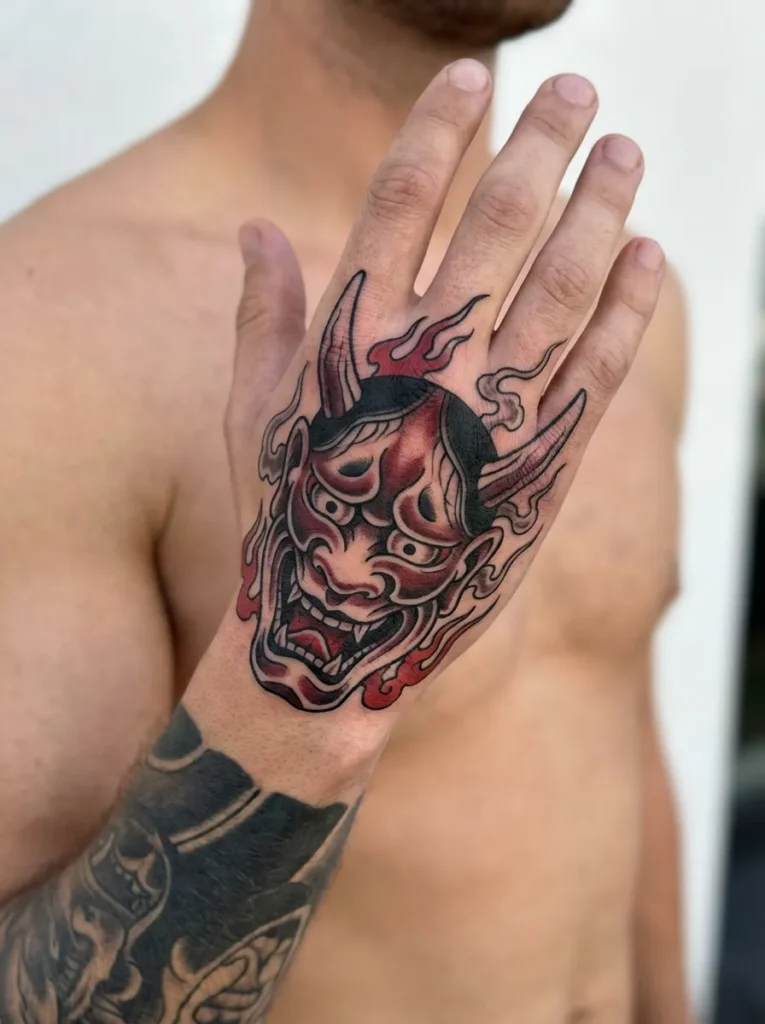
The Oni mask is one of the most iconic images in Japanese tattooing. It’s fierce, it’s dramatic, and it looks incredible stretched across the back of a hand.
Oni are supernatural demons from Japanese folklore. Wearing one on your hand carries the idea of warding off evil and channeling inner strength.
The bold linework and heavy shading in traditional Japanese style makes this design pop on skin. Red and black is the classic color combo, but a greyscale Oni hits just as hard.
- Place the face centered on the back of the hand for maximum impact
- Let the horns extend toward the fingers for a natural flow
- Ask your artist about incorporating flames or clouds around the mask
2. Hannya Mask Hand Design
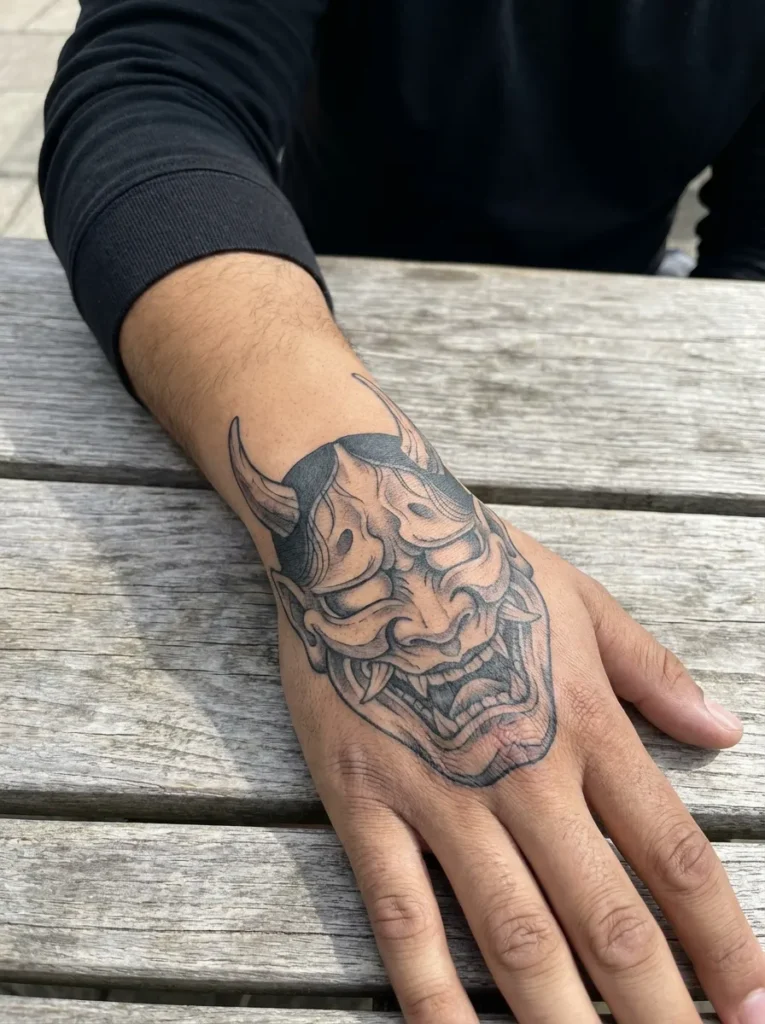
The Hannya looks similar to the Oni but carries a completely different story. This is the face of a woman consumed by jealousy and heartbreak, transformed into a demon.
It’s one of the most emotionally loaded images in Japanese art. People who choose this one usually connect with the duality of beauty and rage.
The curved horns, hollow eyes, and sharp teeth translate beautifully onto the hand. It’s a design that rewards a close look.
The more detail your artist adds, the more expressive the piece becomes. A skilled Japanese tattoo artist can make this mask look alive.
3. Koi Fish Hand Tattoo
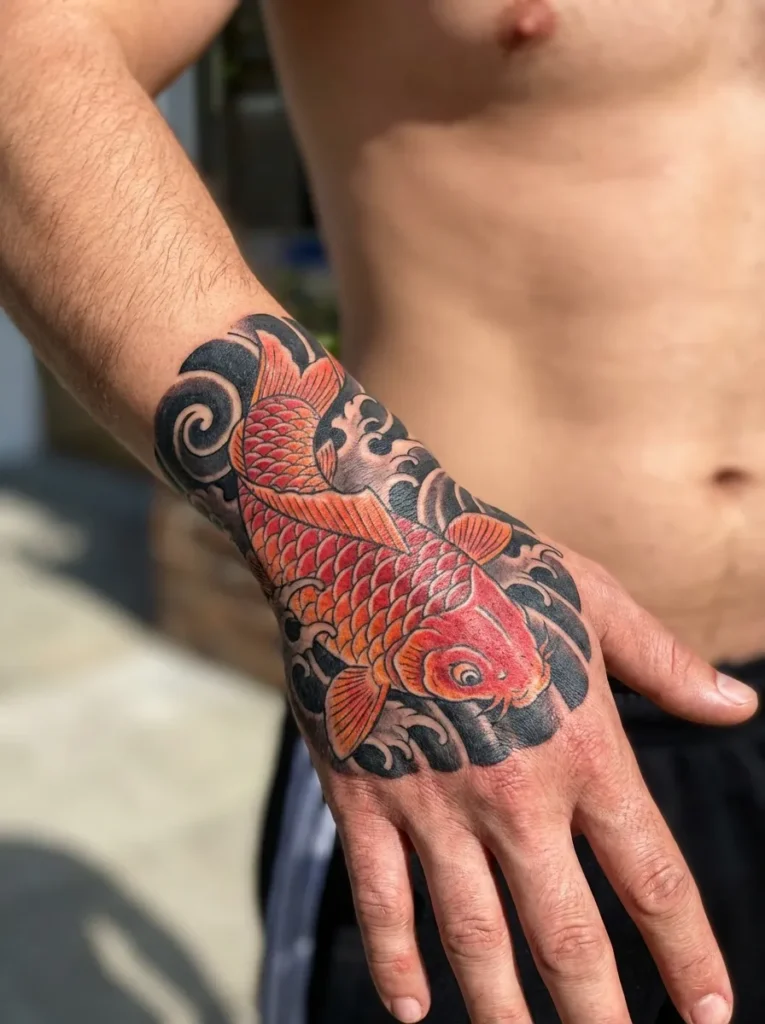
Koi fish are a staple of Japanese tattooing for good reason. They represent perseverance, good luck, and the courage to push forward against the current.
A single koi flowing from the wrist across the back of the hand is a timeless choice. The scales catch light beautifully and give your artist room to show off real technical skill.
Color makes a huge difference here. Red and orange koi are traditional symbols of strength, while black koi represent overcoming adversity.
- Upstream-swimming koi = still fighting through challenges
- Downstream-swimming koi = a battle already won
- Blue koi is associated with masculinity and reproduction in Japanese culture
4. Peony Hand Tattoo
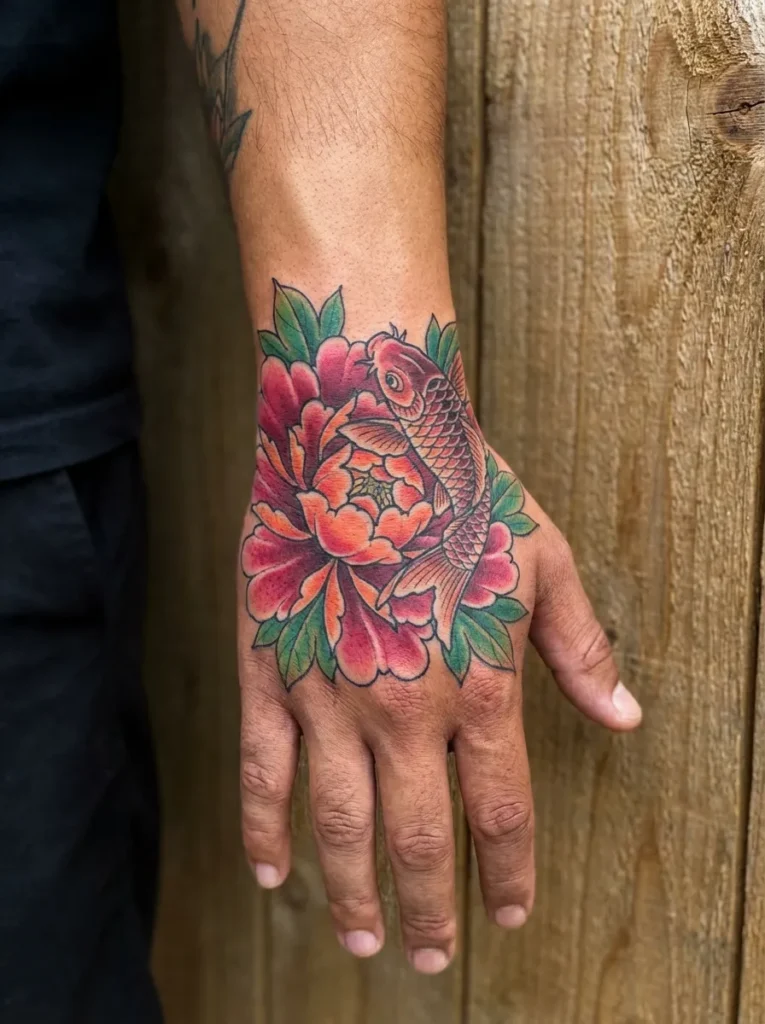
The peony is the king of flowers in Japanese tattooing. It’s lush, layered, and carries the meaning of wealth, good fortune, and a willingness to take risks.
A single large peony on the back of the hand is stunning. The petals fill the space perfectly and give your artist a chance to work with color gradients that really sing.
It pairs beautifully with other elements too. A koi fish swimming through peony blossoms is a classic combination that never goes out of style.
5. Rising Sun Hand Tattoo
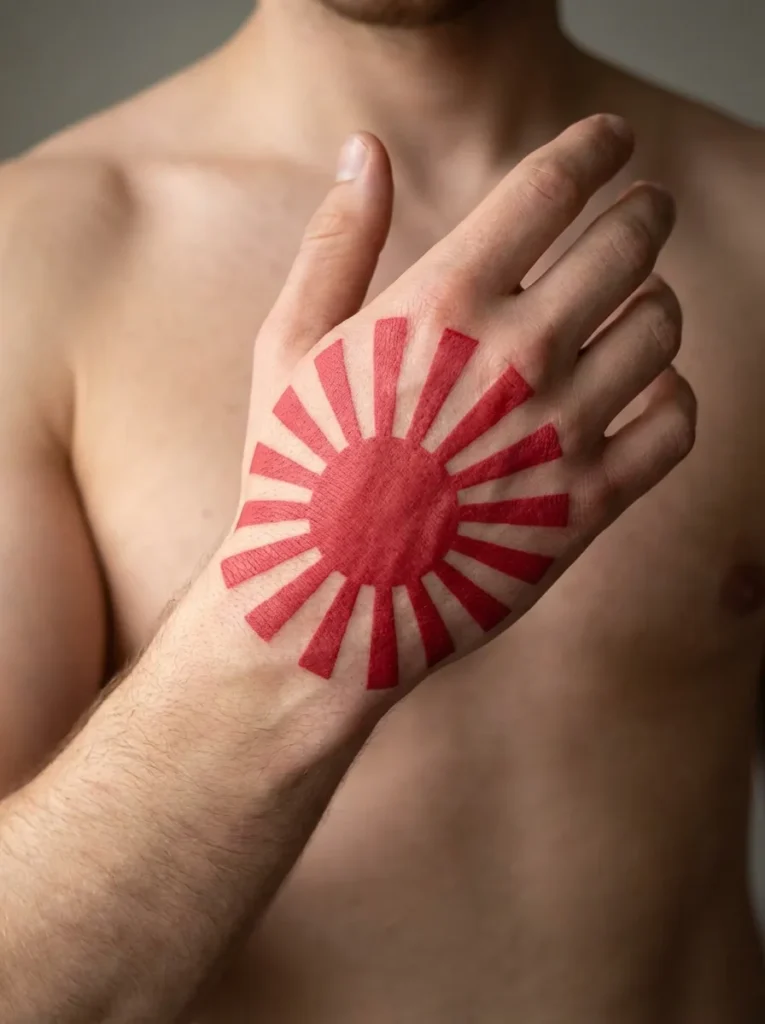
The rising sun is a powerful symbol in Japanese culture. It represents new beginnings, energy, and the unstoppable nature of time moving forward.
The radiating lines of a traditional rising sun design work naturally with the structure of the hand. The rays can extend toward the fingers or wrap around to the palm side.
It’s one of those designs that looks bold from across the room but reveals more detail the closer someone gets.
| Style Variation | Mood | Best Placement |
| Classic red rising sun | Fierce and traditional | Back of hand, centered |
| Watercolor sunrise | Soft and artistic | Wrist flowing onto hand |
| Black and grey sun | Understated strength | Side of hand |
| Full color with clouds | Rich and detailed | Back of hand with finger wrap |
6. Karajishi Hand Tattoo
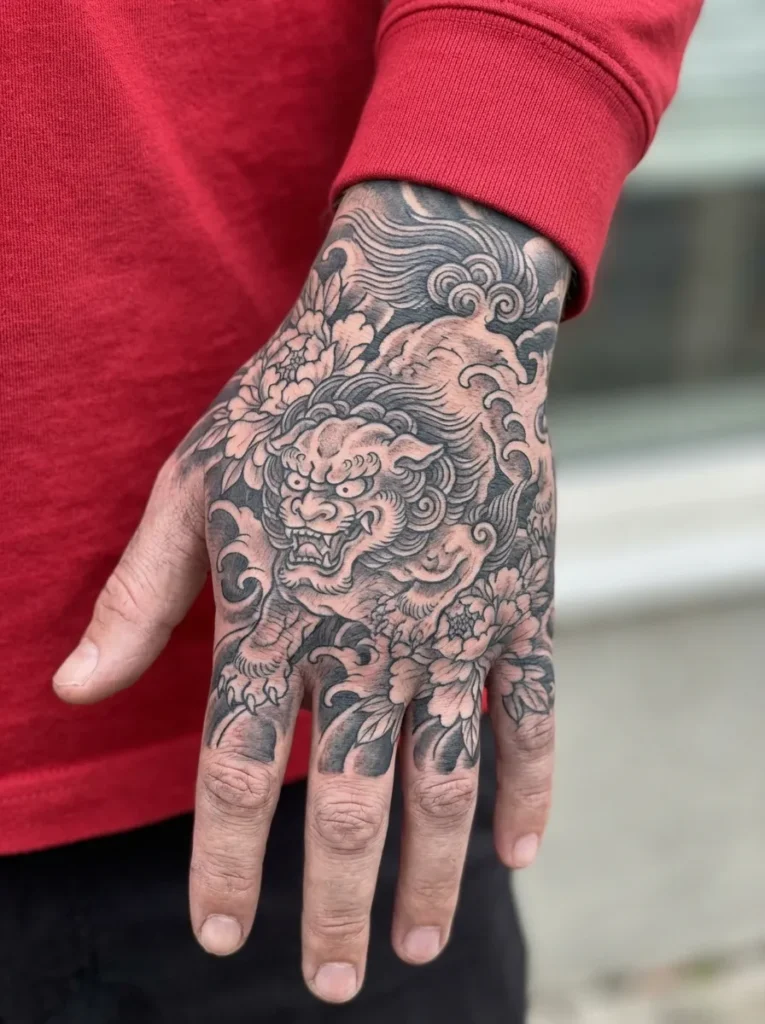
The Karajishi is the Japanese lion, also called the foo dog. It’s a protector figure, meant to guard against evil and bring strength to the person it marks.
This design has serious presence. The mane, the wide eyes, and the open mouth give it a weight that suits the hand perfectly.
It’s a design with centuries of history behind it. Wearing a Karajishi says you take your tattoos seriously.
- Works well in both color and black and grey
- The mane creates natural movement that flows well across the hand
- Pair it with peonies for a classic Japanese composition
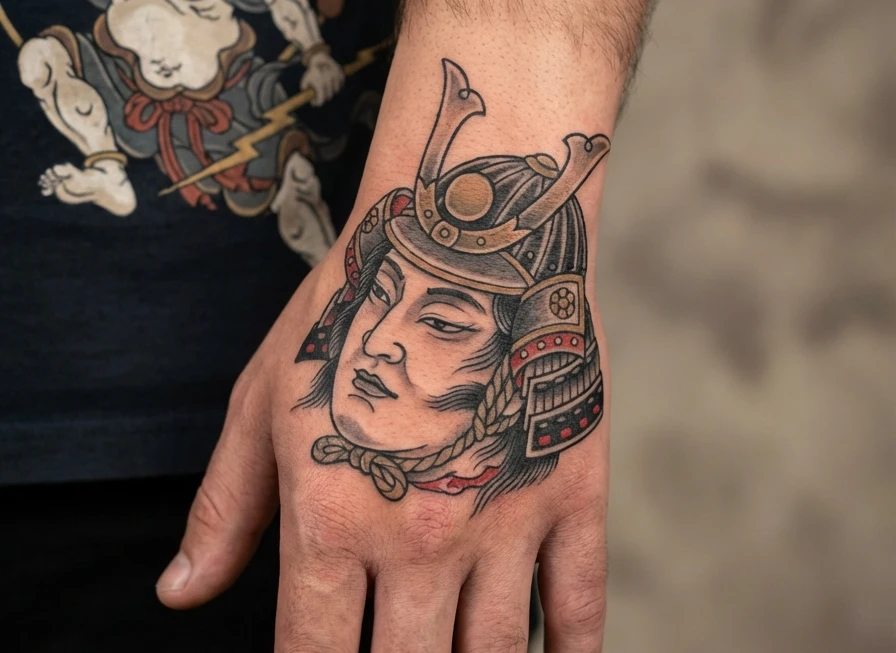
7. Samurai Helmet Hand Tattoo
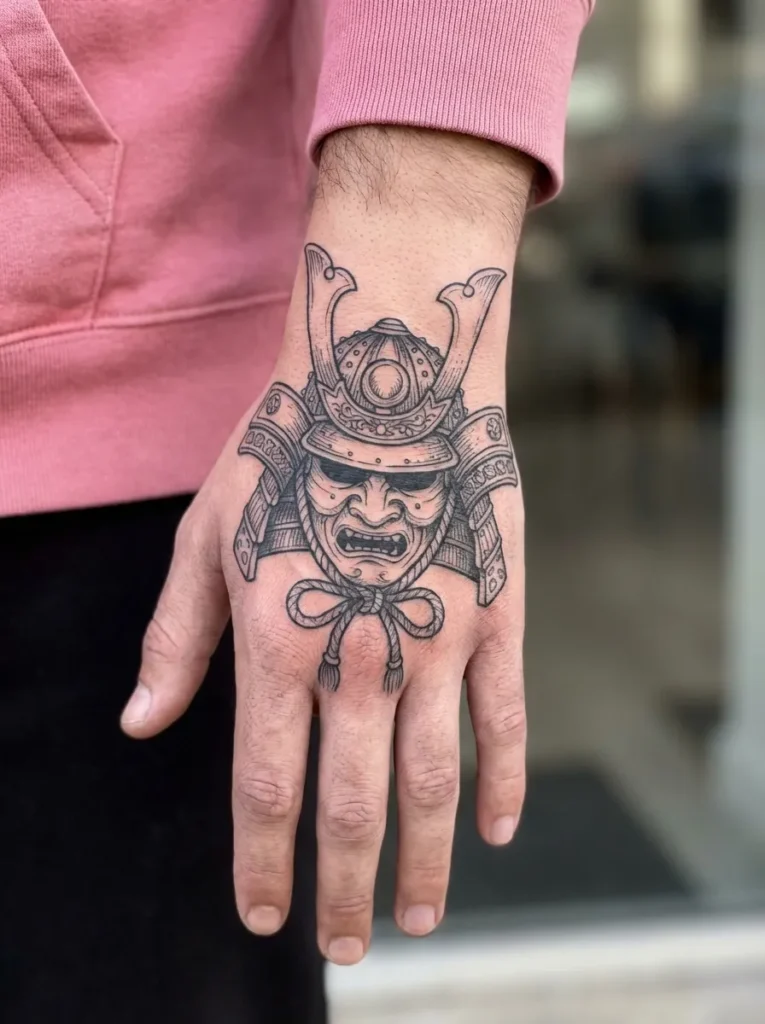
A samurai helmet, or kabuto, is one of the most underrated Japanese tattoo choices. It’s deeply connected to honor, discipline, and warrior spirit.
The angular shapes and decorative details of a kabuto translate surprisingly well onto the hand. It’s a design that rewards intricate linework.
The symbolism is personal too. Many people choose this as a tribute to their own battles, their own code of living.
8. Fudō Myōō Hand Tattoo
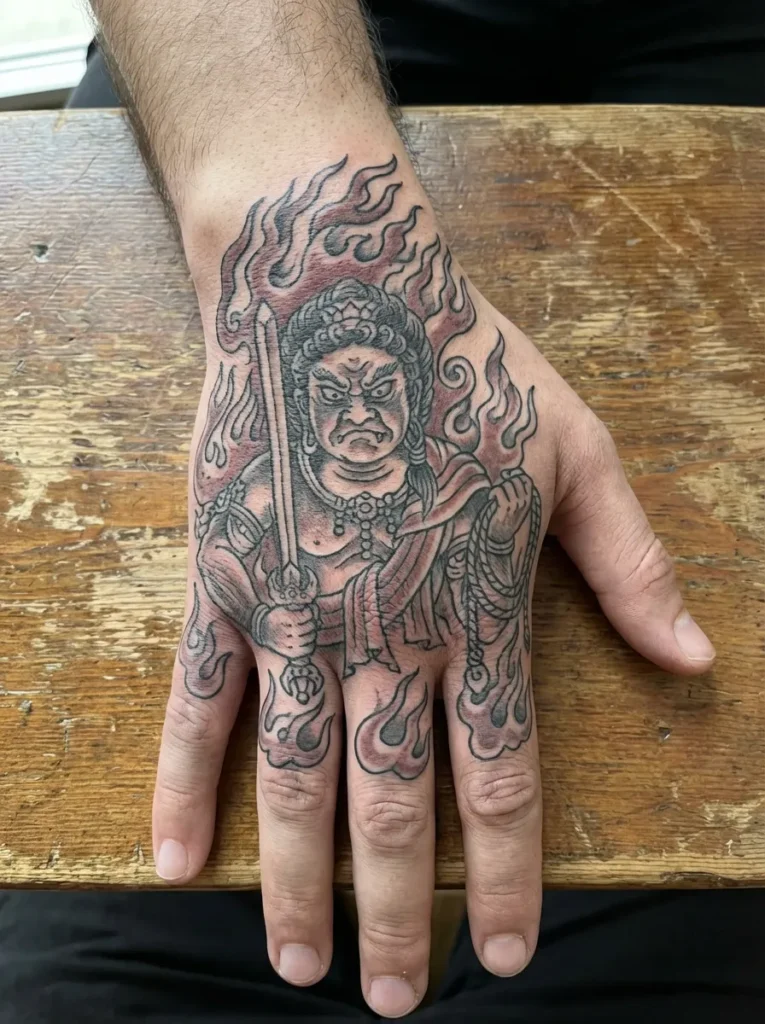
Fudō Myōō is a Buddhist deity of fire and wisdom. He’s depicted surrounded by flames, holding a sword and a rope, with a fierce expression that means serious business.
This is one of the most spiritually charged designs in all of Japanese tattooing. People who wear Fudō Myōō usually feel a deep personal connection to the idea of immovable inner strength.
The flames surrounding him make for an incredibly dynamic composition on the hand. There’s always something moving in this design.
- The sword cuts through ignorance and doubt
- The rope is used to bind evil and pull lost souls back to the right path
- The flames represent the burning away of impurity
9. Kitsune Mask Hand Tattoo
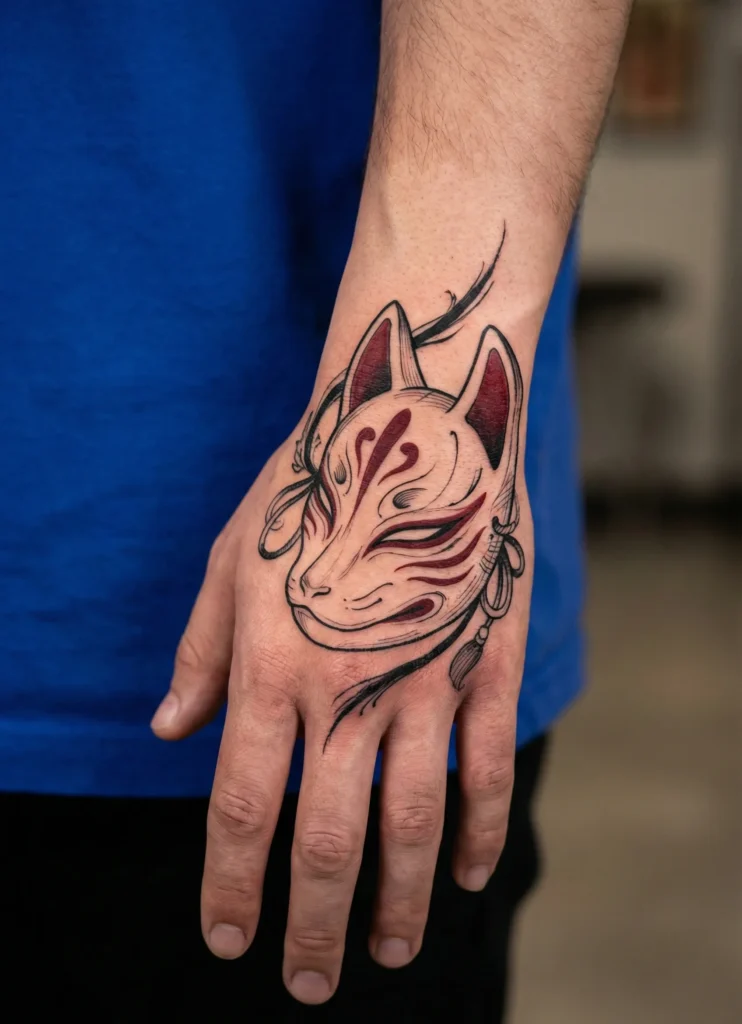
The Kitsune is the fox spirit, one of the most mysterious figures in Japanese mythology. Smart, cunning, and capable of transformation, the fox is both trickster and protector.
The mask version of the Kitsune is elegant and a little eerie. It has a delicate quality that contrasts with the more aggressive designs in Japanese tattooing.
It suits people who connect with the idea of intelligence and adaptability. Not everyone who sees it will understand it immediately, and that’s kind of the point.
The fine linework required for a Kitsune mask makes artist selection crucial. This is not a design to rush or cut corners on.
10. Traditional Pattern Hand Tattoo
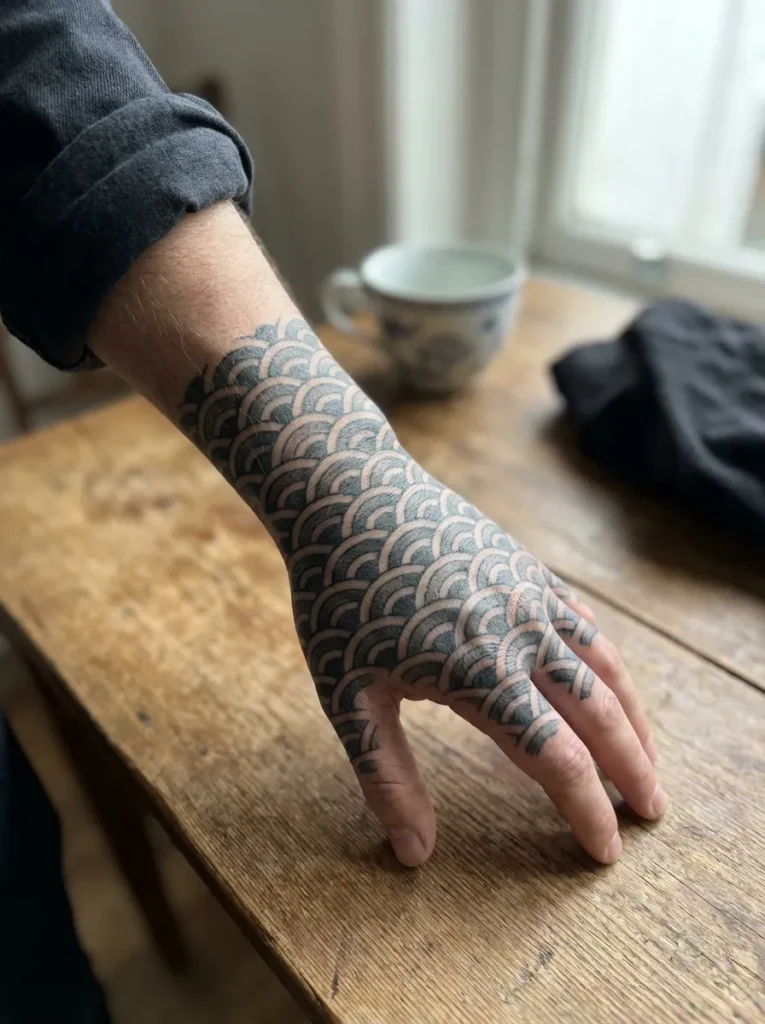
Japanese traditional patterns, called Wagara, have been used in textiles, ceramics, and art for thousands of years. They carry their own meanings and they look incredible as tattoos.
Seigaiha (overlapping waves), Asanoha (hemp leaf), and Shippo (interlocking circles) are just a few options. Each one tells a story rooted in Japanese cultural history.
A full pattern across the back of the hand creates a striking geometric effect. It’s different from the figurative designs but equally powerful.
| Pattern Name | Meaning | Visual Style |
| Seigaiha | Peace and good luck | Overlapping fan/wave scales |
| Asanoha | Growth and resilience | Six-pointed star repeat |
| Shippo | Harmony and good relationships | Interlocking circles |
| Uroko | Protection and rebirth | Triangle fish scale repeat |
11. Kirin Hand Tattoo
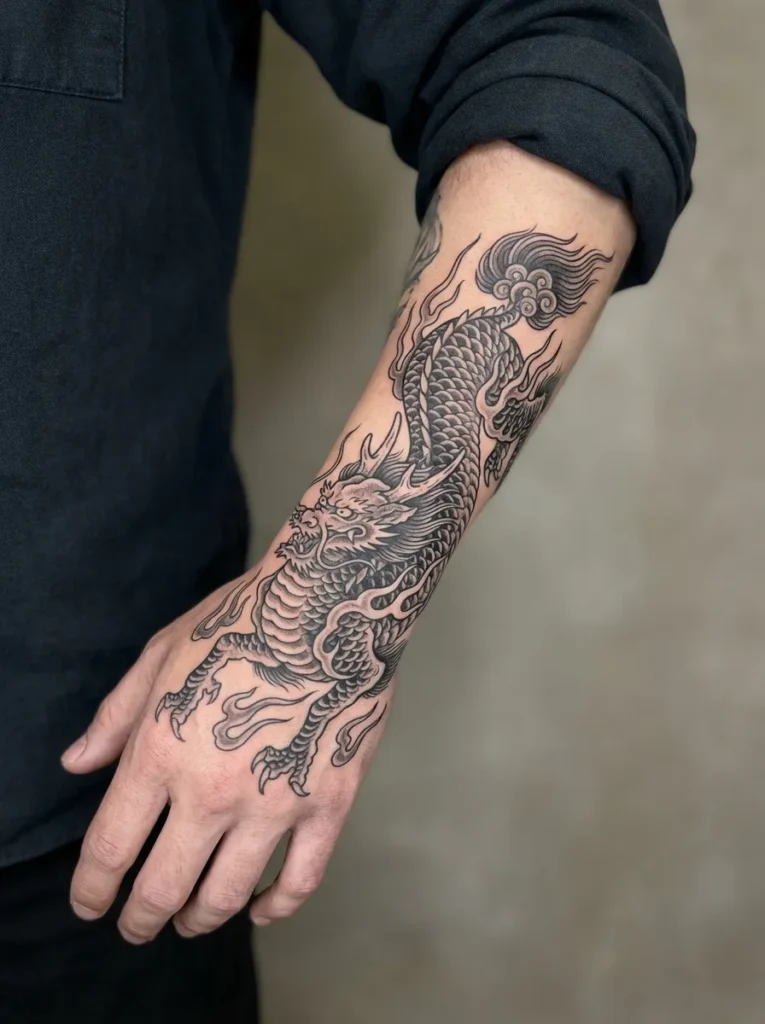
The Kirin is a mythical creature combining dragon, deer, ox, and fish. It only appears in times of peace and is considered the rarest and most auspicious creature in East Asian mythology.
A Kirin tattoo is a serious conversation starter. Most people won’t recognize it immediately, which makes it all the more interesting to explain.
The flowing scales, antlers, and flame details give an artist a lot to work with. It’s a complex design that rewards a skilled hand.
12. Raijin Hand Tattoo
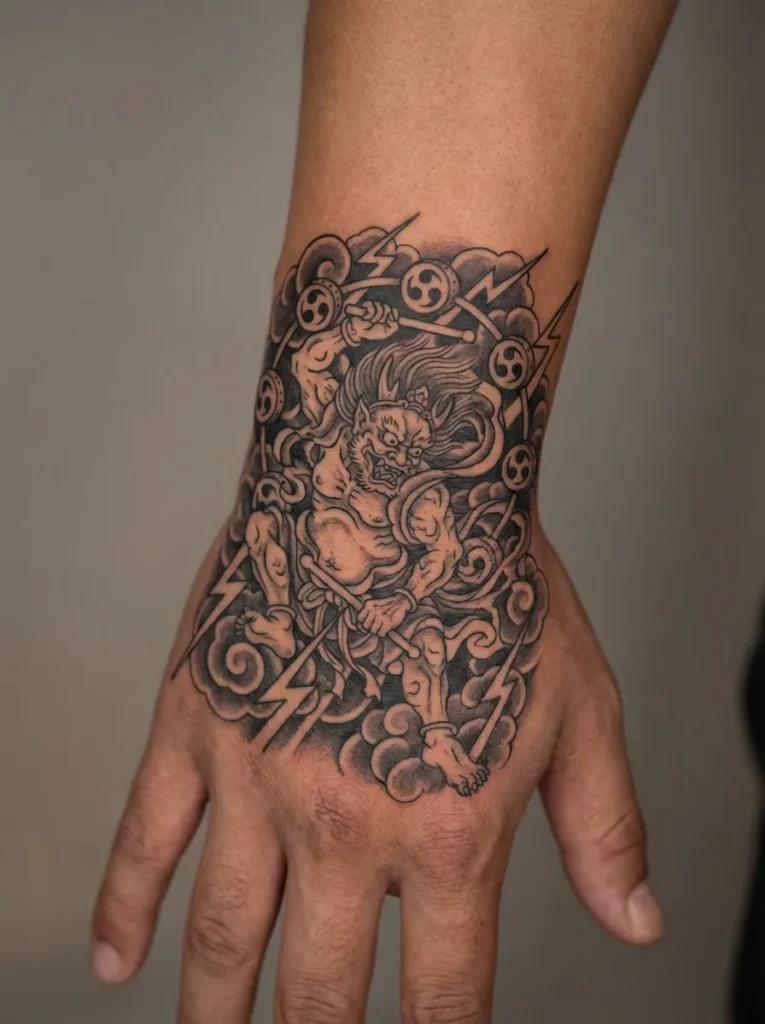
Raijin is the Japanese god of thunder and lightning. He’s typically shown with a ring of drums around him, wild expression, and a raw energy that practically crackles off the skin.
This is a design that carries real intensity. It’s not a subtle choice.
The dynamic composition of Raijin, all movement and power, works naturally on the hand where it stays in constant motion. Every gesture becomes part of the design.
- Often paired with his companion Fūjin, the wind god, for a matching set
- The drums surrounding him represent the sound of thunder
- Works beautifully on the back of the hand with elements extending to the wrist
13. Fūjin Hand Tattoo
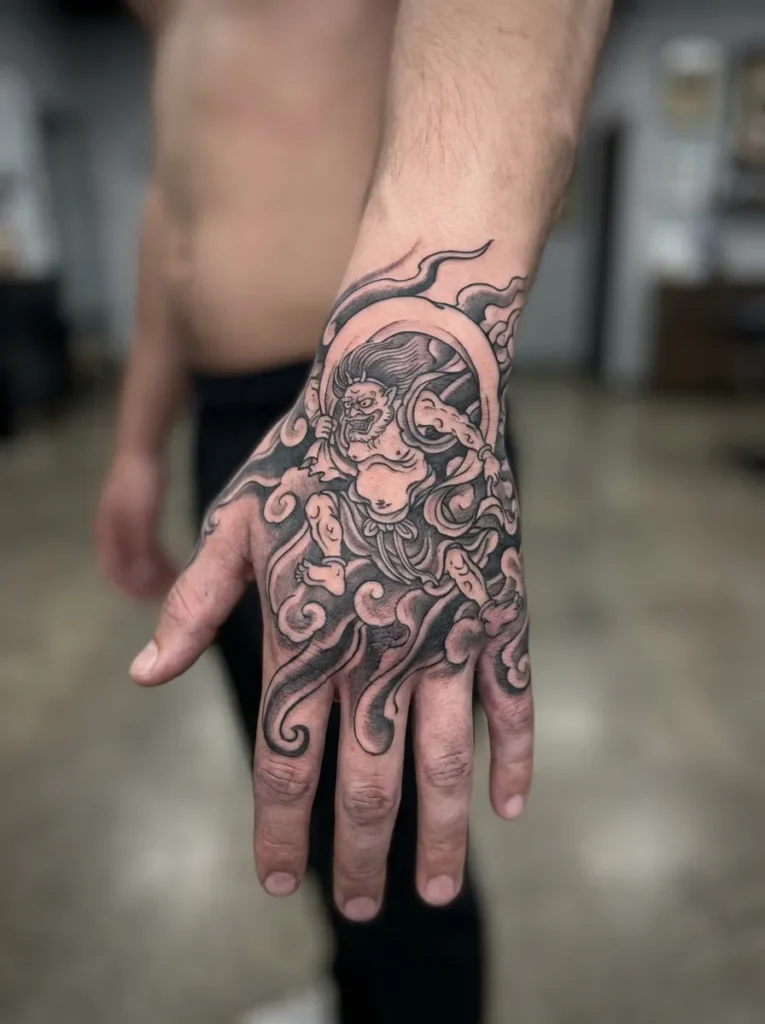
Fūjin is the god of wind and Raijin’s eternal companion. He carries a bag full of wind on his back, always mid-motion, always stirring things up.
Where Raijin is explosive, Fūjin is fluid. The design has a sweeping, flowing quality that moves across the hand beautifully.
Getting Raijin on one hand and Fūjin on the other is one of the great paired tattoo concepts in Japanese art. Together they represent the raw, unstoppable forces of nature.
14. Minogame Turtle Hand Tattoo
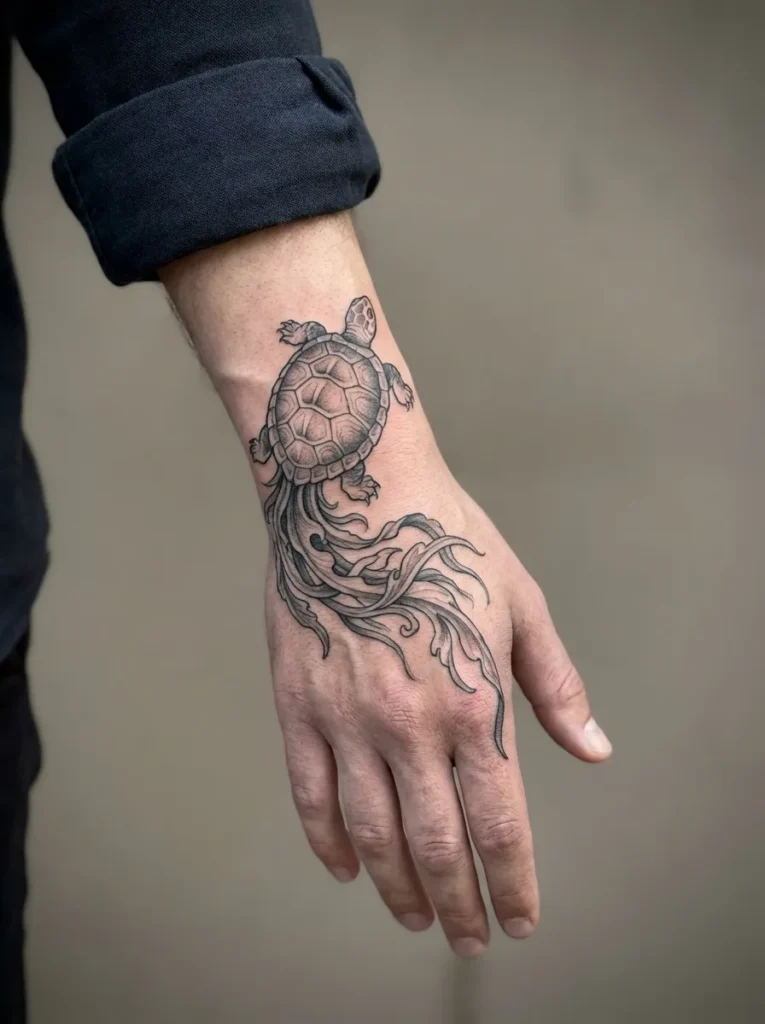
The Minogame is a mythical turtle with a long, flowing tail of seaweed or algae trailing behind it. In Japanese culture, the turtle represents longevity and wisdom and the Minogame is the most powerful version of that symbol.
It’s a gentler image compared to some of the fiercer designs on this list. But don’t mistake gentle for weak.
There’s a quiet confidence to choosing a Minogame. It says you’re thinking long term.
The flowing tail creates natural movement in the design and gives your artist room to fill space elegantly. It’s a beautiful piece that ages really well on the skin too.
15. Nekomata Hand Tattoo
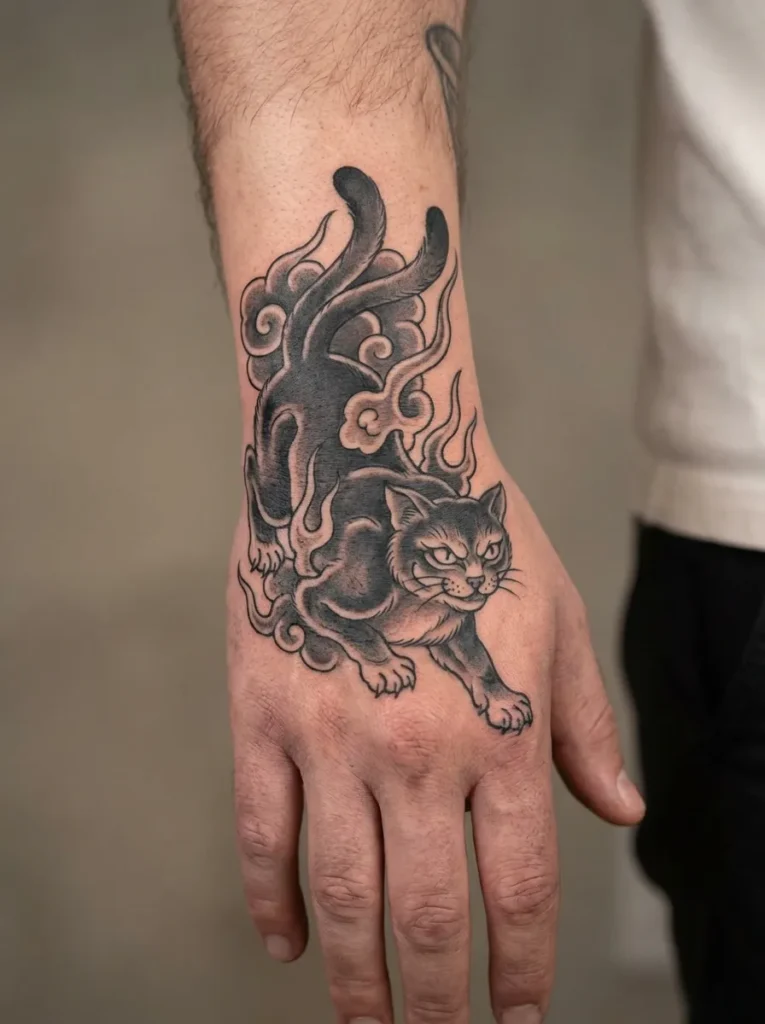
The Nekomata is a two-tailed supernatural cat from Japanese folklore. Old cats were believed to eventually split their tail and gain magical powers, becoming shape-shifters and tricksters.
It’s a playful but eerie concept. The design can go cute or creepy depending on how you and your artist interpret it.
The two tails are the signature element. They create a natural symmetry that works well framing the back of the hand.
- Great choice for cat lovers who want something with genuine cultural depth
- Can be styled to look traditional Japanese or more illustrative
- Works in both color and black and grey depending on your preference
16. Namakubi Hand Tattoo
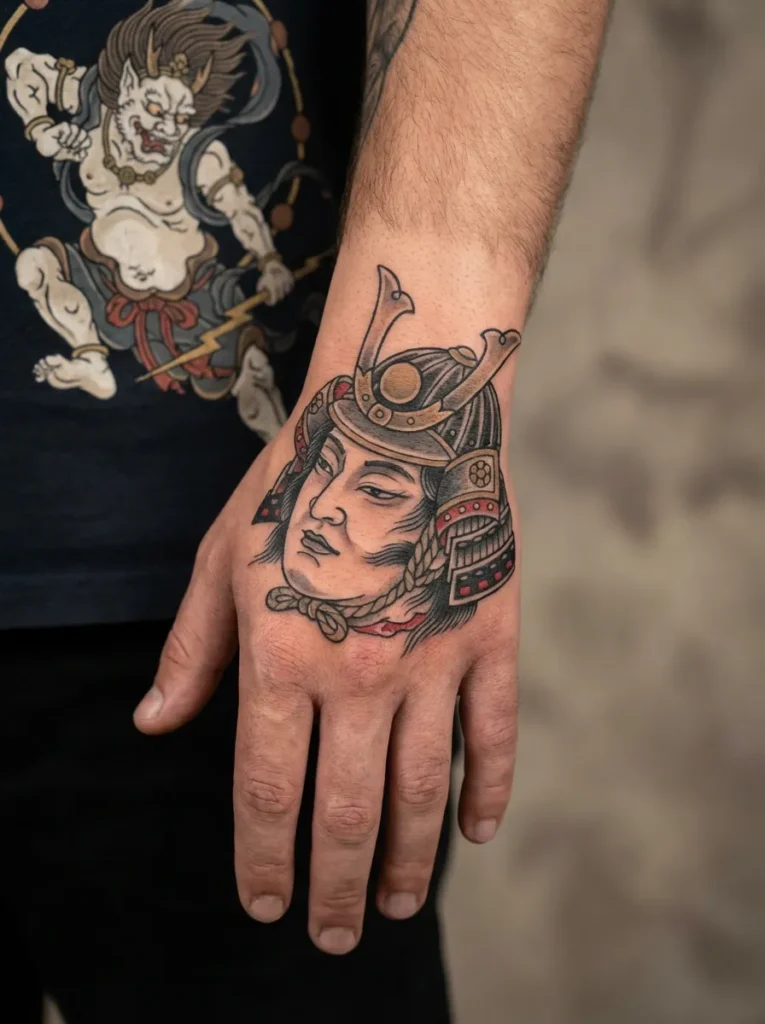
The Namakubi is a severed head, one of the most confrontational images in Japanese tattooing. It comes from samurai culture and it represents courage in the face of death.
This is not a design for everyone. But for those who connect with the history behind it, there’s a profound meaning there about accepting mortality with dignity.
The expression on the face matters a lot. A peaceful Namakubi represents acceptance and honor. An angry one carries a different message entirely.
It’s bold, it’s dark, and it will absolutely get a reaction. If that’s what you’re after, it delivers completely.
Final Thoughts
Japanese hand tattoos are more than just cool imagery. Every one of these designs carries centuries of story, symbolism, and cultural weight behind it.
Take your time choosing. Talk to your artist. Make sure the meaning resonates with you personally, not just the visual.
The right Japanese hand tattoo will feel like it was always supposed to be there. That’s the goal.
So here’s the real question: are you drawn to something fierce like an Oni or Raijin, or does something more mysterious like a Kitsune or Kirin speak to you more? What does your choice say about the story you want to carry on your skin?