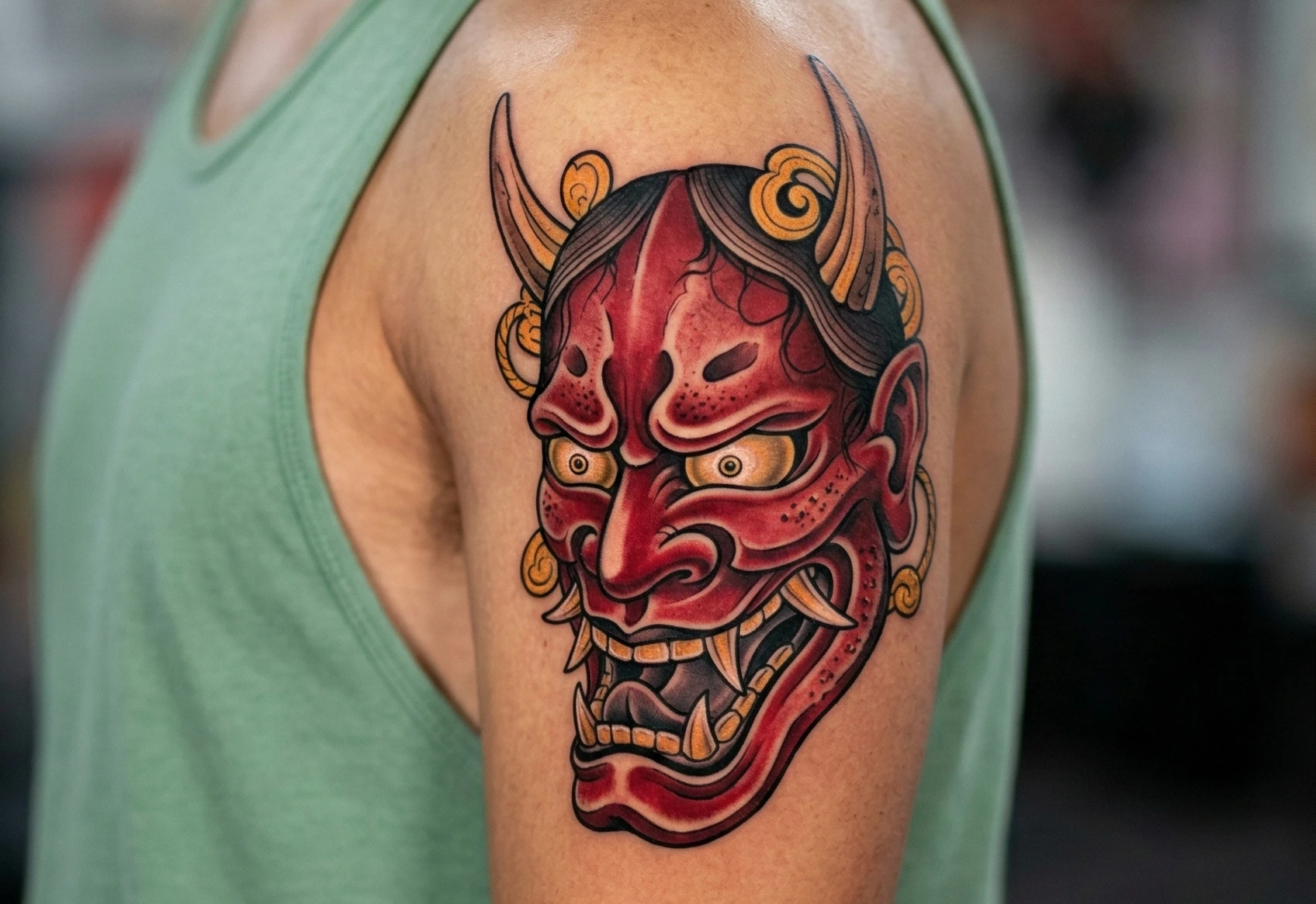
The Japanese devil is not what Western culture made you think it is.
The Oni, Japan’s most iconic devil figure, is not purely evil. It is a punisher of wrongdoers, a guardian of gates, and a force that keeps darker things at bay. It wears the face of something terrifying so that actual threats think twice.
That complexity is what makes Japanese devil tattoos so compelling to people who actually know the mythology. You are not just tattooing a monster. You are tattooing a moral force wearing a monster’s face.
The visual language of Japanese devil imagery is extraordinary. Horns, fangs, wild hair, iron clubs, flames, and expressions that sit somewhere between rage and righteousness. Every element carries meaning that goes layers deeper than surface intimidation.
These 19 designs cover the full spectrum of Japanese devil tattooing. From classic Oni masks to mythological hybrids, battle scenes, and the most unsettling concept of all, the devil that looks almost human. Find the one that speaks to whatever you are carrying.
1. Japanese Red Oni Devil Design
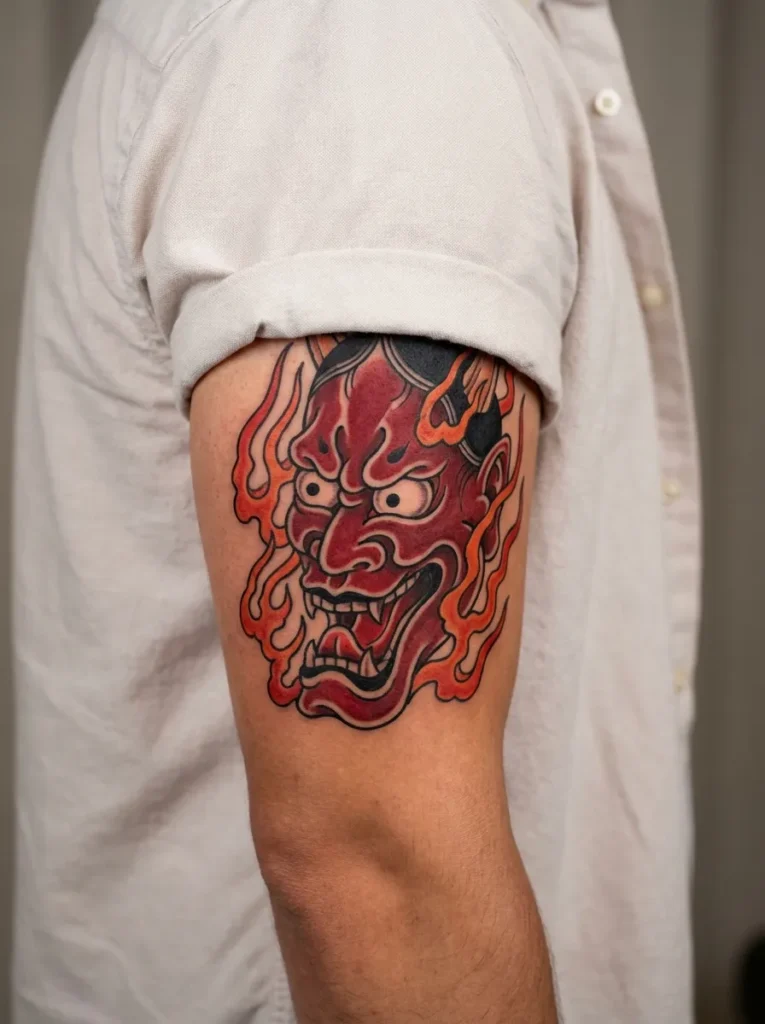
The Red Oni is the most recognizable devil in all of Japanese mythology. Bold, furious, and built from centuries of iconographic tradition that has never once gone out of style.
Red is the color of rage, passion, and supernatural heat. The Red Oni channels all three simultaneously. Its skin burns with that signature crimson. Its eyes bulge with barely contained fury. Its mouth opens wide enough to swallow the sky.
What keeps the Red Oni from being one-dimensional is the folklore behind it. The story of the Red Oni and the Blue Oni is one of Japan’s most beloved moral tales. The Red Oni wanted human friendship so desperately that his Blue Oni companion sacrificed their own reputation to make it happen. Underneath all that fury is a creature that just wants to belong.
A Red Oni tattoo rendered in traditional Irezumi style with bold black outlines, deep red fills, and surrounding flames is a piece that reads clearly from twenty feet away and rewards close inspection for much longer than that.
2. Japanese Blue Oni Devil Concept
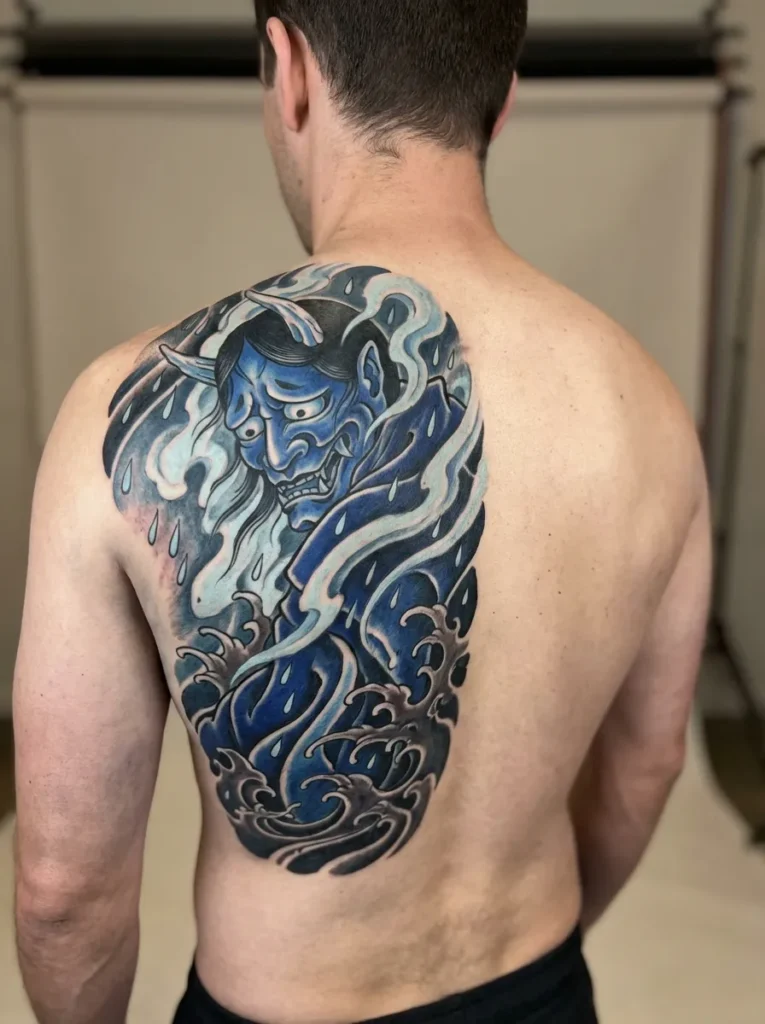
The Blue Oni carries the most emotionally complex story in all of Japanese devil mythology. He is the one who chose loneliness so his friend could have happiness.
In the classic folktale, the Blue Oni pretended to terrorize a village so the Red Oni could play the hero and earn human trust. It worked. The Red Oni found the companionship he had always wanted. The Blue Oni disappeared rather than ruin it, leaving only a note behind.
That story transforms the Blue Oni from a simple devil concept into something genuinely heartbreaking. A figure of sacrifice wearing the face of something terrifying.
Visually the Blue Oni goes cool where the Red goes hot. Deep cobalt and midnight blue skin. Pale ice blue in the highlights. Cold shadows that feel less like fire and more like deep water. The contrast with the Red Oni’s palette tells the emotional difference between the two figures without a single word of explanation.
- Pair with cold background elements like rain, dark water, or winter mist
- An expression that reads as sorrowful rather than purely enraged honors the mythology
- Blue and black together create a palette that feels genuinely haunting rather than aggressive
3. Japanese Female Devil (Kijo) Tattoo
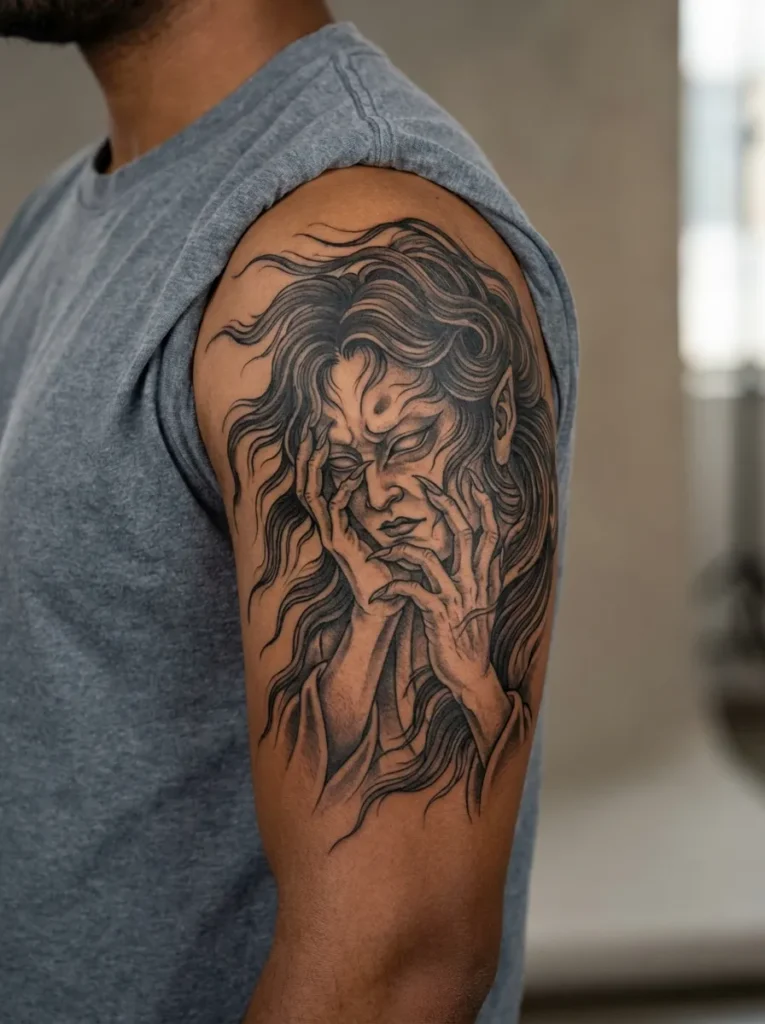
The Kijo is the female demon of Japanese mythology and she is in a category entirely her own. More unsettling than the Oni, more tragic than the Hannya, the Kijo is what happens when a woman is consumed completely by supernatural grief or rage.
Stories of Kijo appear throughout Japanese literature and theatre. Women transformed by jealousy, abandonment, or grief into something that no longer resembles the person they once were. The transformation is always complete and always irreversible.
Visually the Kijo occupies a disturbing middle ground between beautiful and monstrous. Long wild hair. A face that was once lovely and is now something else. Clawed hands. Eyes that have moved past human emotion into something older and colder.
The power of the Kijo tattoo is in that middle ground. She is not simply a monster. She is recognizably a person who became one. That recognition is what makes her genuinely frightening in a way that a straightforward demon never quite achieves.
4. Japanese Tengu Devil Warrior Tattoo
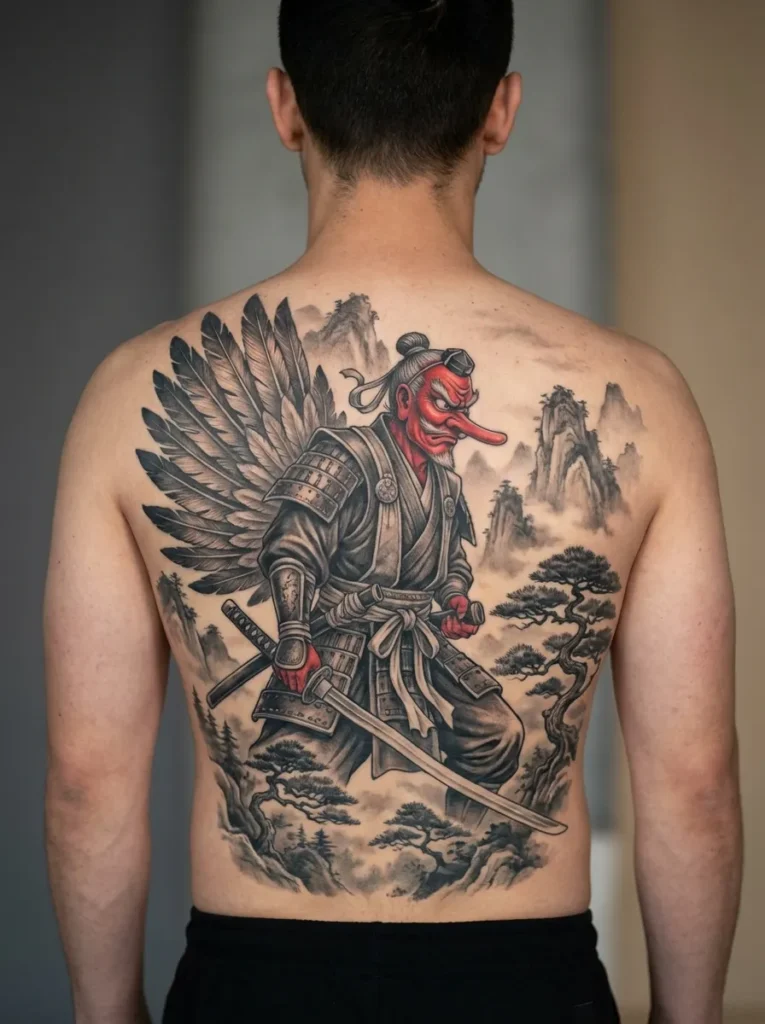
The Tengu sits at the edge of the devil category. Not quite demon, not quite god, not quite human. Something older and stranger than any of those categories can contain.
Early Japanese Buddhism classified the Tengu as devils, disruptive supernatural beings who led people away from enlightenment. Over centuries they evolved into something more respected. Master warriors. Mountain sages. Supernatural teachers who trained the greatest fighters in Japanese history.
The warrior Tengu with its long nose, red face, fan of feathers, and warrior’s robes carrying a sword is one of the most compositionally rich subjects in Japanese tattooing. Every element earns its place.
The mountain and forest settings associated with Tengu give artists extraordinary background material. Mist-covered peaks, ancient cedar trees, the quality of light filtering through forest that has not been touched in centuries. The Tengu belongs in that environment and the environment makes the Tengu.
5. Japanese Oni Devil with Flames
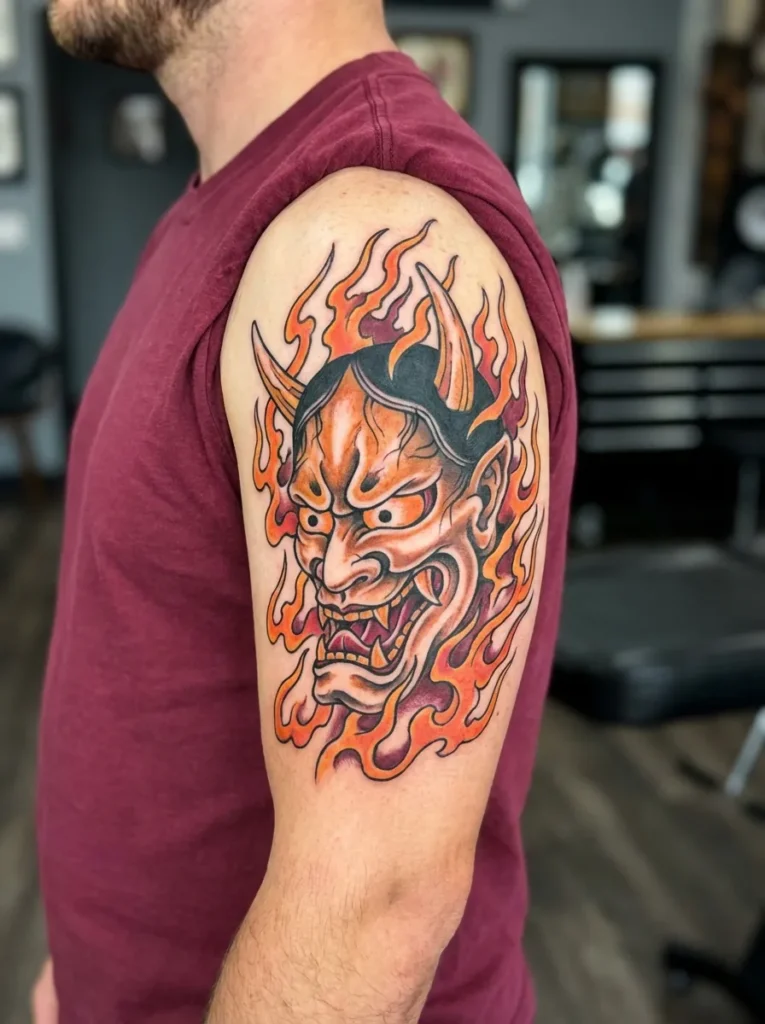
An Oni surrounded by flames is the most elemental version of the Japanese devil tattoo. No complexity, no narrative layering. Just raw supernatural power surrounded by fire.
The flames around an Oni are not accidental decoration. Fire in Japanese mythology is purification. The Oni wrapped in flames is simultaneously consuming and being consumed, punishing and being tested by the same force it wields.
The composition gives an artist an extraordinary amount of fill material to work with. Flame shapes radiating outward from the central Oni figure fill every corner of negative space with movement and heat. The colors range from near-white at the hottest core through yellow, orange, and deep crimson at the outer edges.
Deep black outlines on the Oni against the warm flame palette creates the contrast that makes both elements perform at their absolute best. The devil and the fire need each other visually as much as they do mythologically.
6. Japanese Oni Devil and Snake (Hebi)
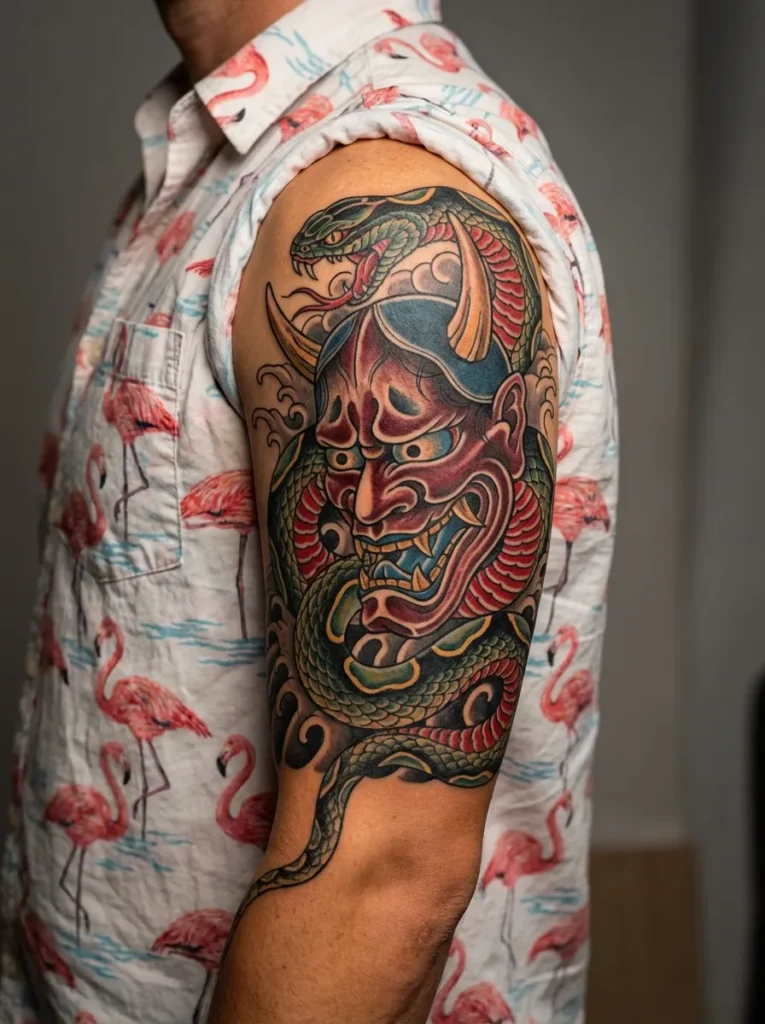
An Oni paired with a Japanese snake is a combination that doubles the protective symbolism while creating a composition full of visual tension and mythological depth.
The Oni punishes from outside. The Hebi protects from within. Together they create a guardian pairing that covers both the visible threats and the ones that approach quietly.
The snake can coil around the Oni’s arm, emerge from behind the mask, or wind through the entire composition as a secondary but equal presence.
Each approach creates a different relationship between the two figures and a different compositional energy.
Visually the contrast between the Oni’s heavy, broad forms and the snake’s long, fluid movement creates exactly the kind of visual variety that makes a tattoo composition satisfying to look at from any angle. Bold and massive beside sinuous and precise.
7. Japanese Devil Mask Half Sleeve
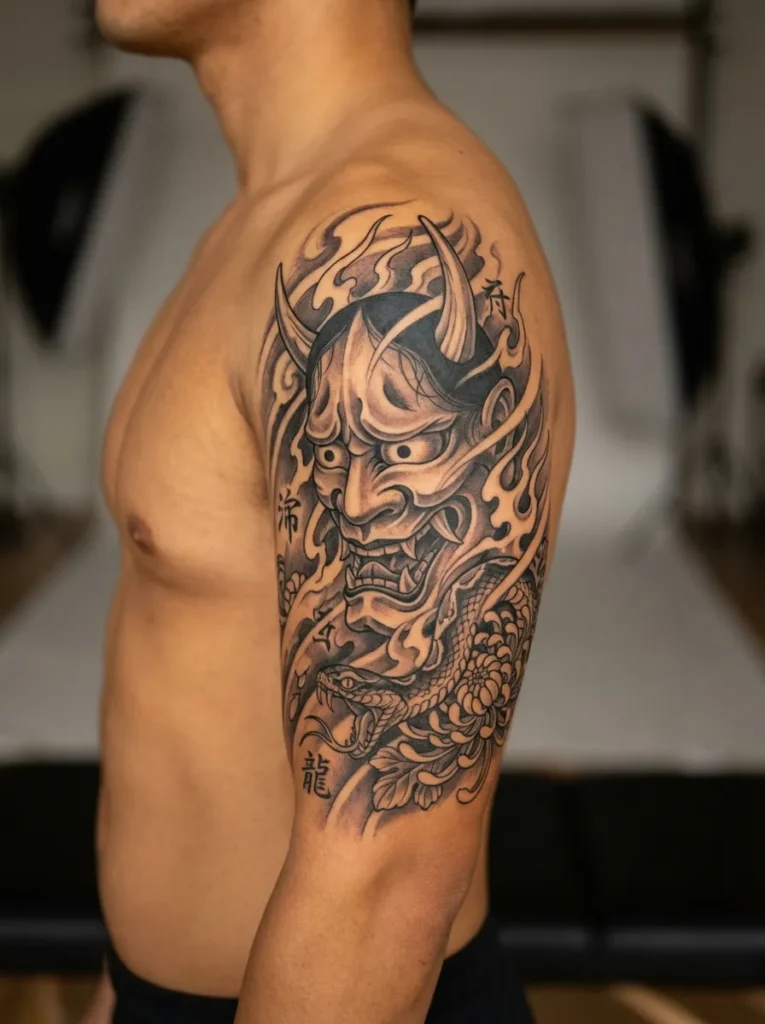
A Japanese devil mask half sleeve uses the arm format to give the Oni mask the breathing room it genuinely deserves. Not compressed into a small placement but expanded into a full compositional environment.
The mask anchors the piece with its dramatic central presence. Flames, smoke, and wind bars fill the surrounding arm space in continuous movement. The background elements wrap around the arm rather than sitting flat, making the tattoo three-dimensional when seen from different angles.
Half sleeve format also allows for narrative layering that smaller placements cannot support. Chrysanthemums or peonies growing beside the flames. A snake emerging from behind the mask. Scattered kanji adding textual weight to the visual mythology.
This is the format for someone who wants the devil mask experience without committing to a full sleeve. It is complete on its own and expandable if that ever changes.
8. Japanese Devil Chest Panel Design
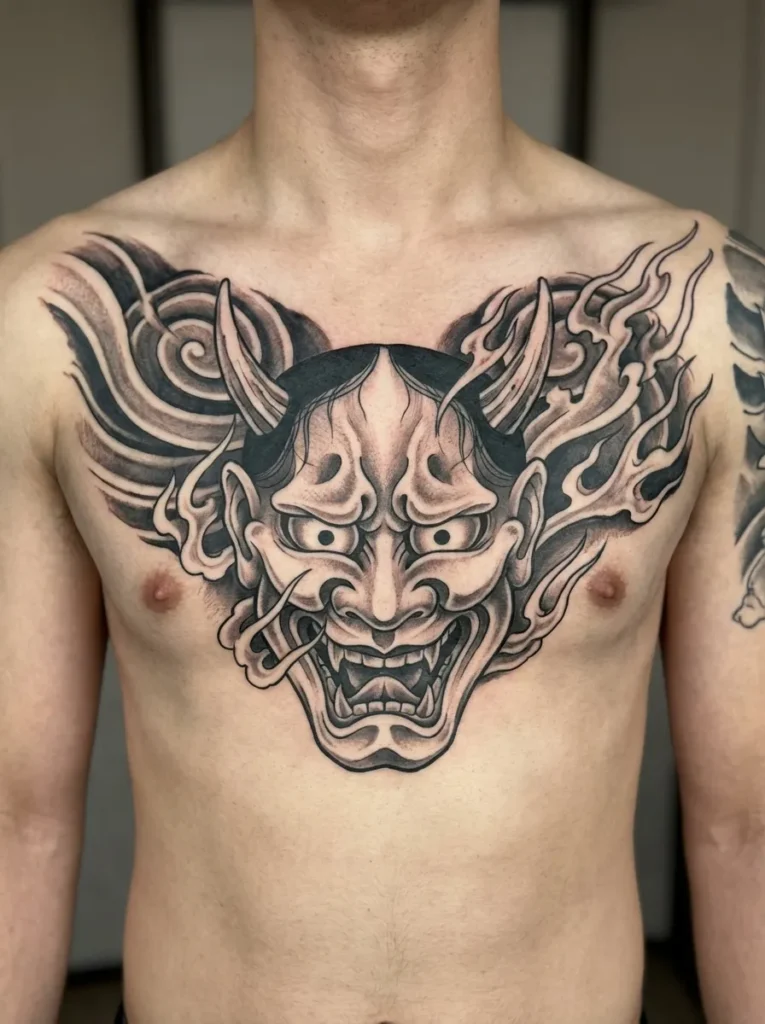
A Japanese devil chest panel is one of the most personally significant placements available. Centered over the heart. Directly over whatever you are protecting or carrying inside yourself.
The chest gives the Oni mask or full devil figure a wide, flat canvas that lets the composition breathe horizontally. The shoulders at each side of the chest panel frame the piece naturally and give an artist clear boundaries to work within.
A full devil face centered on the sternum with flames or wind elements spreading outward toward each shoulder creates a composition that looks like it is emerging from inside the person wearing it. That visual quality is uniquely powerful in chest placement.
The personal nature of the chest placement makes the protective symbolism of the Oni feel less like decoration and more like intention. You are not displaying the devil. You are putting it over the thing that matters most.
9. Japanese Devil with Katana Theme
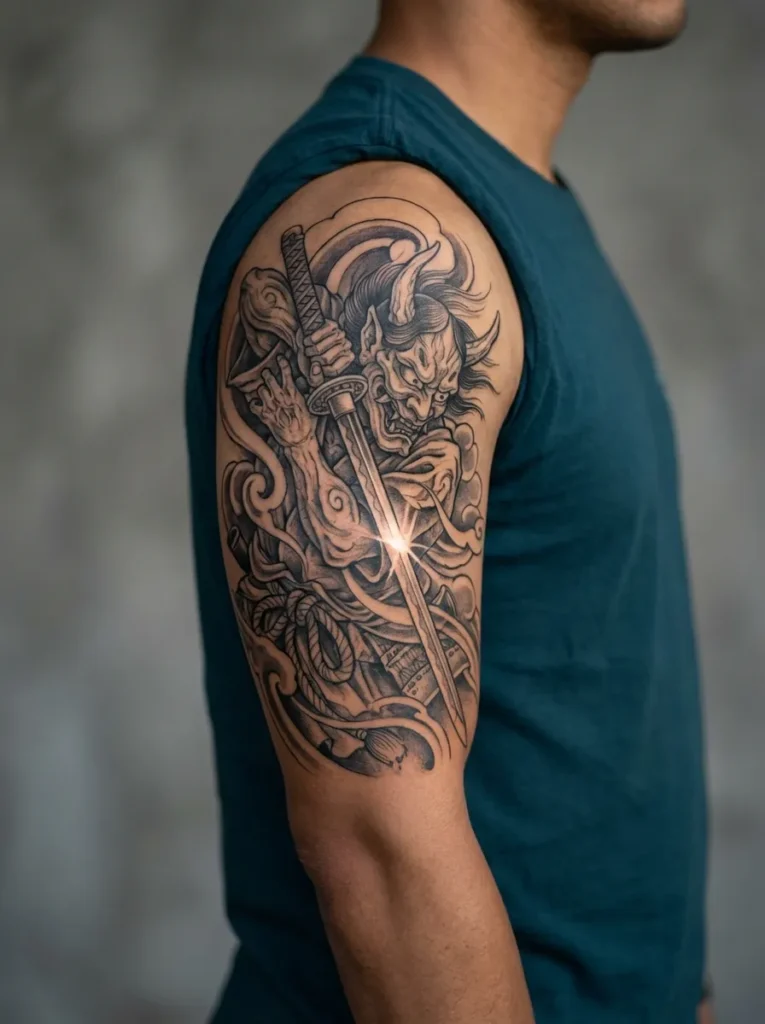
An Oni holding a katana shifts the devil from supernatural punisher into something closer to a warrior. It bridges the world of Japanese devil mythology and samurai culture in a single composition.
The Oni as a sword-wielding figure appears in Japanese folklore in several forms. Some as enemies of samurai heroes.
Some as former warriors who continued fighting after death in demonic form. The ambiguity between the two readings gives this concept real narrative depth.
The katana itself is treated with the same visual reverence in the tattoo as it holds in Japanese culture.
The blade catching light. The tsuba guard rendered with precise detail. The handle wrapped in traditional ito cord that an artist can render with extraordinary precision.
| Composition Approach | Narrative Reading | Visual Energy |
| Oni mid-swing, blade in motion | Aggression, battle, forward force | High movement, diagonal lines |
| Oni holding blade at rest | Authority, readiness, controlled power | Still, centered, imposing |
| Oni blade raised above head | Challenge, defiance, battle cry | Vertical energy, maximum drama |
10. Japanese Devil and Samurai Battle Scene
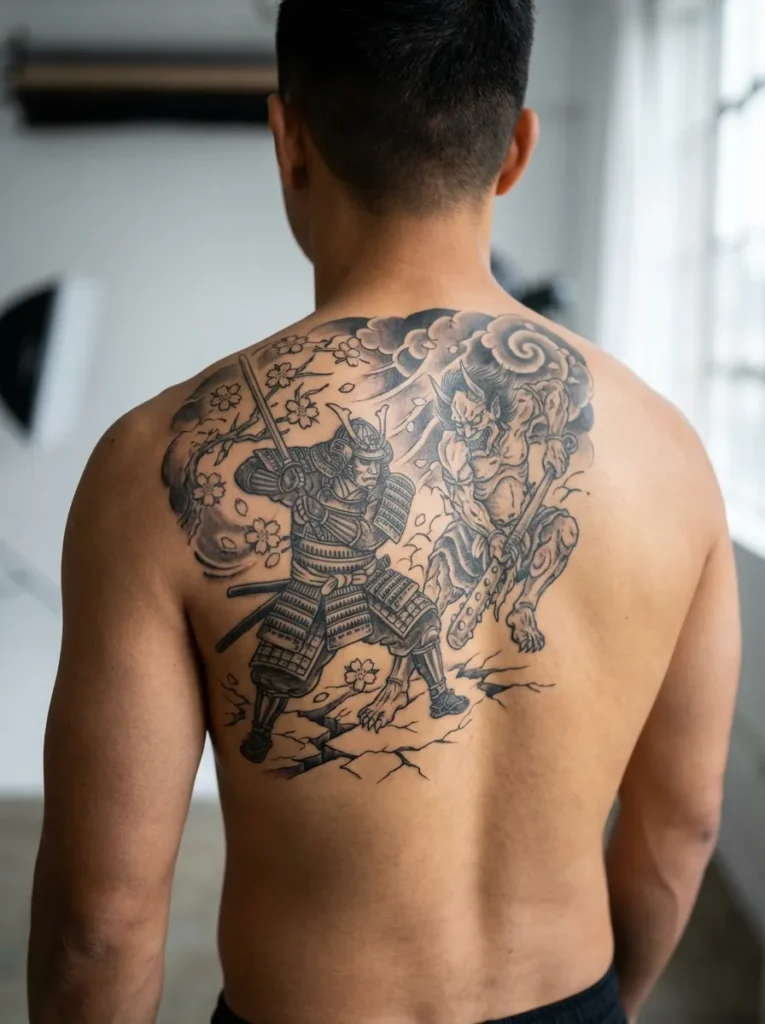
A samurai and an Oni locked in combat is one of the oldest and most dramatic narrative compositions in all of Japanese visual art. The discipline of the warrior against the chaos of the devil. Humanity against the supernatural. Order against everything that threatens it.
The tension in this composition is everything. The moment of maximum drama, sword meeting club, eyes locked, neither side giving ground, is the moment worth capturing in ink.
The samurai’s precise armor detailing contrasts visually with the Oni’s wild, organic forms. Lacquered plates against raw supernatural flesh.
The contrast is not just visual. It is philosophical. Two completely different relationships to power facing each other across a single frame.
Background elements like wind-torn cherry blossoms, storm clouds, and broken ground beneath their feet build the world around the confrontation.
The battle is not happening in a void. It is happening in Japan, in a real landscape, with real stakes.
11. Japanese Devil Backpiece Concept
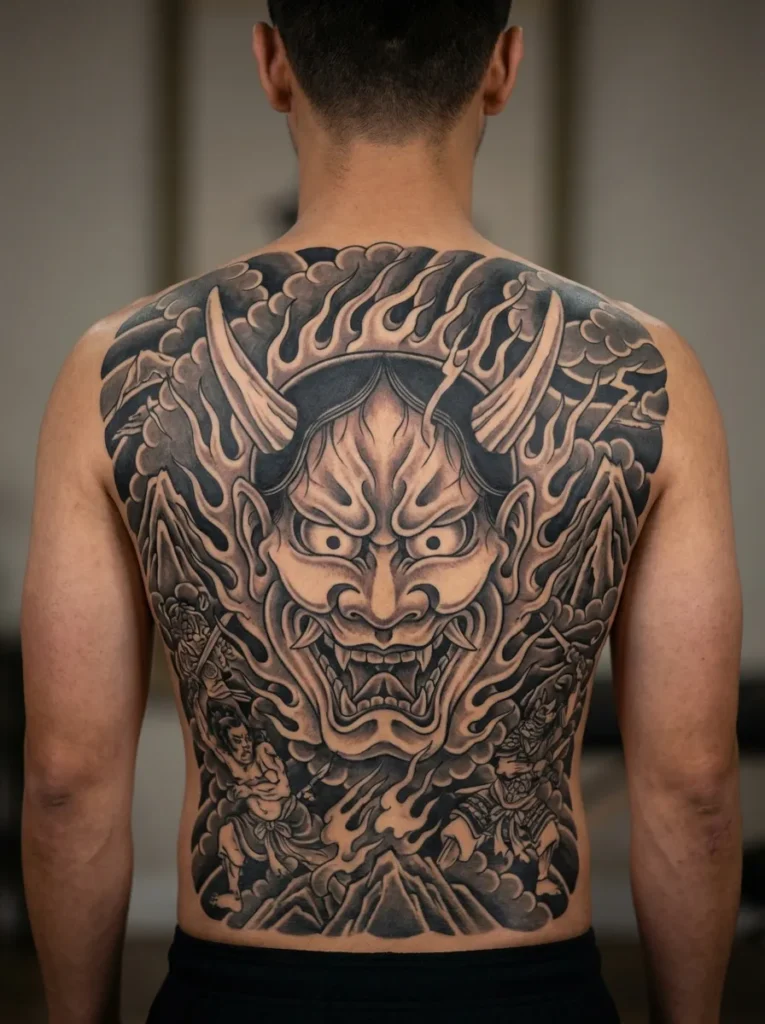
A full back Japanese devil tattoo is the most ambitious version of this subject matter available. The scale transforms what could be an aggressive image into something genuinely overwhelming in its scope and detail.
A single enormous Oni face centered on the back with horns reaching toward the shoulders, flames radiating outward in every direction, and surrounding elements filling every corner of the canvas is a backpiece that stops people mid-conversation when it is revealed.
The back also supports full figure compositions. An Oni standing, full body, surrounded by a complete environmental context, mountains, flames, storm clouds, defeated enemies beneath its feet, is a narrative backpiece that tells a story as complete as any painting.
Sessions for a full back devil concept are extensive. This is a multi-year commitment with the right artist. The people who go through that process consistently say it is the tattoo that defines everything else they have.
12. Japanese Golden Horned Devil Mask
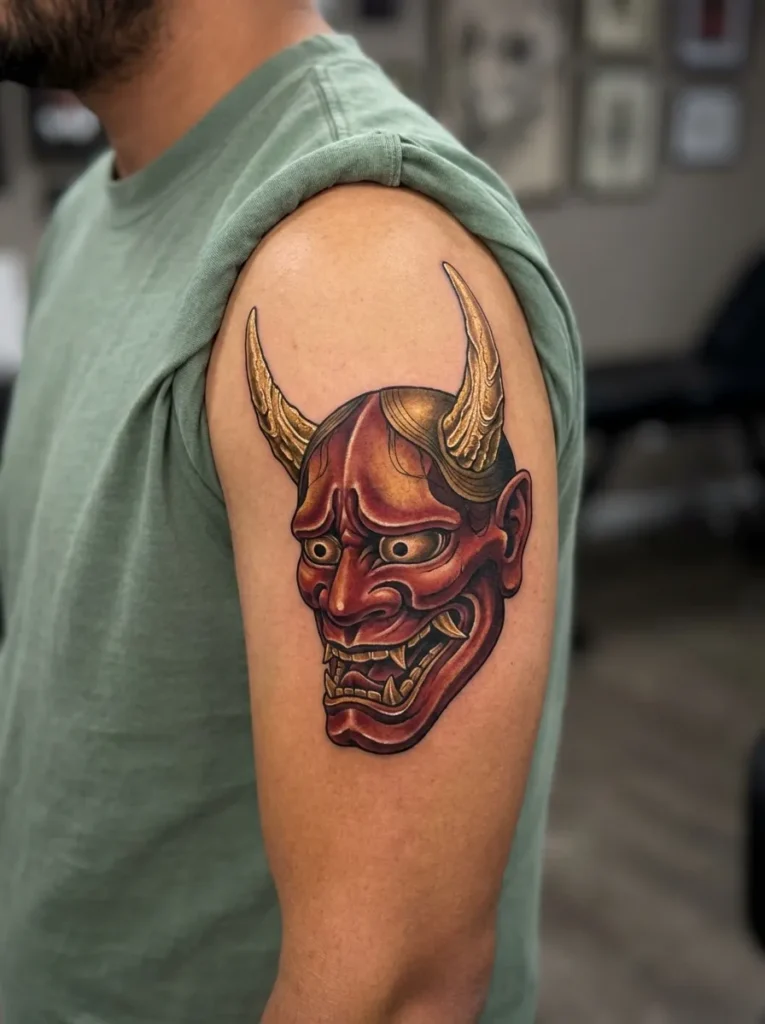
A golden horned Oni mask is a version of the devil concept that leans toward the divine rather than the demonic. Gold in Japanese visual culture is the color of the sacred, the imperial, and the incorruptible.
An Oni wearing golden horns becomes something that sits between devil and deity. Too powerful and too precise to be simply monstrous. More like a divine judge than an infernal creature.
The gold against deep red or black skin of the mask creates a color combination with genuine visual authority. Rich, warm, and completely commanding without needing to rely on shock or aggression alone.
Fine detail work on the golden horns, texture suggesting real metal, highlight placement that makes them appear to catch light, elevates the entire piece from a devil tattoo into something that reads as genuinely sacred.
13. Japanese Devil with Lotus (Hasu) Contrast
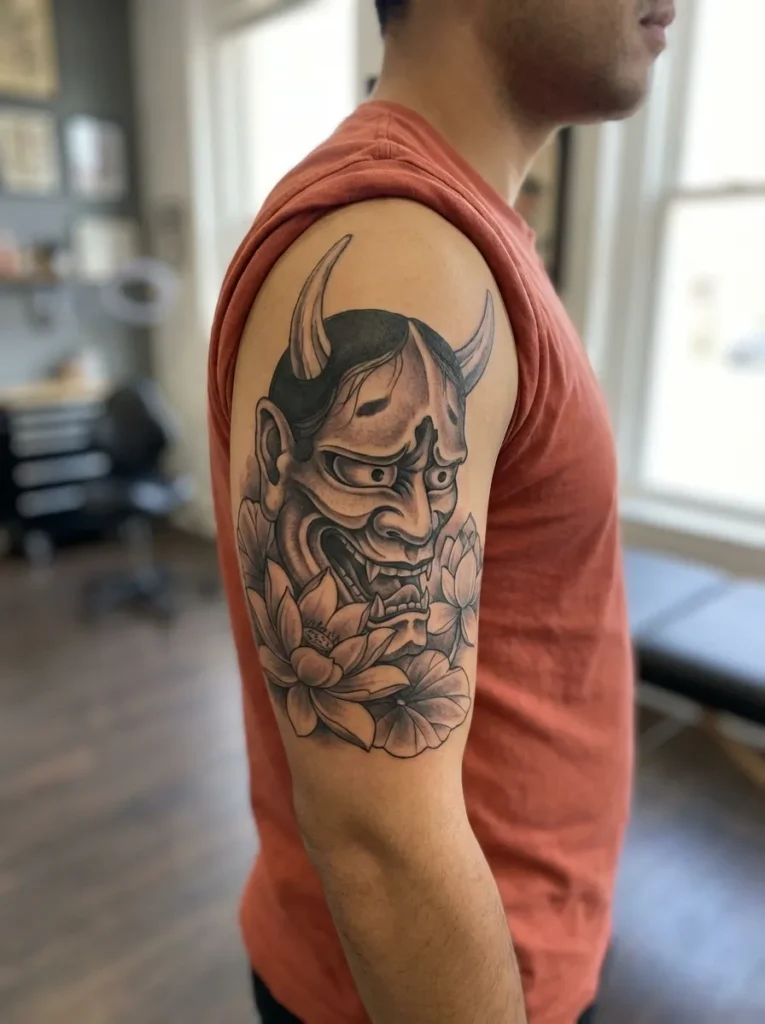
An Oni surrounded by lotus flowers is one of the most visually and symbolically rich contrasts available in Japanese tattooing. The most aggressive and the most serene. The punisher and the symbol of enlightenment sharing the same frame.
The lotus grows from muddy water and blooms into something pure. The Oni enforces purity through fear and force. Both are, in their own way, in service of the same thing. Order over chaos. Light over darkness. The contrast in method is the whole point.
Visually the soft, layered petals of the lotus against the hard, aggressive forms of the Oni mask create textural contrast that makes both elements perform better than they would alone. The devil needs the flower. The flower needs the devil.
This combination works especially well in black and grey where the tonal contrast between the soft floral shading and the deep aggressive shadows on the Oni mask carries the full weight of the symbolic opposition.
14. Japanese Devil and Phoenix (Hō-ō) Fusion
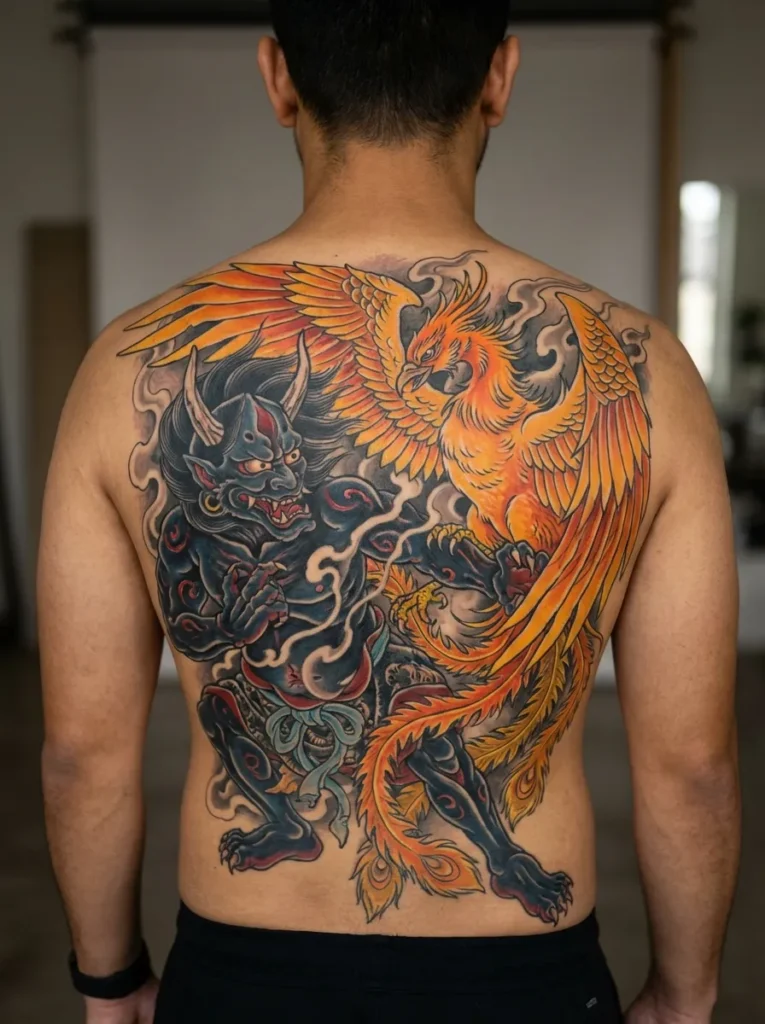
An Oni fused with or paired against a Japanese phoenix creates one of the most mythologically charged compositions in the entire style.
Death and rebirth. Destruction and transformation. The force that ends things and the force that begins them again.
In some interpretations the Oni and the Hō-ō are in conflict, one destroying as the other rises.
In others the fusion suggests a single entity that carries both powers simultaneously. The capacity for destruction and the capacity for complete renewal in the same being.
The visual contrast between the Oni’s dense, dark, grounded forms and the phoenix’s soaring, flame-bright, ascending energy creates a composition with extraordinary range.
From the deepest shadows to the brightest light, the piece uses the full tonal and color spectrum available.
This is a backpiece or full sleeve concept. The scale of both subjects demands space to do justice to what each of them means individually before the combination can make its full statement.
15. Japanese Devil with Maple Leaves (Momiji)
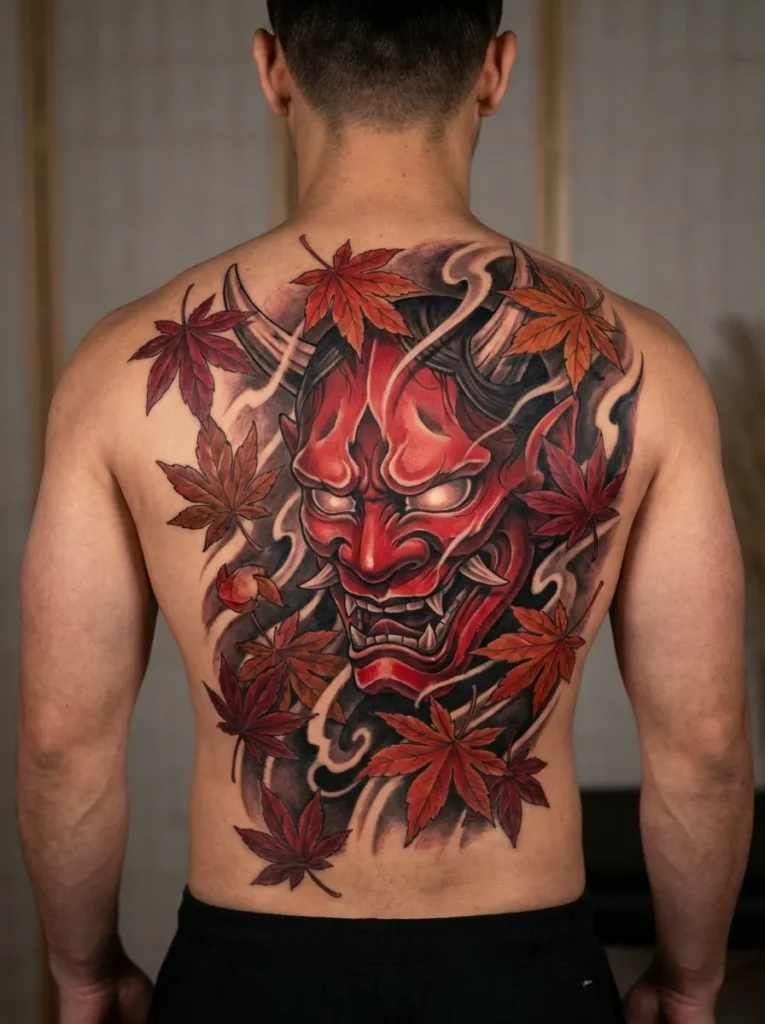
An Oni surrounded by falling maple leaves is a seasonal composition that adds a layer of poetic melancholy to the devil concept. Momiji, the Japanese autumn maple, represents the passing of time, the beauty of impermanence, and the particular sadness of beautiful things ending.
The Oni in autumn is a figure of power in a season of dying. The deep crimson and burnt orange of the maple leaves mirrors the red of the Oni’s skin but carries none of its aggression. The leaves are just falling. They do not fight anything. They simply let go.
That contrast between the devil’s fury and the leaves’ peaceful descent creates an emotional tension that is unlike any other Japanese devil composition.
It is fierce and melancholic at the same time. Power surrounded by acceptance of things it cannot stop.
The color palette writes itself. Red Oni, crimson and orange maple leaves, deep background shadows.
Warm throughout but emotionally complex in a way that purely aggressive devil compositions rarely achieve.
16. Japanese Devil Grinning with Fangs Detail
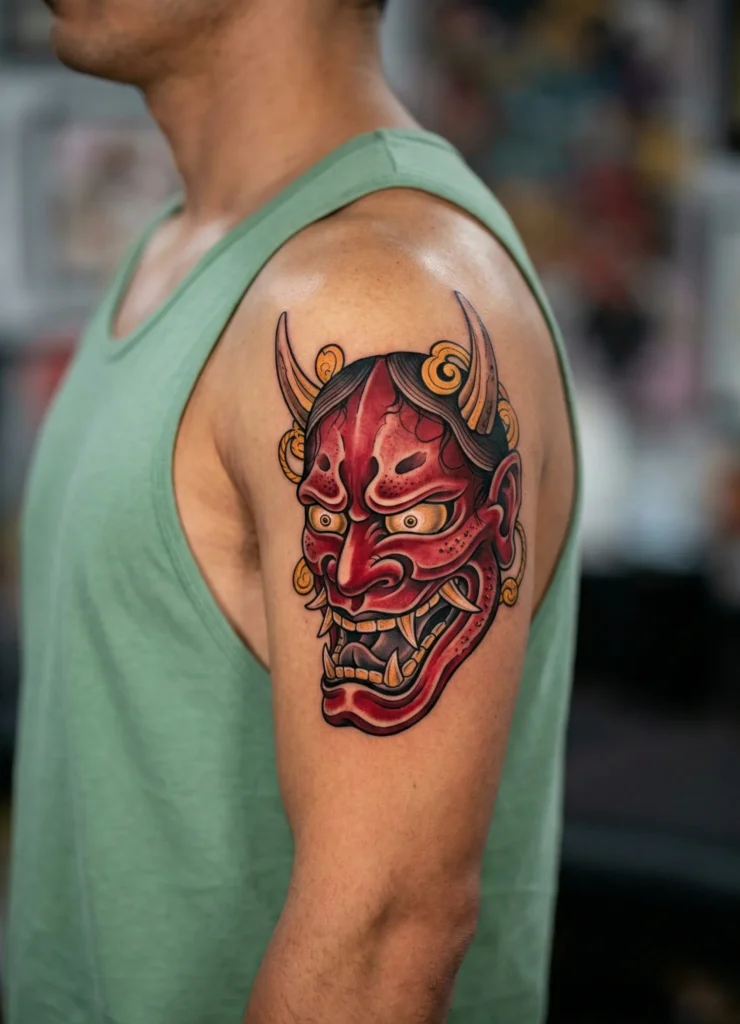
A grinning Oni is more unsettling than a raging one. Rage is understandable. A devil that looks like it is enjoying itself is something else entirely.
The grin suggests the Oni knows something you do not. That it has already won whatever confrontation is coming and is simply waiting for you to catch up to that understanding.
That quality of supernatural confidence is genuinely chilling in a way that open-mouthed fury never quite reaches.
Fang detail in this composition is the technical centerpiece. Each tooth individually rendered, the lower fangs overlapping the lip slightly, the tongue visible and dark behind the teeth, the corners of the mouth pulling back far enough to show gums.
The kind of dental detail that makes people uncomfortable in exactly the right way.
Eyes matter enormously in a grinning Oni. Wide, amused, and completely without warmth. Gold or pale irises with small, focused pupils in a wide-open eye create the expression of something that finds your situation genuinely funny.
17. Japanese Devil Emerging from Waves (Nami)
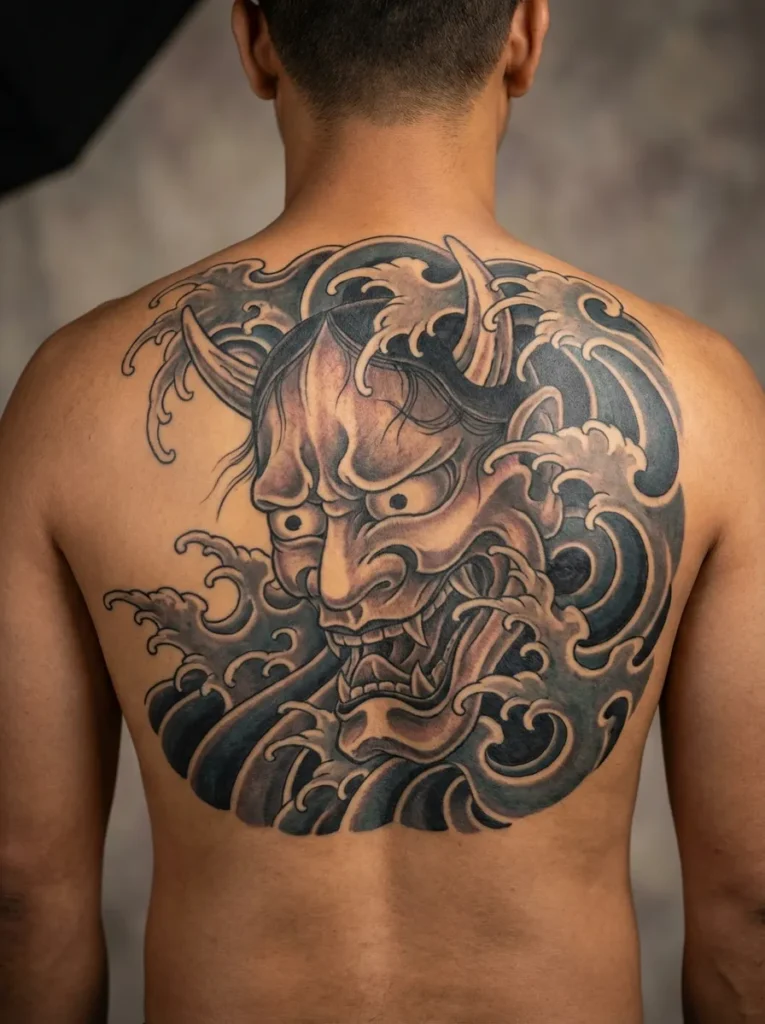
An Oni rising from crashing ocean waves brings together two of the most powerful visual forces in Japanese tattooing. The supernatural devil and the unstoppable natural force of the sea.
The composition has inherent drama built in. The waves are massive. The Oni is rising through them as if the ocean is nothing, as if water that could sink ships is simply the place it sleeps.
That visual relationship establishes the Oni’s power more effectively than any flames or weapons could.
The wave work surrounding the emerging devil gives an artist extraordinary technical territory to explore.
Curling peaks, churning foam, deep dark water between the waves. The Irezumi wave tradition is one of the most sophisticated in tattooing and this composition lets it perform at full capacity.
A backpiece or large panel format suits this concept best. The waves need room to build and the Oni needs room to emerge from them completely. Compression ruins both.
18. Japanese Devil with Temple Background
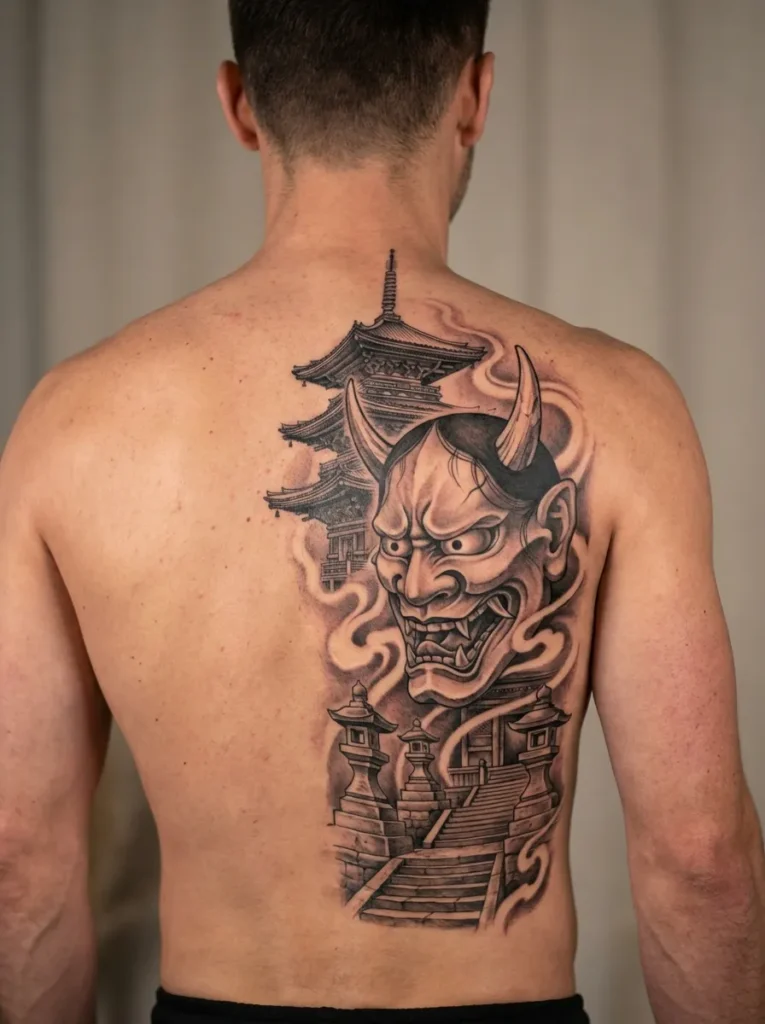
An Oni set against a Japanese temple background creates a composition with deep irony built directly into its structure.
The devil at the gates of the sacred. The punisher at the place of worship. Both existing in the same frame because in Japanese tradition, they were never truly separate.
Oni appear at temple gates across Japan. They are carved into guardian pillars and painted on ceremonial drums. The temple is not the Oni’s enemy. It is the Oni’s home.
A pagoda emerging through mist behind the devil figure, stone lanterns flanking the scene, temple steps leading down and away from where the Oni stands, all of it creates a setting that gives the devil context and legitimacy that a plain background never could.
The architectural precision of temple details against the organic wildness of the Oni creates the same kind of contrast as the devil with lotus composition.
Order and chaos. Structure and the thing that makes structure necessary.
19. Japanese Half Devil Half Human Face
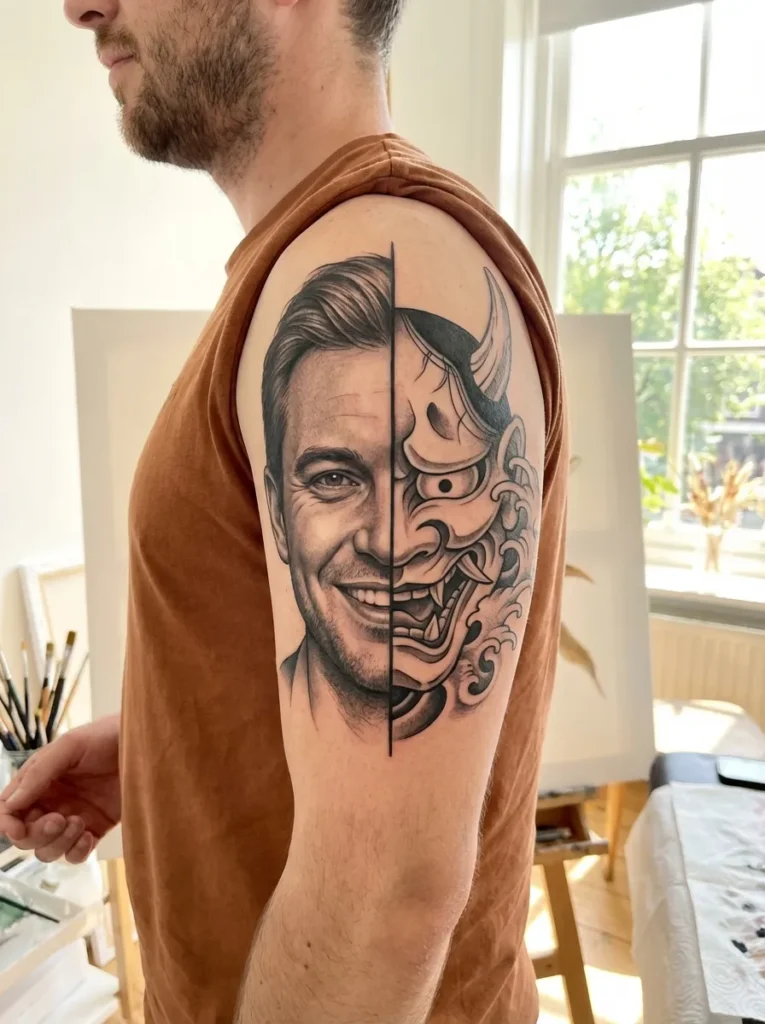
The half devil half human face is the most psychologically complex concept on this entire list. And the most personal.
Split directly down the center, one side shows a human face. The other shows what lives underneath or alongside it. The Oni emerging from the same face that smiles at people every day.
This concept has ancient roots in Japanese art and theatre. The Noh and Kabuki traditions both explore the moment of transformation between human and demon, the face caught between two states. The tattoo freezes that moment permanently.
The meaning shifts with whoever wears it. For some it represents the duality between public persona and private nature.
For others it is about the capacity for both compassion and cruelty that every human carries.
For others still it is about transformation, the person they were becoming the person they are now, both faces equally true.
Technically this is one of the most demanding Japanese devil compositions available. Portrait realism on the human side.
Traditional Irezumi rendering on the devil side. Both executed with equal skill and meeting at a center line that is the most important mark in the entire tattoo.
Which of these 19 Japanese devil designs speaks to something you have been carrying around quietly, and do you want the world to see it the way the Red Oni does, loudly and without apology, or the way the Blue Oni does, deeply and without explanation?