
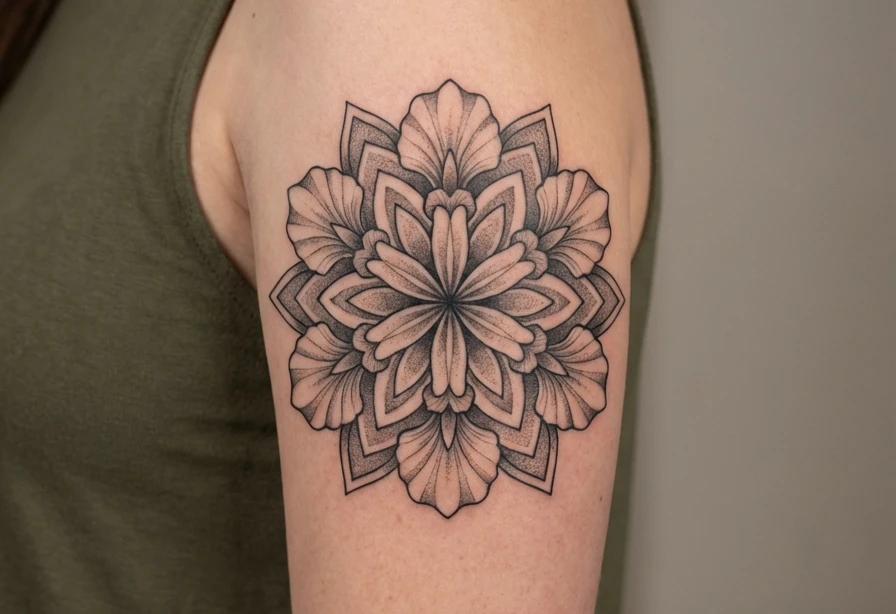
Flowers and mandalas share the same secret. Both organize themselves outward from a center point in patterns that repeat, layer, and radiate with a precision that feels almost mathematical.
Put them together and something genuinely extraordinary happens. The flower becomes more than botanical.
The mandala becomes more than geometric. The combination creates something that feels both ancient and completely personal.
Mandala flower tattoos sit at the intersection of sacred geometry and natural beauty. They carry meaning that goes deeper than aesthetics, touching something in the viewer that recognizes pattern and order as inherently meaningful.
This list covers 23 mandala flower tattoo ideas that explore what becomes possible when nature’s design language meets geometry’s perfect logic.
1. Lotus Flower Mandala Tattoo
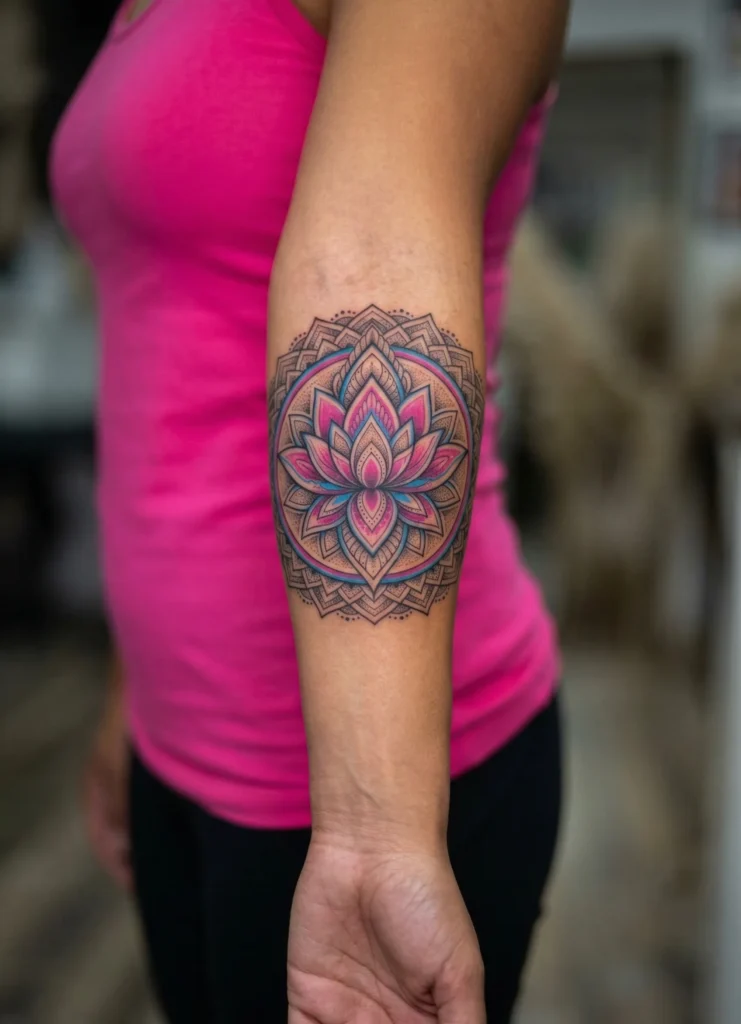
The lotus and the mandala were made for each other. Both emerge from a center point and radiate outward in layered symmetry.
Both carry spiritual significance across multiple traditions. Both use repetition and pattern as their primary visual language.
A lotus mandala tattoo integrates the flower’s petals directly into the mandala’s geometric rings. Each petal becomes part of the pattern rather than sitting on top of it.
The flower and the geometry are the same thing viewed from different angles.
This design carries weight in every sense. Visual weight, spiritual weight, personal weight. It’s not a casual choice and the people who choose it generally know exactly why.
- Black and gray dot work suits this concept beautifully, creating tonal depth through pattern density
- The sternum and upper back are classic placements where the symmetrical design can sit centered
- Adding a second outer ring of geometric pattern beyond the lotus petals creates a more complete mandala feel
2. Rose Flower Mandala Tattoo
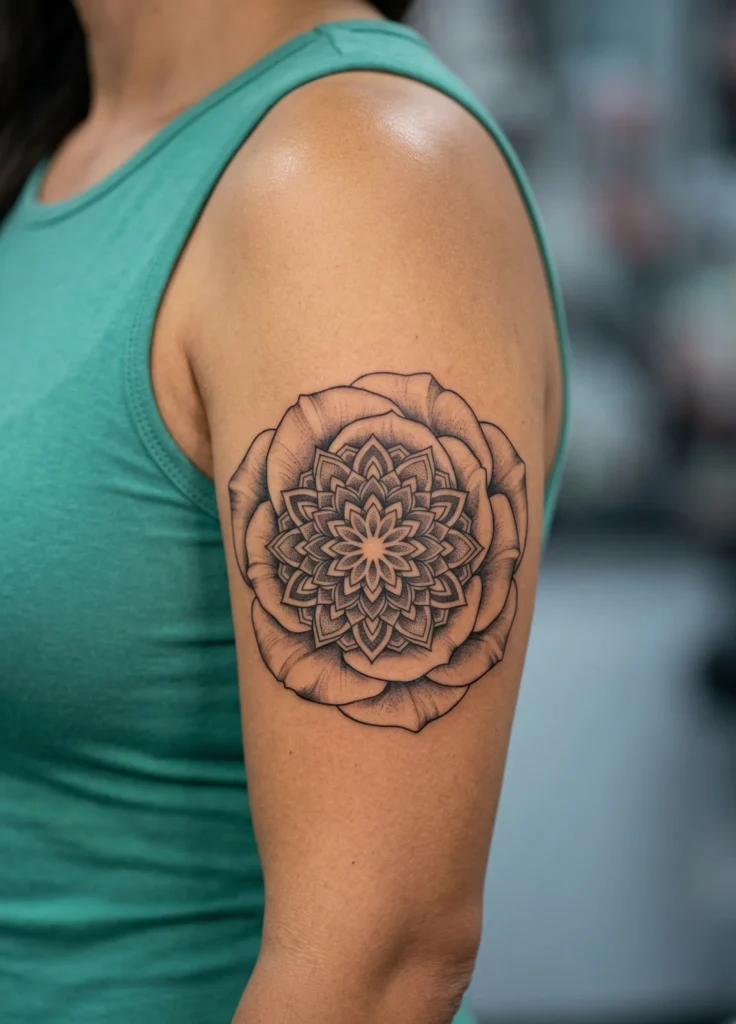
Taking the rose and rebuilding it within mandala geometry creates something that feels simultaneously familiar and completely transformed.
The rose’s petals become the outermost ring of the mandala. The inner structure moves from botanical to geometric as it approaches the center.
That transition from natural to geometric within a single design is the most interesting visual aspect of a rose mandala.
The moment where you stop seeing a flower and start seeing pure pattern is different for every viewer and at every viewing distance.
In black and gray with fine line geometric detail this design has a timeless quality that suits the rose’s own enduring status as the most recognized flower in the world.
3. Peony Flower Mandala Tattoo
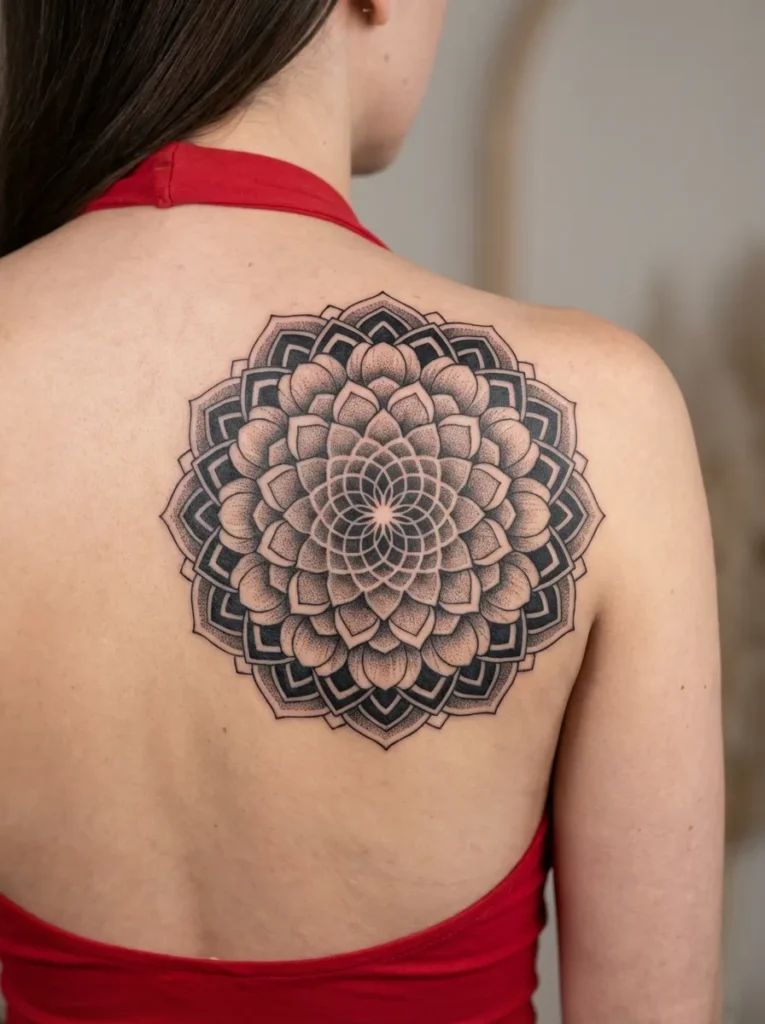
The peony’s naturally layered petal structure makes it one of the most intuitive flowers to integrate with mandala geometry.
Each concentric ring of petals already exists in the real flower. The mandala simply makes that geometry explicit and extends it with mathematical precision.
A peony mandala tattoo reveals something true about the flower itself. That its beauty was always geometric. That nature was doing sacred geometry before anyone gave it that name.
In deep black ink with fine dot work shading the peony mandala achieves a density and richness that purely botanical versions of the same flower rarely approach.
| Design Element | Natural Source | Geometric Translation |
| Outer petals | Peony’s opening bloom | First mandala ring |
| Middle petals | Inner petal layers | Geometric petal repetition |
| Center detail | Tight bud center | Fine line geometric core |
| Background rings | Artistic addition | Sacred geometry extension |
4. Sunflower Flower Mandala Tattoo
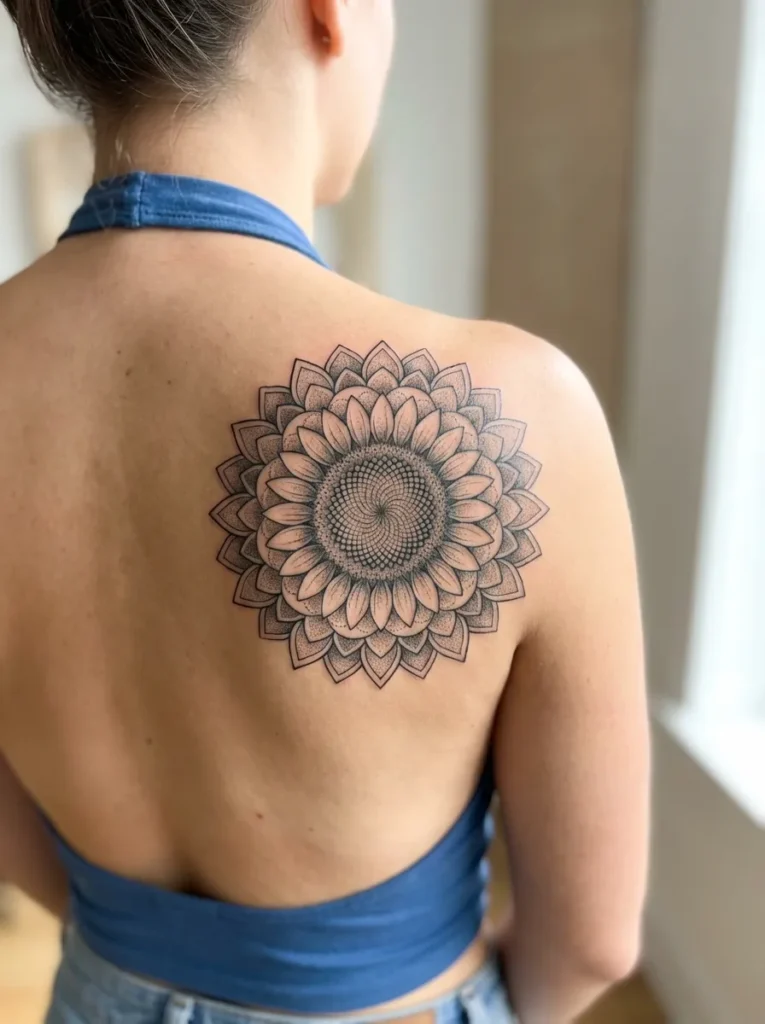
The sunflower carries its own mandala within it already. That seed head center with its Fibonacci spiral arrangement of seeds is one of nature’s most perfect geometric patterns. A sunflower mandala tattoo simply makes visible what was always there.
The ray petals become the outermost mandala ring. The seed center becomes the inner geometric core. Between them the artist can add rings of geometric detail that bridge the botanical and the mathematical.
This is one of the few mandala flower combinations where the flower itself already understands what it’s being asked to do. The sunflower has always been a mandala. The tattoo is just the acknowledgment.
- Fibonacci spiral detail in the seed center rewards the viewer who looks closely
- Golden ratio geometry in the petal spacing can be worked into the design intentionally
- This concept suits the upper arm, thigh, or back where the full circular design has room to breathe
5. Tulip Flower Mandala Tattoo
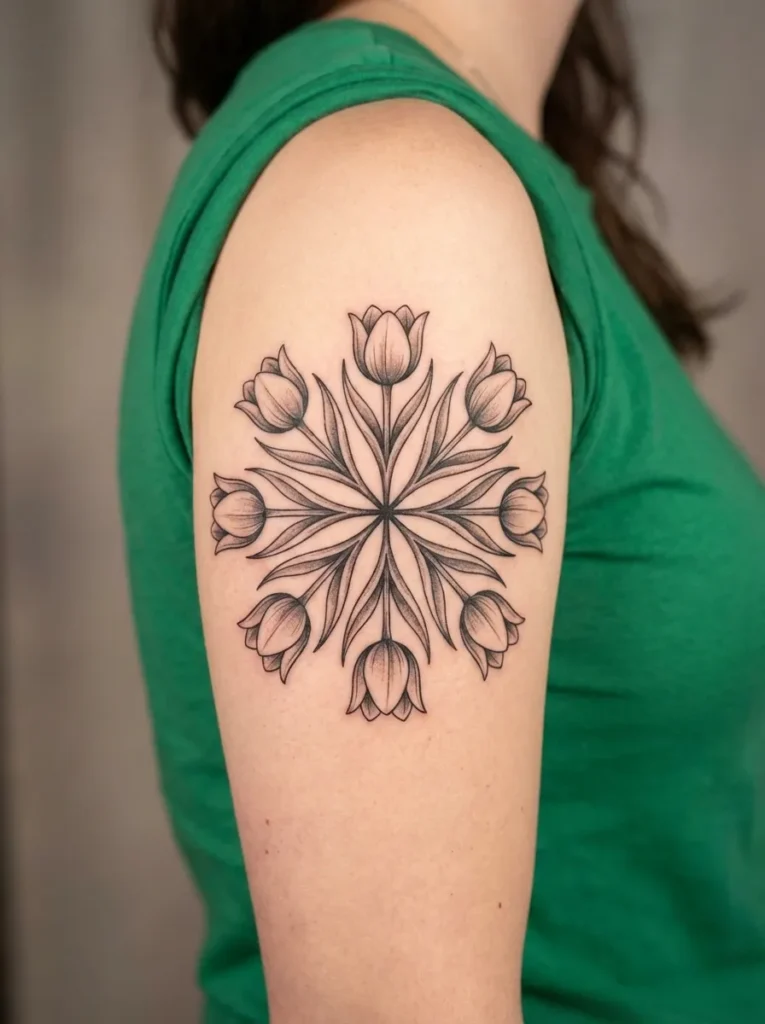
Placing the tulip within a mandala framework creates an interesting challenge because the tulip’s natural form is vertical rather than radial.
The solution is to use the tulip bloom as a central focal element from which mandala rings extend outward, as if the flower is the source of the geometry surrounding it.
Multiple tulip blooms arranged radially around a central point, each one pointing outward like spokes from a wheel, creates a different and equally compelling interpretation.
Eight tulips in perfect circular arrangement, their stems meeting at the center, their blooms facing outward.
That radial arrangement makes the tulips themselves the mandala rather than placing a mandala around a single bloom.
6. Lavender Flower Mandala Tattoo
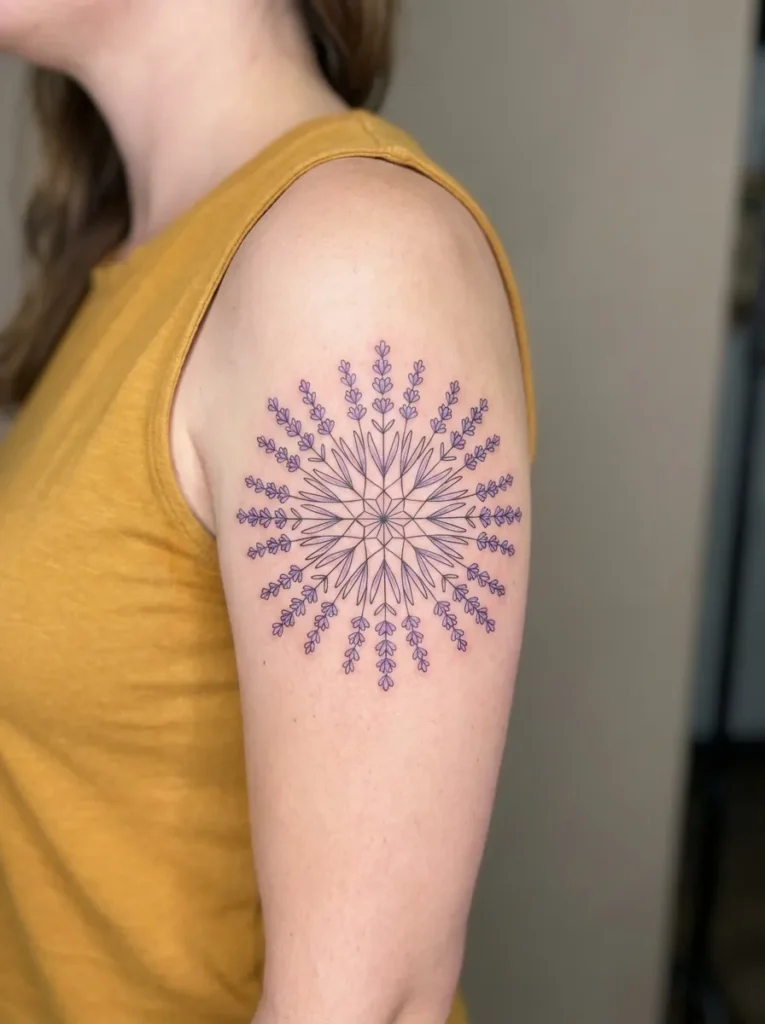
Lavender integrated into mandala geometry takes those long vertical sprigs and incorporates them as repeating radial elements.
Multiple lavender stems arranged around a central point, their buds forming an outer ring of clustered detail.
The small individual buds of the lavender sprig translate beautifully into the kind of repeated small-scale detail that mandala geometry uses throughout its inner rings.
Lavender and mandala share the same love of small elements accumulating into larger patterns.
In fine line with soft purple coloring this design has a meditative, aromatic quality that makes it one of the more personally meaningful mandala flower combinations available.
7. Magnolia Flower Mandala Tattoo
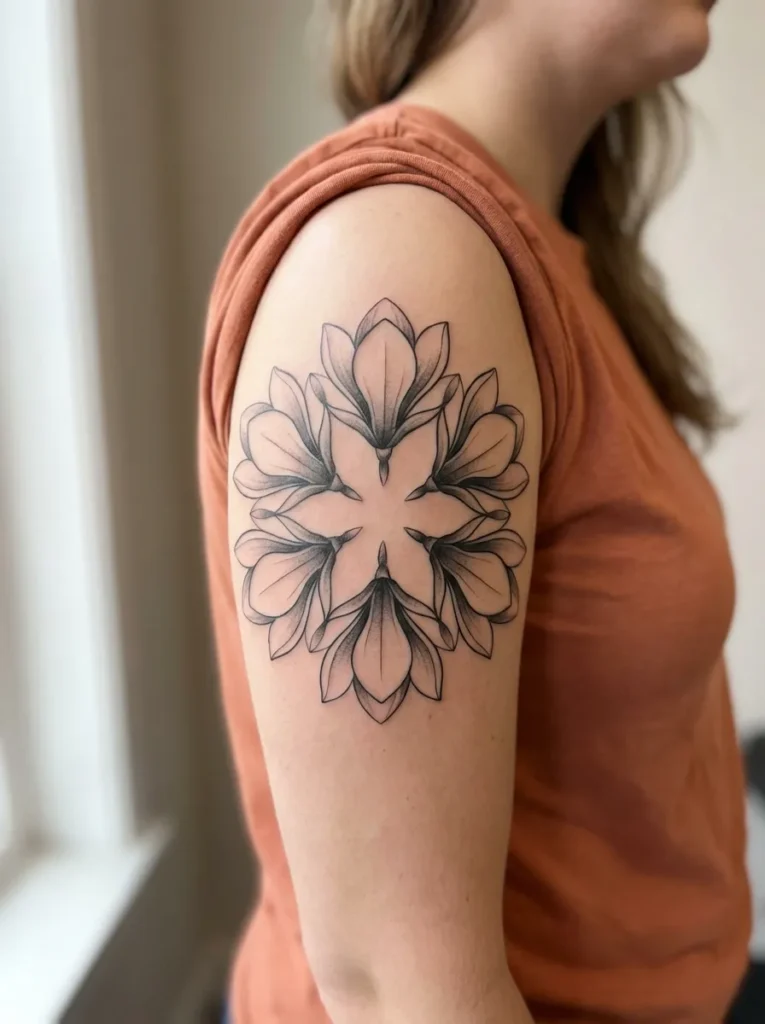
The magnolia’s broad smooth petals create a different kind of mandala energy from more complex flowers.
Where other mandala flowers add detail through petal complexity, the magnolia mandala achieves its power through the elegant simplicity of a few large petal forms arranged with geometric precision.
Six or eight magnolia blooms arranged radially, each one perfectly positioned, their smooth petal surfaces creating clean geometric shapes between them.
The negative space between the blooms becomes as geometrically intentional as the blooms themselves.
That combination of large simple forms and precise geometric spacing creates a mandala with a quiet grandeur that busier designs rarely achieve.
8. Hibiscus Flower Mandala Tattoo
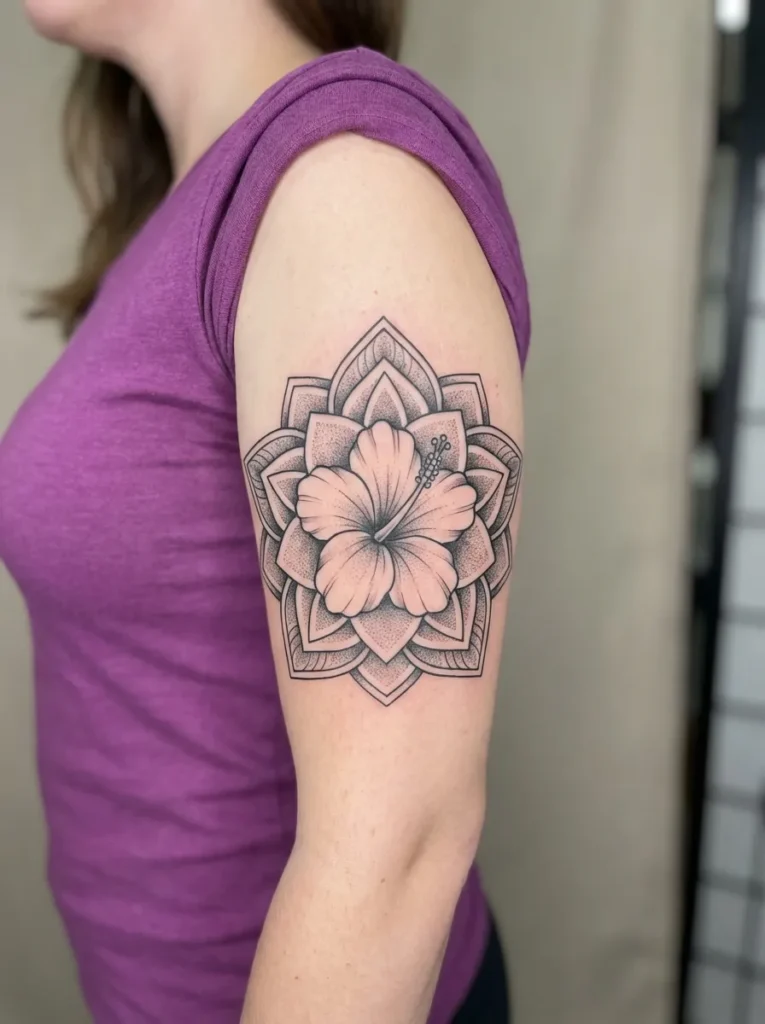
The hibiscus with its five broad open petals and dramatic central stamen lends itself naturally to mandala integration.
The five-fold symmetry of the flower creates a natural pentagon geometry that mandala artists can extend outward into five-pointed star patterns and pentagonal ring structures.
That five-fold geometry gives a hibiscus mandala a different energy from the more common six-fold or eight-fold mandala structures.
It feels slightly unexpected, slightly asymmetric to eyes trained on conventional mandala proportions.
That productive discomfort is part of what makes the hibiscus mandala tattoo interesting. It’s a mandala that follows nature’s own geometry rather than imposing conventional mandala geometry onto a floral subject.
9. Wildflower Cluster Mandala Tattoo
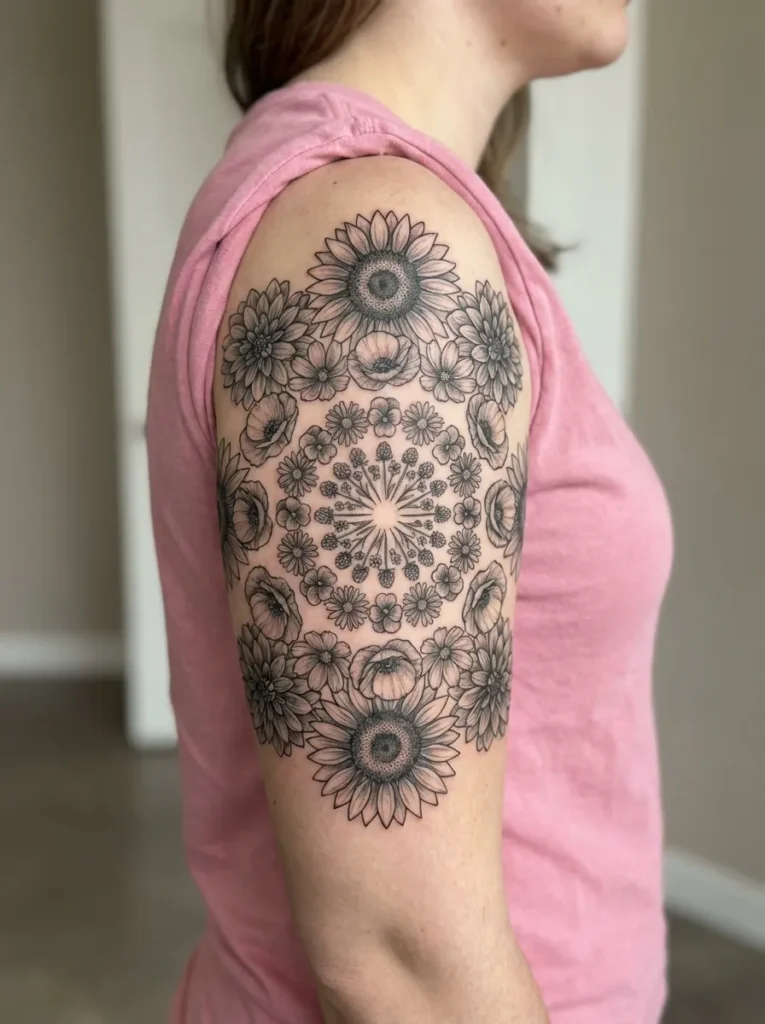
A wildflower cluster mandala arranges multiple species in concentric rings radiating from a central point. The inner ring might be tight buds and small blooms.
The middle ring opens to larger flowers. The outer ring extends to the boldest and most open blooms.
That radial arrangement of different species creates a mandala that tells a botanical story about diversity and relationship.
Each species placed not randomly but according to geometric logic that gives the arrangement meaning beyond aesthetics.
This is one of the most complex and rewarding mandala flower concepts available. Executed well it looks like a botanical illustration of an entire ecosystem arranged with sacred geometry.
| Ring Position | Flower Scale | Species Examples |
| Inner core | Tiny buds and seeds | Clover, forget-me-not buds |
| First ring | Small open blooms | Violets, daisies |
| Middle ring | Medium flowers | Poppies, cosmos |
| Outer ring | Large bold blooms | Sunflower, dahlia |
10. Poppy Flower Mandala Tattoo
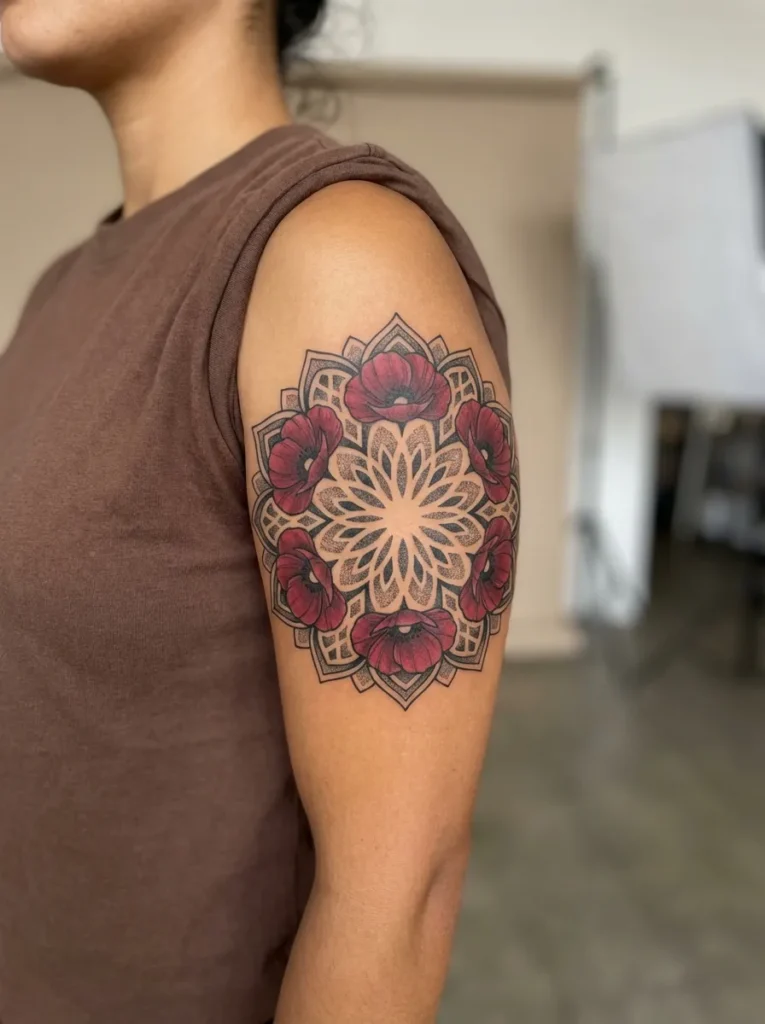
The poppy’s four broad petals create a cross-like symmetry when used as the foundational unit of a mandala design.
Multiple poppies arranged radially with their petals touching at the center create a mandala where the negative space between poppies forms its own geometric pattern.
The dark poppy centers become dots of visual weight distributed evenly around the mandala’s inner ring, anchoring the design with regular emphatic marks that draw the eye around the circle.
In deep red color against black mandala linework the poppy mandala is one of the most visually striking color combinations in floral geometric tattoo design.
11. Dahlia Flower Mandala Tattoo
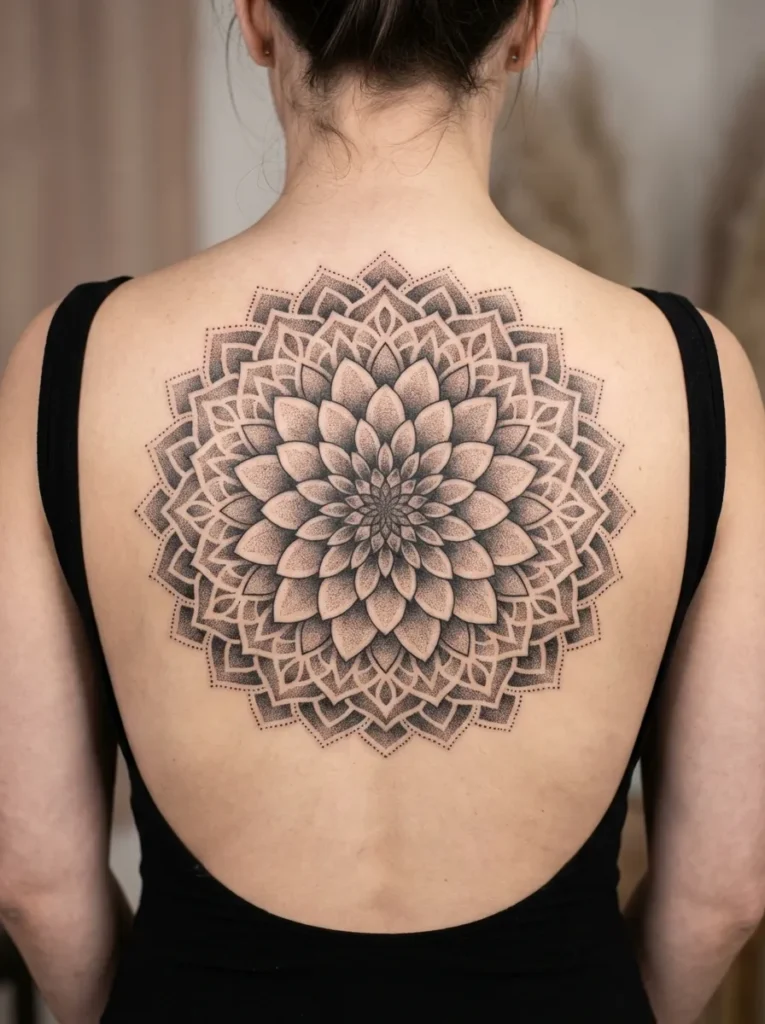
The dahlia is already a mandala. There’s no other way to say it. Those dozens of symmetrically arranged petals in perfect concentric rings are exactly what sacred geometry describes.
Placing the dahlia within an extended mandala framework simply acknowledges what the flower has always been.
A dahlia mandala tattoo is the most natural pairing on this list. The transition between the botanical flower and the geometric mandala is seamless because they’re using the same visual vocabulary from the start.
This design scaled large on the upper back or thigh with full dot work shading throughout is one of the most impressive single tattoo pieces possible in the floral geometric category.
- Full dot work shading throughout unifies the botanical and geometric elements seamlessly
- Scaling up to 15cm or larger allows the full detail of both dahlia and mandala to be properly expressed
- The circular form fits naturally on the upper back, thigh, and upper arm
12. Camellia Flower Mandala Tattoo
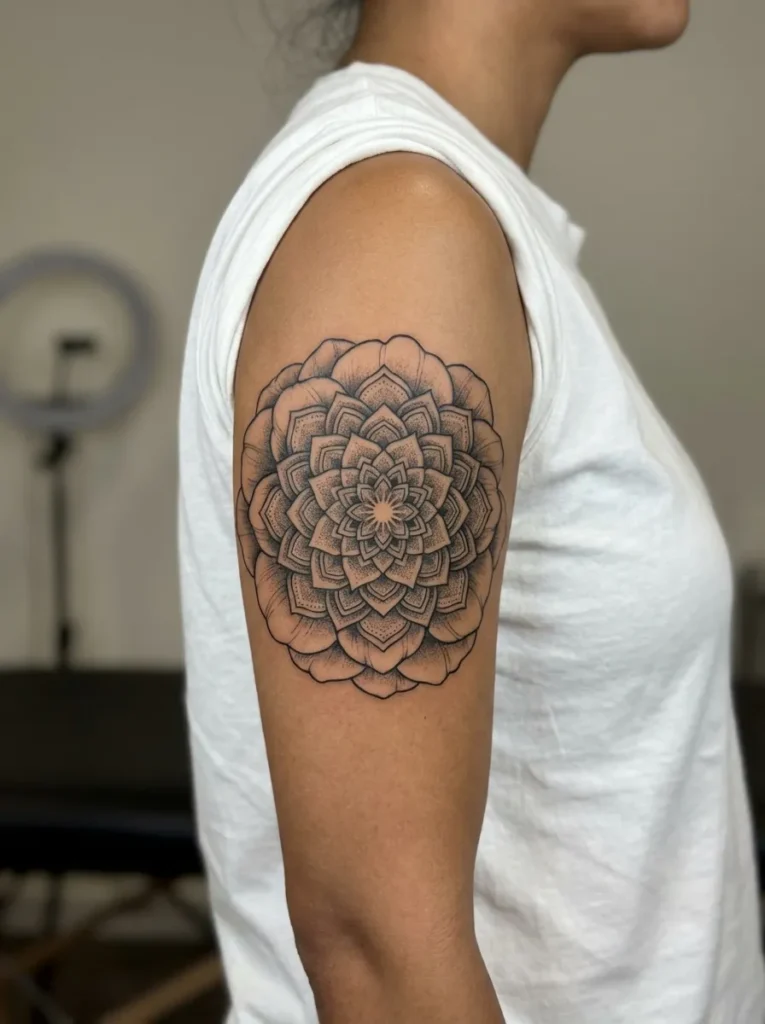
The camellia’s concentric petal rings and the mandala’s concentric geometric rings share such obvious structural similarity that integrating them creates a design that feels completely inevitable.
The outer camellia petals transition into geometric petal forms that become progressively more abstract as they move toward the center.
Botanical on the outside, purely geometric at the core. The transition between the two is where the real design interest lives.
That gradient from natural to mathematical mirrors something true about how we understand both flowers and geometry. We move from surface beauty toward deeper structure and find that the same principles were operating throughout.
13. Gardenia Flower Mandala Tattoo
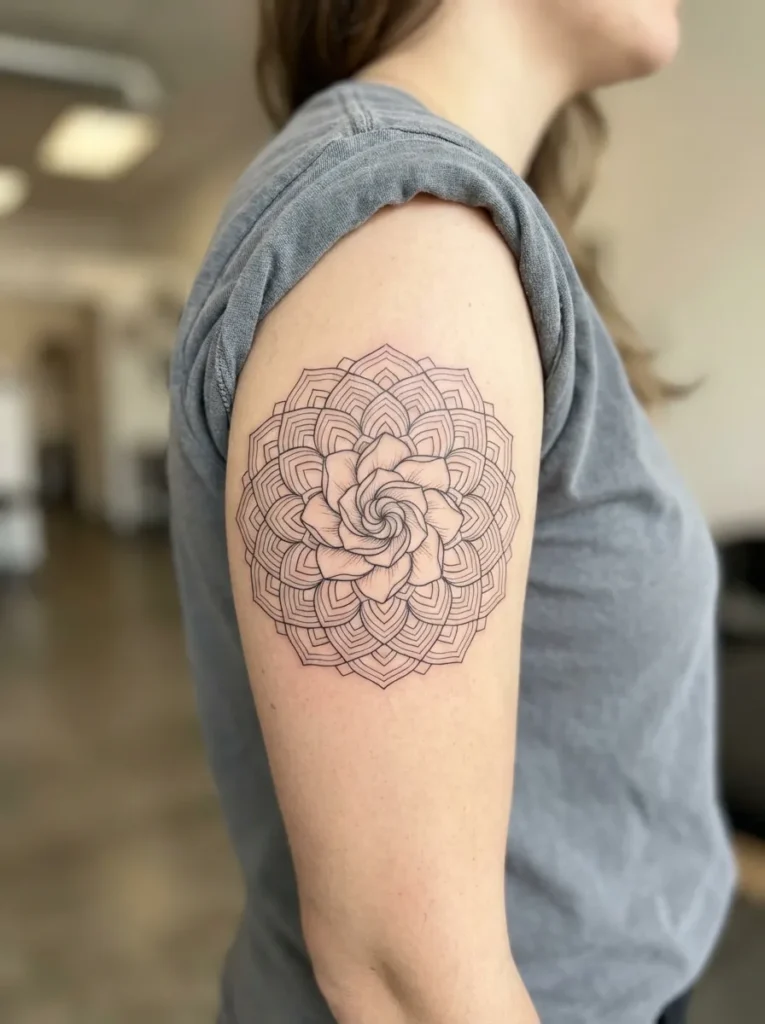
The gardenia’s inward spiral of petals creates a natural focal point that draws the eye toward the center of a mandala composition.
That centripetal quality, drawing inward rather than radiating outward, creates interesting tension with the mandala’s typical outward radial energy.
A gardenia mandala that acknowledges this tension, letting the flower draw inward while the outer geometric rings radiate outward, creates a design with dynamic push and pull between its two visual forces.
In fine line black ink that tension is most clearly visible. The spiral gardenia center pulling one direction, the mandala rings expanding in the other.
14. Anemone Flower Mandala Tattoo
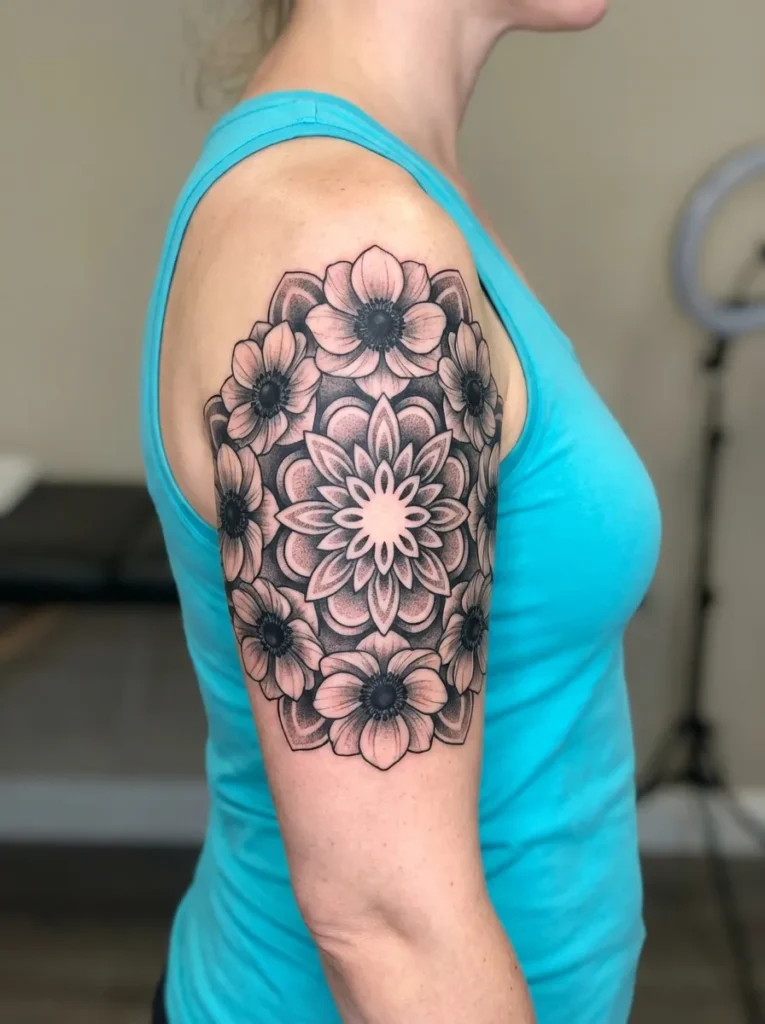
The anemone’s strong center-to-petal contrast, light petals against a dark dramatic center, creates a powerful focal point for mandala geometry to radiate from.
That dark center becomes the mandala’s nucleus, the point from which all geometric energy originates.
Multiple anemone blooms arranged radially, each dark center contributing to an inner ring of repeated dark marks, creates a mandala with genuine visual rhythm.
The repetition of that center detail across the circular arrangement creates a drumbeat quality in the design.
Black and white contrast suits this concept better than any other color approach. The maximum contrast between dark centers and light petals extended into the geometric rings creates something genuinely striking.
15. Ranunculus Flower Mandala Tattoo
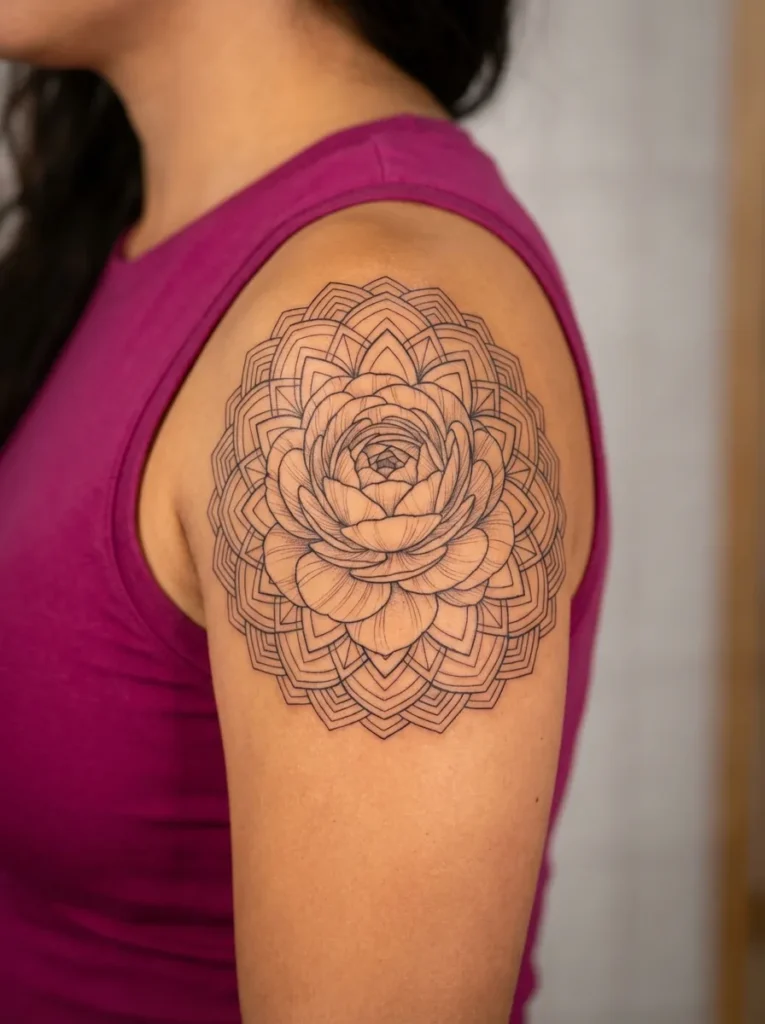
The ranunculus with its dozens of paper-thin petals arranged in concentric circles is one of the flowers most naturally suited to mandala integration.
The flower’s own petal arrangement is already mandala geometry operating at a botanical scale.
Extending that concentric structure outward into explicit geometric rings simply continues what the ranunculus was already doing.
The mandala doesn’t impose a new structure on the flower. It completes a structure the flower already started.
In fine line work the transition from ranunculus petals to geometric lines is achieved through a gradual shift in stroke character rather than a sudden change.
The petals become slightly more geometric as they approach their outer edges. The geometry becomes slightly more organic as it approaches the flower.
16. Cosmos Flower Mandala Tattoo
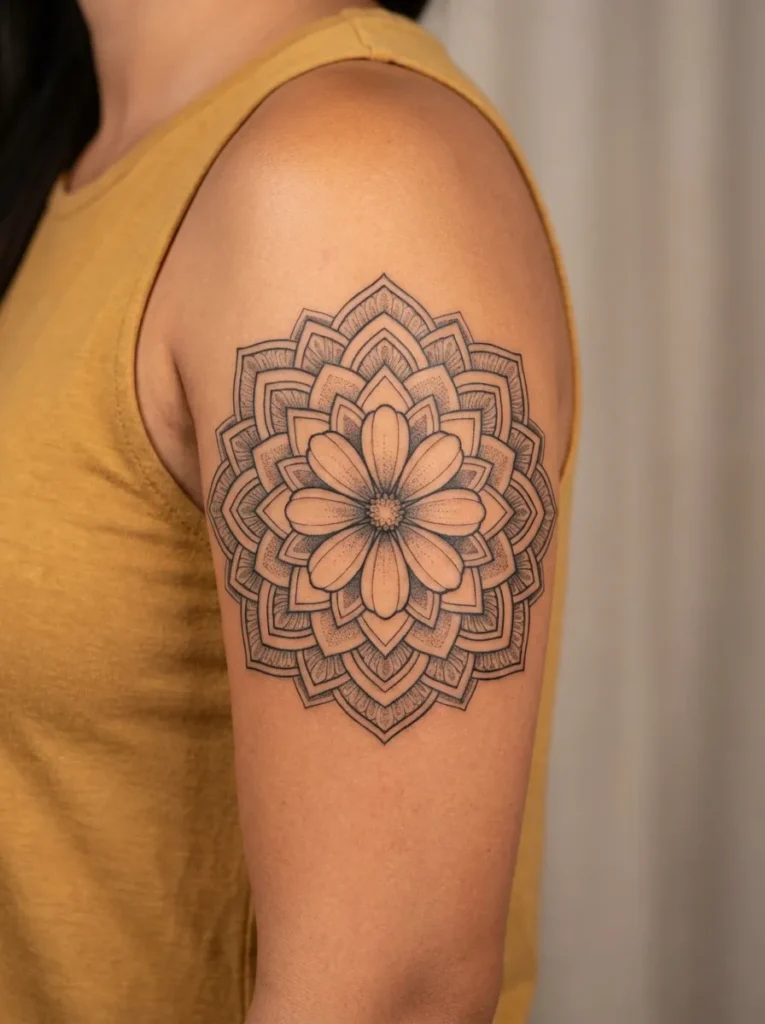
Eight petals, perfectly spaced, radiating from a small central point. The cosmos is already as close to mandala geometry as a flower gets without being a formal geometric pattern.
A cosmos mandala tattoo uses this natural geometric quality as its starting point and extends it outward. More rings of eight-fold symmetry.
Finer geometric detail in the inner rings. The cosmos’s own geometry scaled up and elaborated into a full mandala composition.
The airiness of the cosmos translates into a mandala that feels lighter and more open than most. Less dense, more breath. A mandala with space in it rather than every ring packed with detail.
17. Zinnia Flower Mandala Tattoo
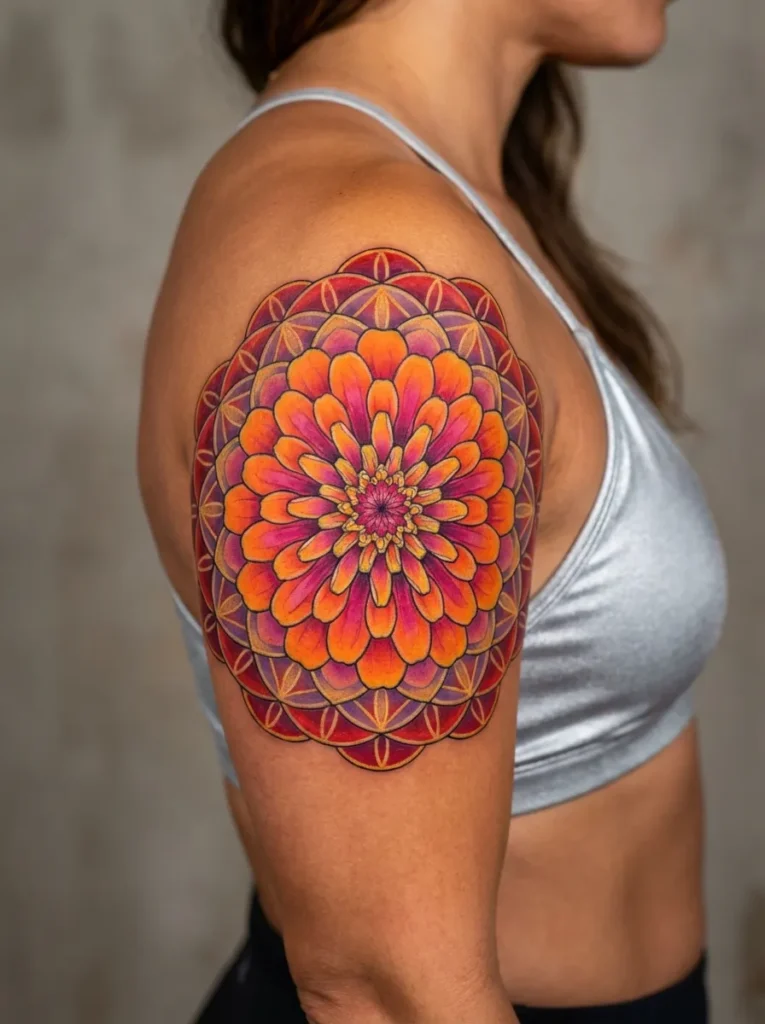
The zinnia’s multiple concentric rings of petals and its strong circular symmetry make it one of the more naturally mandala-ready flowers available. Those rings of petals already read as mandala geometry to eyes looking for pattern.
A zinnia mandala extends the flower’s own concentric structure outward with increasing geometric precision.
Inner rings close to the flower remain botanical. Outer rings become progressively more geometric until the outermost ring is pure sacred geometry.
In vivid color the zinnia mandala is one of the most celebratory floral geometric tattoos possible. Bold, warm, and completely committed to its own joyful energy.
18. Freesia Flower Mandala Tattoo
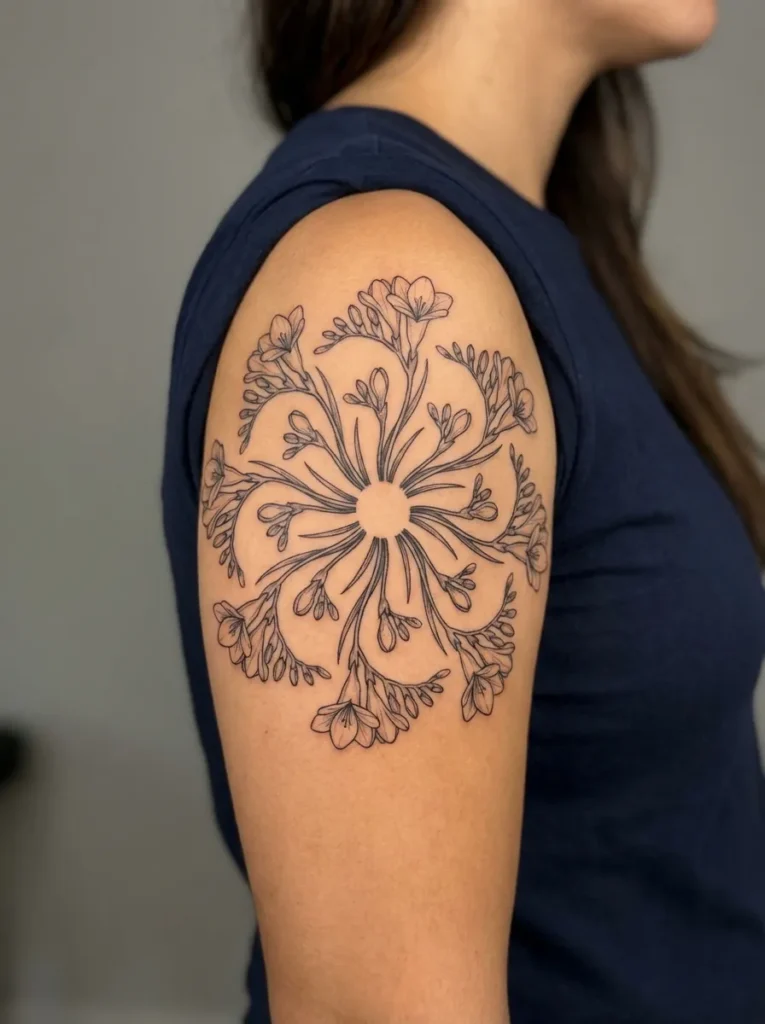
Incorporating freesia into mandala geometry requires creative thinking because the freesia’s natural form is linear rather than radial.
The solution is elegant. Multiple freesia stems arranged around a circular center, each stem curving outward from the central point like rays of a sun.
The sequential blooms along each stem, opening progressively from base to tip, create a sense of movement within the mandala’s static geometry.
Each ring of the mandala corresponds to a different stage of freesia bloom, from tightest bud in the inner rings to fully open flower in the outer rings.
That narrative of opening and growth embedded within geometric structure gives a freesia mandala a quality that most mandala flower designs don’t attempt.
19. Iris Flower Mandala Tattoo
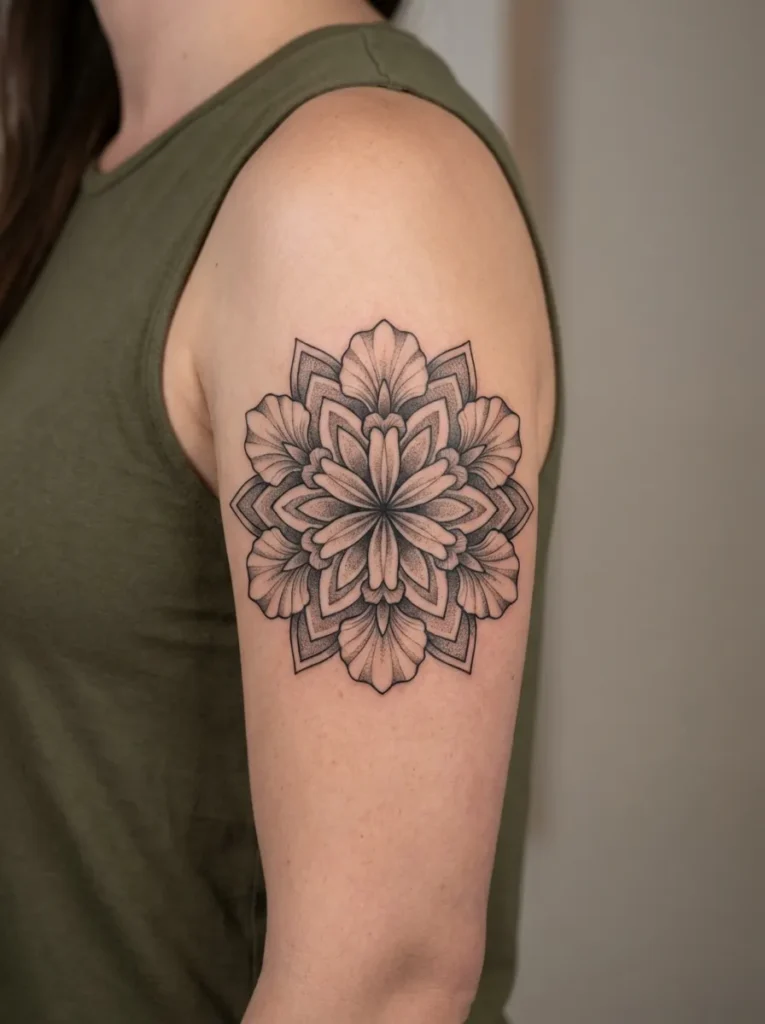
The iris’s complex architecture, standards rising upward, falls drooping downward, creates a flower with genuine three-dimensional structure that mandala geometry must interpret rather than simply repeat.
The approach that works best is to view the iris from directly above and render what that bird’s-eye perspective reveals.
The alternating standards and falls create a six-pointed star pattern from above that translates directly into classic mandala geometry.
That overhead perspective reveals the iris as the geometric form it truly is when viewed from the right angle. The mandala tattoo simply makes that angle permanent and visible.
20. Marigold Flower Mandala Tattoo
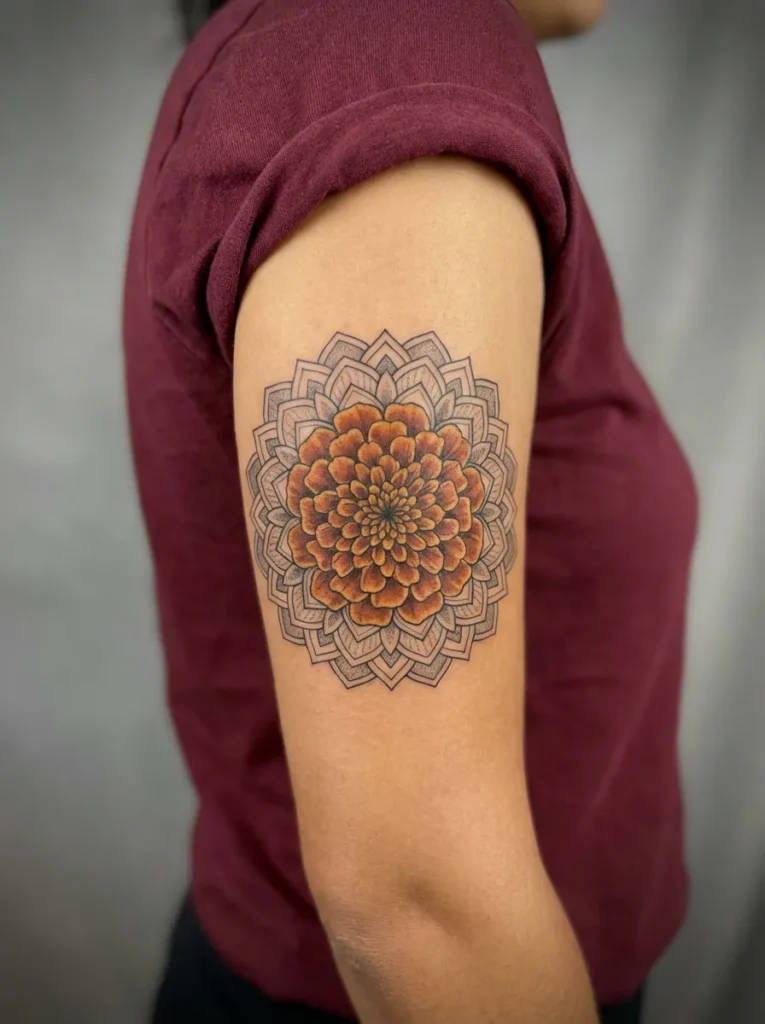
The marigold’s densely packed concentric rings of ray petals are almost indistinguishable from mandala geometry when rendered in fine line.
The flower and the geometric pattern use the same visual vocabulary so completely that integration feels seamless.
A marigold mandala with warm orange and golden color filling the inner botanical rings transitioning to black and gray geometric detail in the outer rings creates a design with genuine color depth and tonal variety.
That warm-to-cool color transition from center to edge mirrors the marigold’s own natural color gradient from deep center to lighter petal tips, extended outward into pure geometric space.
| Ring Zone | Color | Character |
| Center core | Deep burnt orange | Warm, dense, botanical |
| Inner rings | Golden yellow | Transitional, warm |
| Middle rings | Light gray | Shifting from botanical to geometric |
| Outer rings | Pure black linework | Cool, precise, geometric |
21. Plumeria Flower Mandala Tattoo
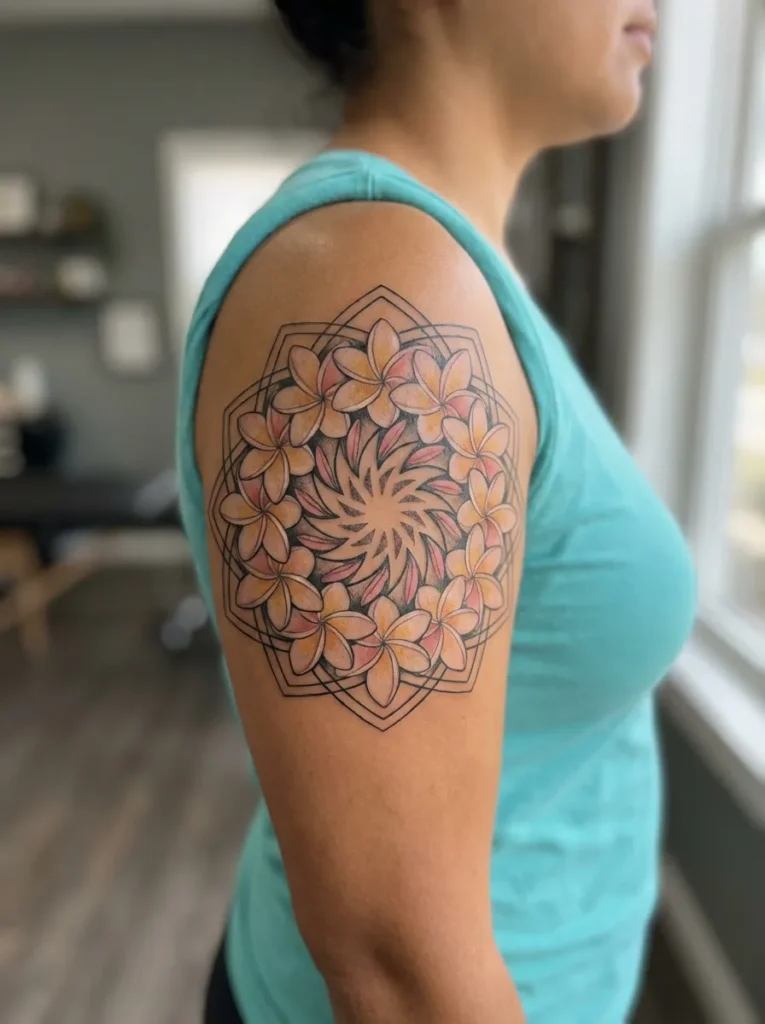
The plumeria’s five smooth petals arranged in a gentle pinwheel create a mandala unit with natural rotational energy.
That slightly spiraling quality of the plumeria arrangement gives a plumeria mandala a sense of movement that more symmetrically static flowers don’t generate.
Multiple plumeria blooms arranged radially, each one’s pinwheel rotation contributing to the overall sense of the whole mandala turning slowly, creates a design that feels genuinely kinetic despite being permanently static.
In tropical colors, warm white, soft yellow, blush pink, against black geometric linework, the plumeria mandala captures the flower’s warmth within geometric precision.
22. Begonia Flower Mandala Tattoo
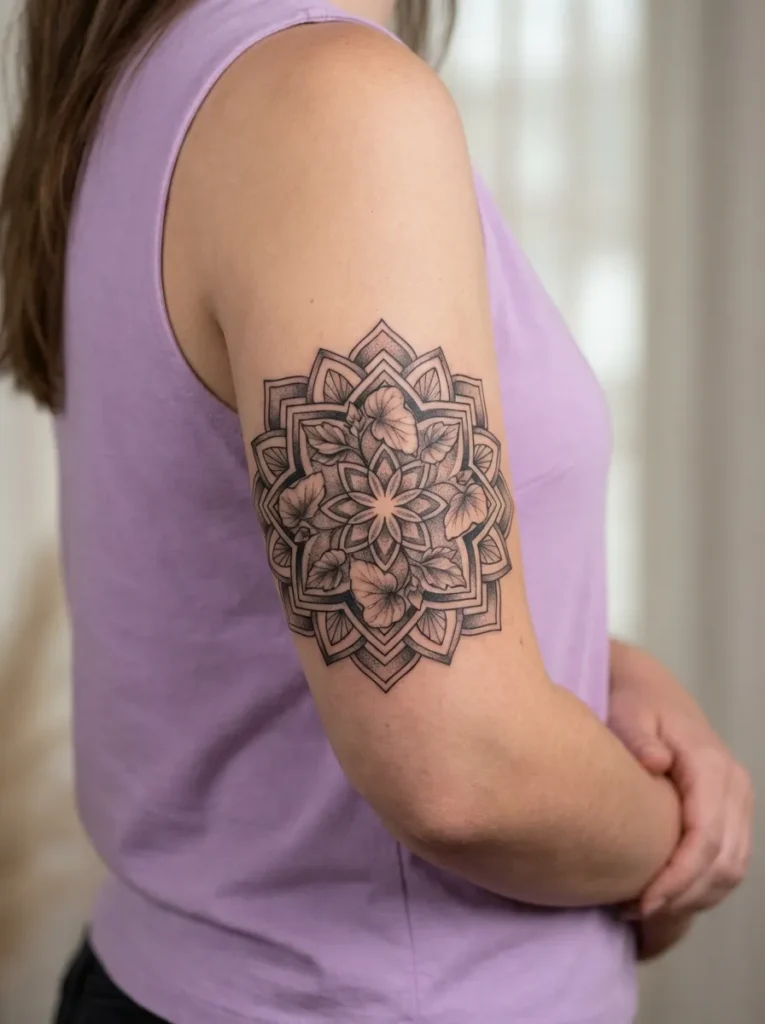
The begonia’s natural asymmetry creates an interesting challenge for mandala integration because mandalas require symmetry as their fundamental principle.
The resolution of that tension is what makes a begonia mandala design genuinely interesting.
The approach is to use begonia petals as decorative elements within a symmetrical mandala framework rather than attempting to make the begonia itself symmetrical.
The mandala provides the geometric order. The begonia petals, slightly varied and organically shaped, provide the natural irregularity that keeps the design from feeling mechanical.
That productive tension between the mandala’s demand for symmetry and the begonia’s natural resistance to it creates a design with more visual interest than either element generates alone.
23. Buttercup Flower Mandala Tattoo
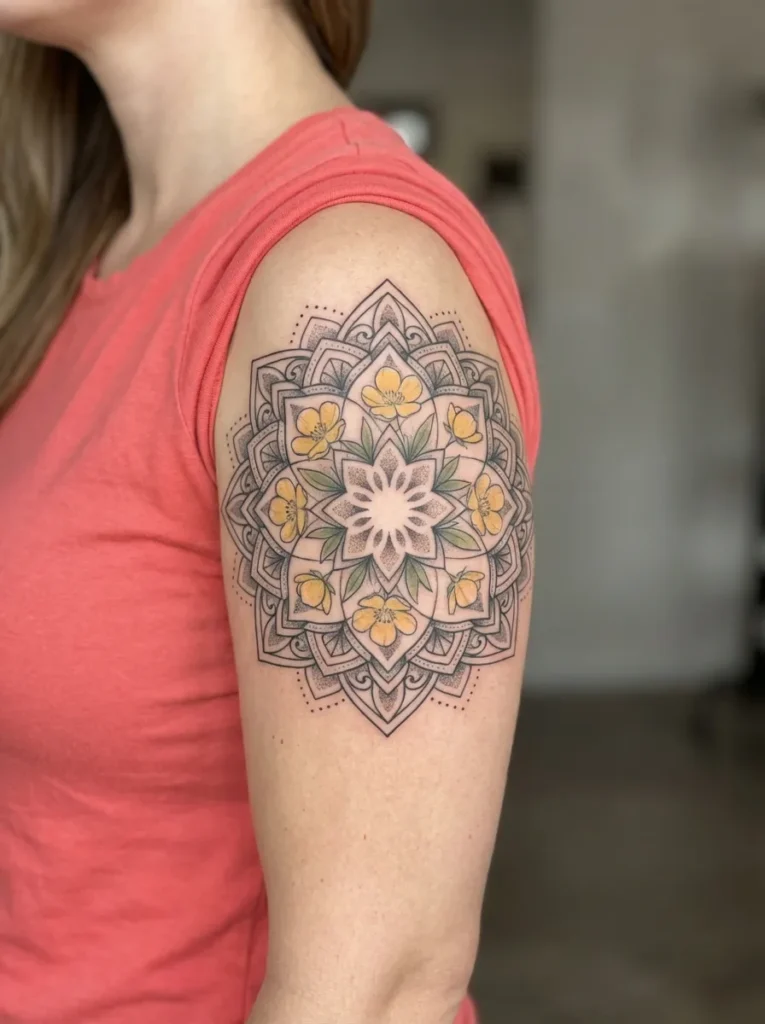
The buttercup might be the most unexpected flower on a mandala list. Small, simple, five yellow petals around a small center. Not an obvious candidate for sacred geometry integration.
That unexpectedness is exactly what makes it interesting. Taking the humblest meadow flower and placing it within the framework of sacred geometric tradition creates a beautiful statement about where significance actually lives.
It’s not in the grand or the impressive or the obviously beautiful. It’s in the small things that most people walk past without stopping.
The buttercup mandala says that the simplest things contain the same geometric truth as the most complex.
Which might be the most profound thing any mandala flower tattoo can say. That beauty and meaning and sacred order exist in everything, from the most intricate dahlia to the smallest buttercup growing through a crack in the pavement. Which flower’s hidden geometry feels most like yours?