
Every culture has its myths. Japan built an entire universe with them.
Gods who created islands from the ocean. Demons who punish the wicked. Fox spirits who shapeshift and deceive. Snow women who haunt blizzards. Serpents with eight heads. These are not bedtime stories. These are the forces that ancient Japan believed shaped every single thing in existence.
Japanese mythology tattoos carry that weight with them. You are not just getting a cool design. You are wearing a story that has been told for over a thousand years.
The depth of meaning in these designs is what separates them from ordinary tattoo choices. Each figure has a history, a personality, a set of powers, and a reason why people have revered or feared them across centuries.
These 21 Japanese mythology tattoos bring those legendary figures to life on skin. Every single one of them has a story worth knowing before the needle ever touches you.
1. Japanese Ryū Dragon Mythology Tattoo
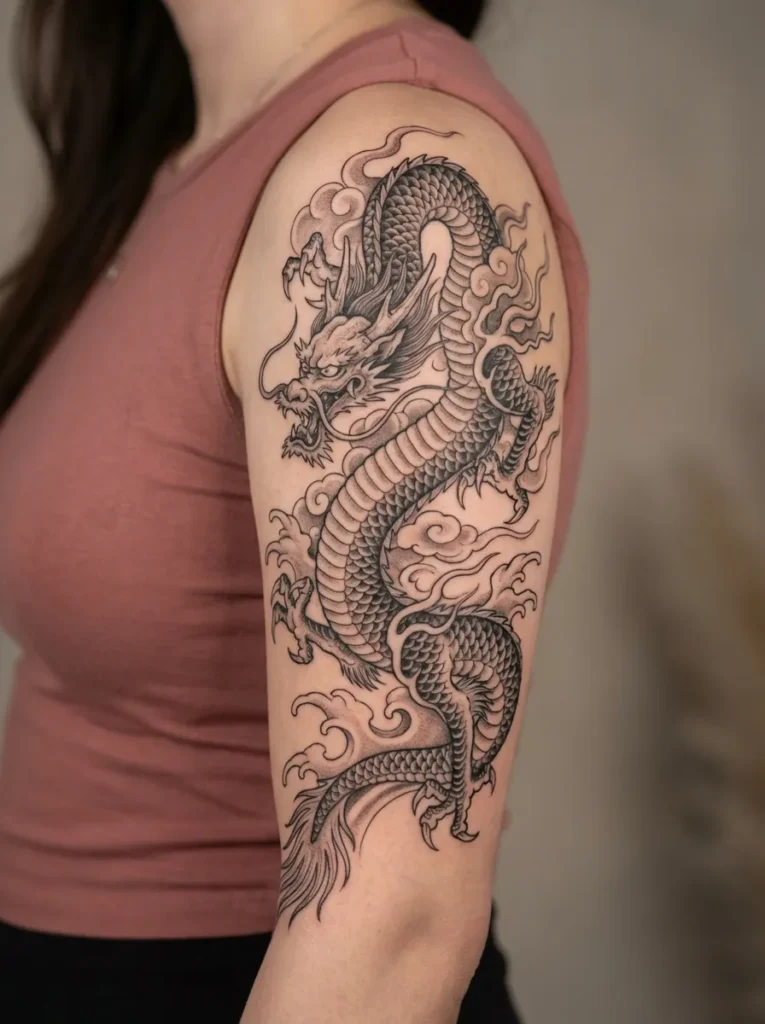
The Ryū is not the fire-breathing, castle-destroying dragon of Western mythology. The Japanese dragon is a water deity. A bringer of rain, a guardian of rivers and seas, and a symbol of wisdom and imperial power.
It is long, serpentine, and moves through clouds and water rather than flying over them. It does not destroy. It governs.
In Japanese mythology, dragons lived at the bottom of the sea in palaces called Ryūgū-jō. The Dragon King, Ryūjin, controlled the tides with magical jewels. The Ryū tattoo connects directly to that sovereign, elemental power.
Five-clawed dragons traditionally represented the emperor and divine authority. Three-clawed versions were for warriors and nobility. That distinction still carries meaning in tattoo culture today.
2. Japanese Hō-ō Phoenix Legend Tattoo
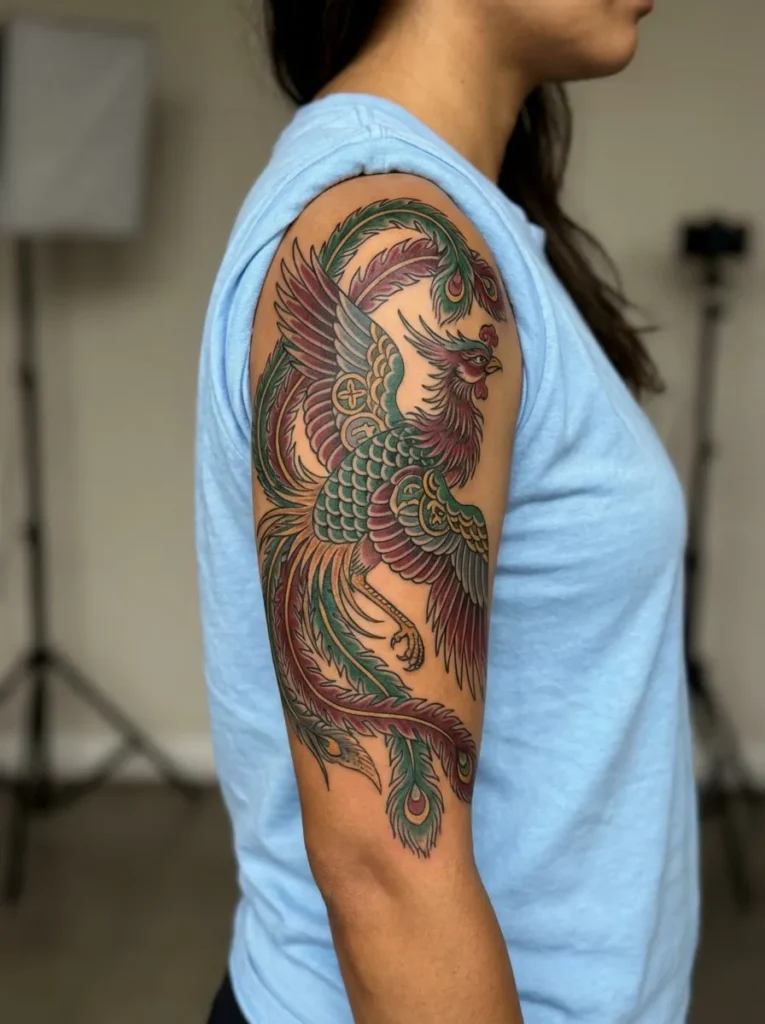
The Hō-ō appears only during the reign of a virtuous ruler and disappears when a corrupt one takes power. Its very presence is a sign that the world is in balance.
Unlike the Western phoenix, the Hō-ō does not die and rise from ash. It is eternal, perfect, and incorruptible. It feeds only on bamboo seeds and drinks only from sacred springs. Nothing impure can touch it.
It represents the virtues of the sun, the sky, wind, fire, and the south. Its body parts each carry their own symbolic meaning across its feathers, wings, and tail.
As a tattoo, the Hō-ō is a declaration of integrity and moral strength. You are not just wearing a beautiful bird. You are wearing the embodiment of a world in righteous order.
3. Japanese Oni Demon Folklore Tattoo
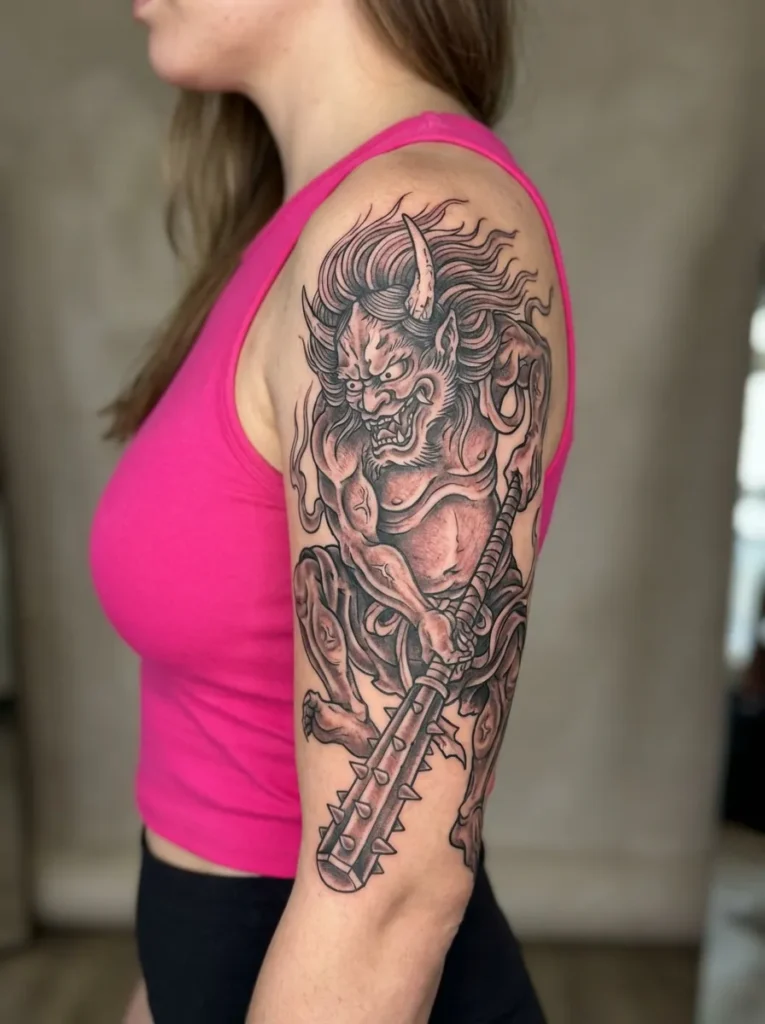
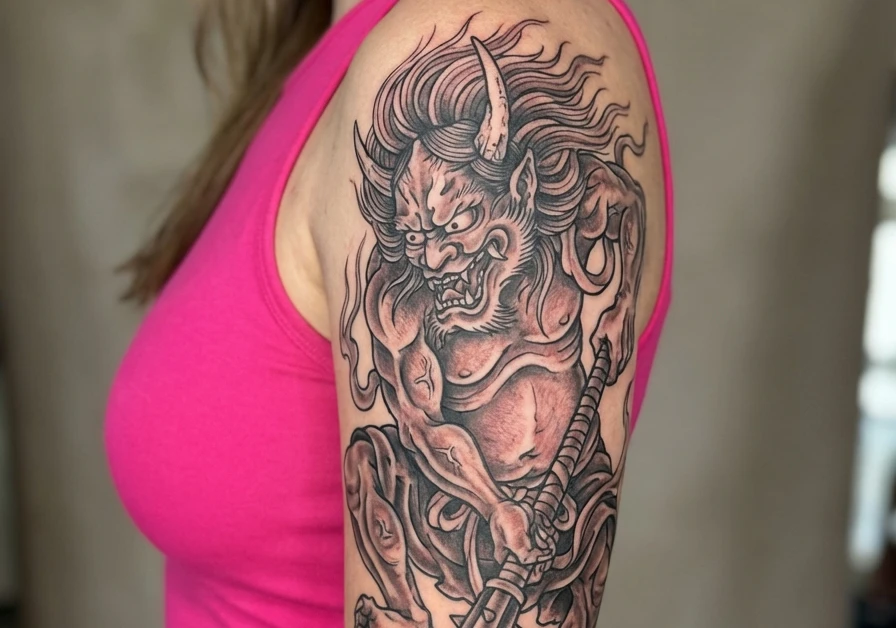
The Oni is the most recognizable demon in Japanese folklore. Massive, horned, wild-haired, and carrying an iron club called a kanabō. They are the enforcers of divine punishment in the underworld.
Emma-ō, the Japanese god of death, commands armies of Oni to judge and punish the souls of sinners. They are terrifying precisely because they represent justice in its most uncompromising form.
But the Oni is layered. During Setsubun, the Japanese bean-throwing festival, people shout “Oni wa soto” to drive them out. Yet some Oni protect shrines, guard temples, and ward off evil spirits. They are simultaneously feared and relied upon.
A tattoo of the Oni carries that duality. Protection wearing the face of something terrifying. A guardian that looks like the thing it is keeping away.
4. Japanese Tengu Warrior Spirit Tattoo
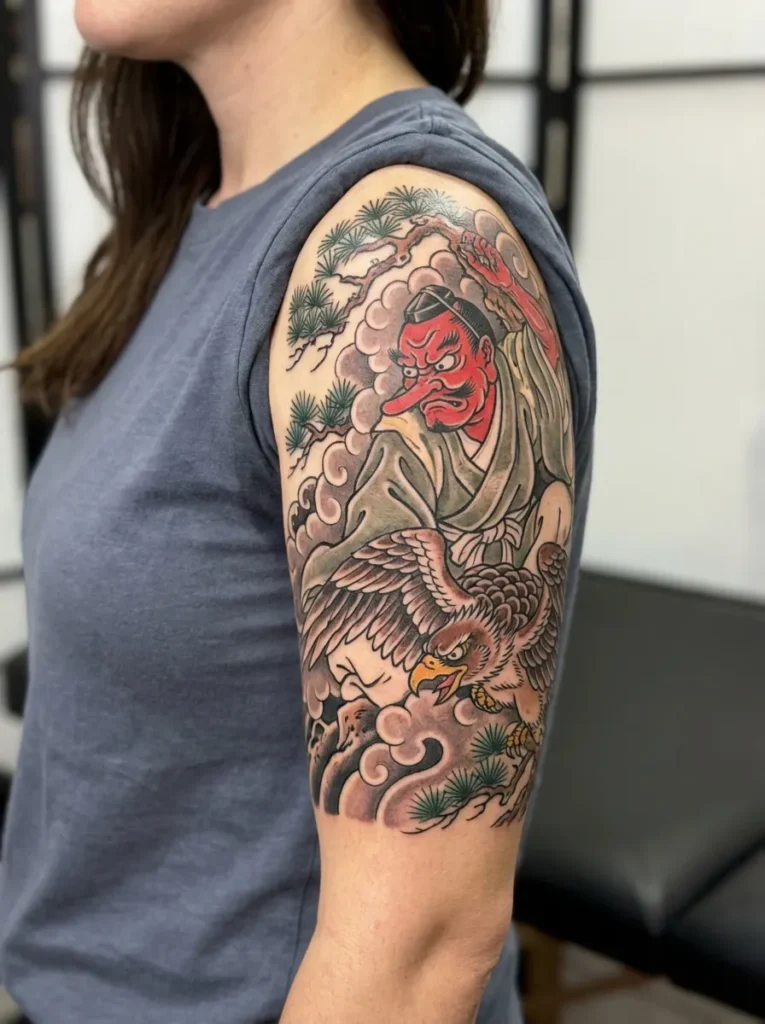
The Tengu is one of the most complex and fascinating figures in Japanese mythology. Part human, part bird, and entirely its own thing.
Early depictions showed the Tengu as monstrous birds of prey. Over centuries they evolved into something more refined. Long-nosed, red-faced Dai-Tengu dressed in mountain hermit robes. Winged Ko-Tengu with sharp beaks and feathered bodies. Each type carrying different powers and personality.
Tengu were the great warrior trainers of legend. Ushiwakamaru, who would become the legendary warrior Minamoto no Yoshitsune, was said to have learned swordsmanship from Tengu masters in the mountains.
- The Dai-Tengu represents wisdom, mastery, and the teaching of martial arts
- The Ko-Tengu represents wild, chaotic supernatural energy
- Both versions are associated with mountainous forest regions and spiritual power
A Tengu tattoo honors the tradition of disciplined mastery and the supernatural edge that separates great warriors from ordinary ones.
5. Japanese Kitsune Yokai Tattoo
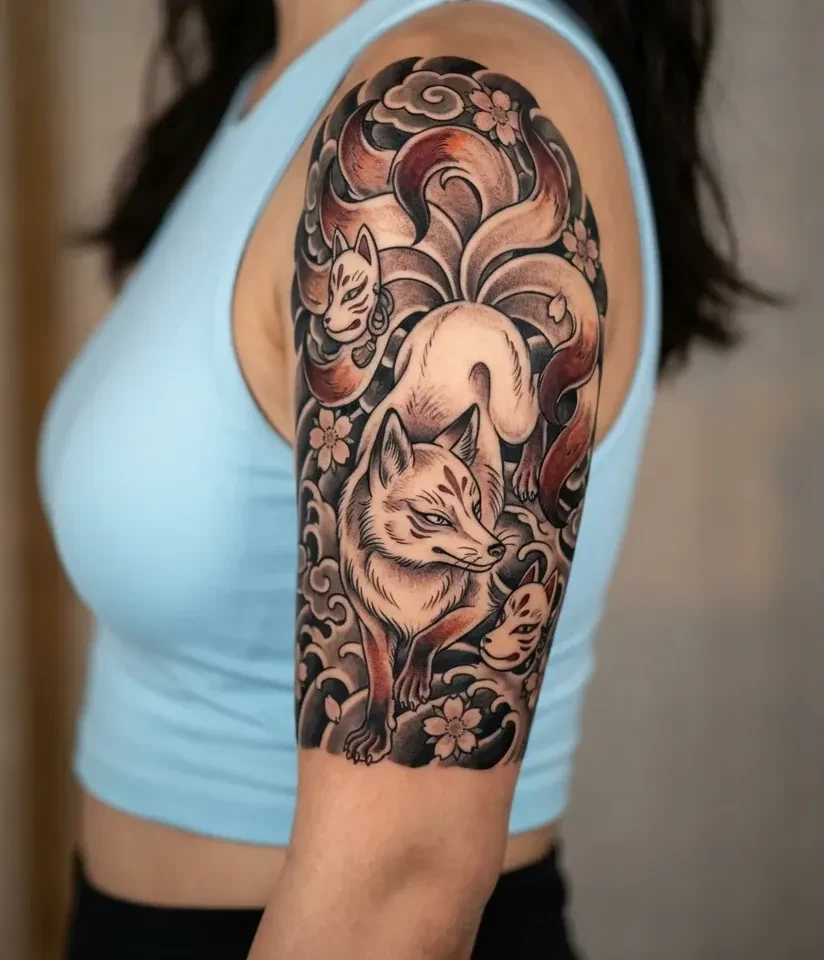
The Kitsune is a fox spirit and one of the most beloved and feared Yokai in all of Japanese mythology. It is intelligent beyond measure, capable of shapeshifting, illusion casting, and seeing into the hearts of humans.
Fox spirits gain a new tail for every hundred years they live. A nine-tailed Kitsune is divine, essentially a god, and serves as a messenger of Inari, the Shinto deity of rice, foxes, and prosperity.
The Kitsune can be a trickster or a devoted companion depending entirely on how it is treated. Stories of Kitsune taking human form and living as wives and scholars are woven throughout Japanese literature.
What makes the Kitsune tattoo so compelling is the ambiguity. Is it protecting you or testing you? Is it loyal or planning something three moves ahead? That uncertainty is exactly what makes it legendary.
6. Japanese Raijin Thunder God Tattoo
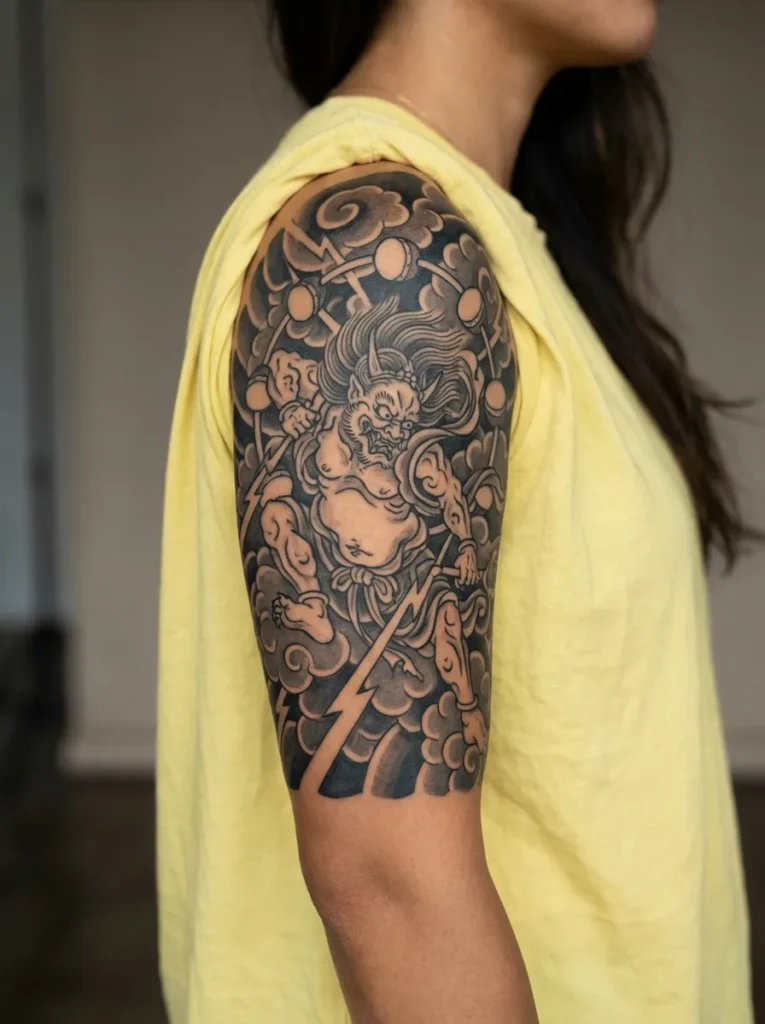
Raijin was born from the corpse of Izanami in the underworld. He emerged as chaos personified, a demon-like god with wild hair, a ring of drums surrounding him, and an insatiable need to make the sky break open.
He is not a calm or distant deity. Raijin is primal energy given divine authority. He beats his drums and the thunder rolls across the entire world.
In some regional Japanese traditions, children were told to hide their navels during storms because Raijin would eat them. That specific, wild, almost playful ferocity is part of what makes him so compelling as both a mythological figure and a tattoo subject.
Paired with Fūjin, his eternal companion, Raijin has appeared in Japanese art for over a thousand years. A Raijin tattoo connects you to all of that iconographic history in one powerful image.
7. Japanese Fūjin Wind God Tattoo
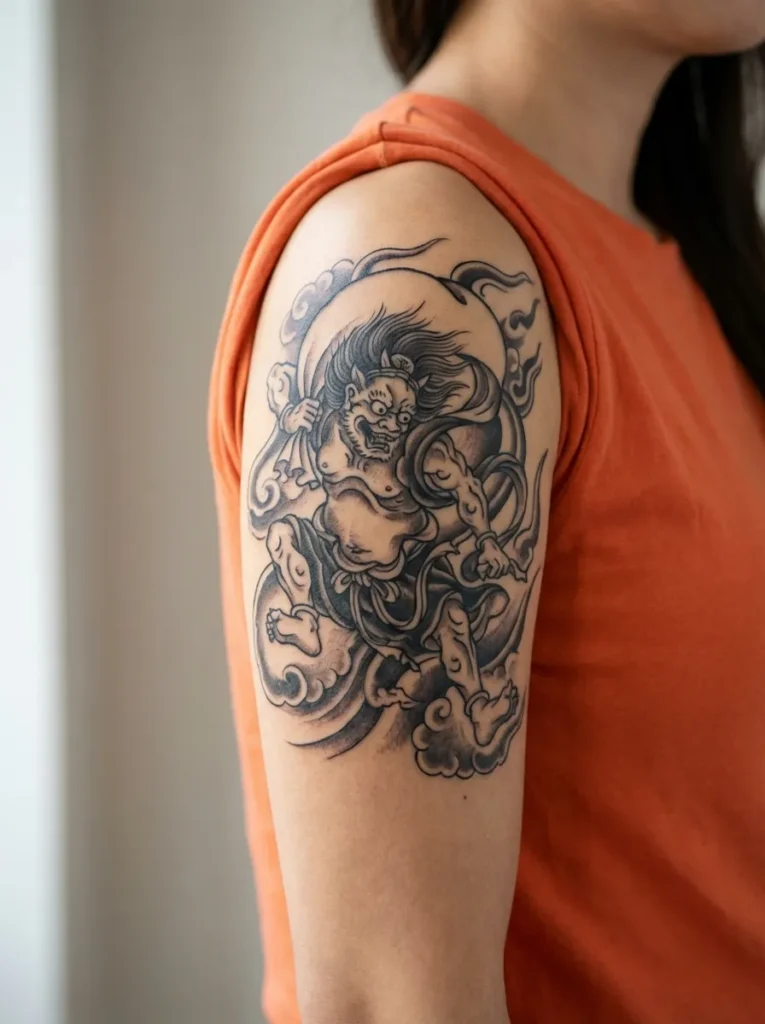
Fūjin predates the current age of Japanese gods. He was present at the very creation of the world, releasing the winds from his bag to clear the primordial mist and let light into existence for the first time.
He carries that bag on his shoulders always, a dark sack of winds that he releases to move clouds, push rain, and shape the weather across the entire world.
Fūjin is usually depicted mid-leap, robes flying, hair wild, eyes wide, completely consumed by the chaos he controls. He is not serene. He is perpetual motion.
The partnership between Fūjin and Raijin is one of the oldest visual relationships in Japanese religious art. They appear together at the entrance of temples across Japan as cosmic gatekeepers. A Fūjin tattoo carries all of that ancient protective energy.
8. Japanese Amaterasu Sun Goddess Tattoo
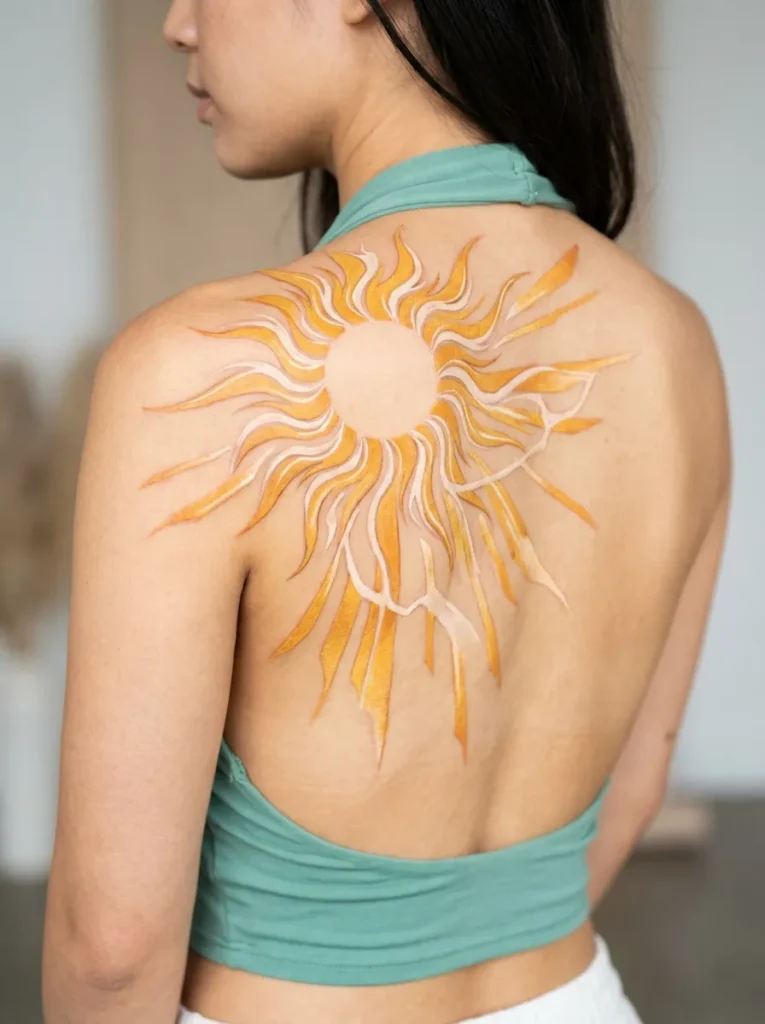
Amaterasu is the most important deity in the entire Shinto pantheon. The goddess of the sun and the universe. The divine ancestor of the Japanese imperial family. The reason the world has light.
Her mythology is extraordinary. When her brother Susanoo’s destructive rampages became unbearable, Amaterasu retreated into a cave and plunged the entire world into darkness. The other gods had to create a massive celebration outside the cave, so joyful and loud that curiosity drew her back out. Light returned to the world.
That story alone, of a goddess so powerful that her withdrawal meant the end of light, captures something true about what the sun means to life on earth.
As a tattoo, Amaterasu is rendered in blazing gold and white, radiating light from every edge of the composition. A divine feminine figure surrounded by pure radiant energy. There is nothing else in Japanese mythology that carries this scale of cosmic importance.
9. Japanese Susanoo Storm God Tattoo
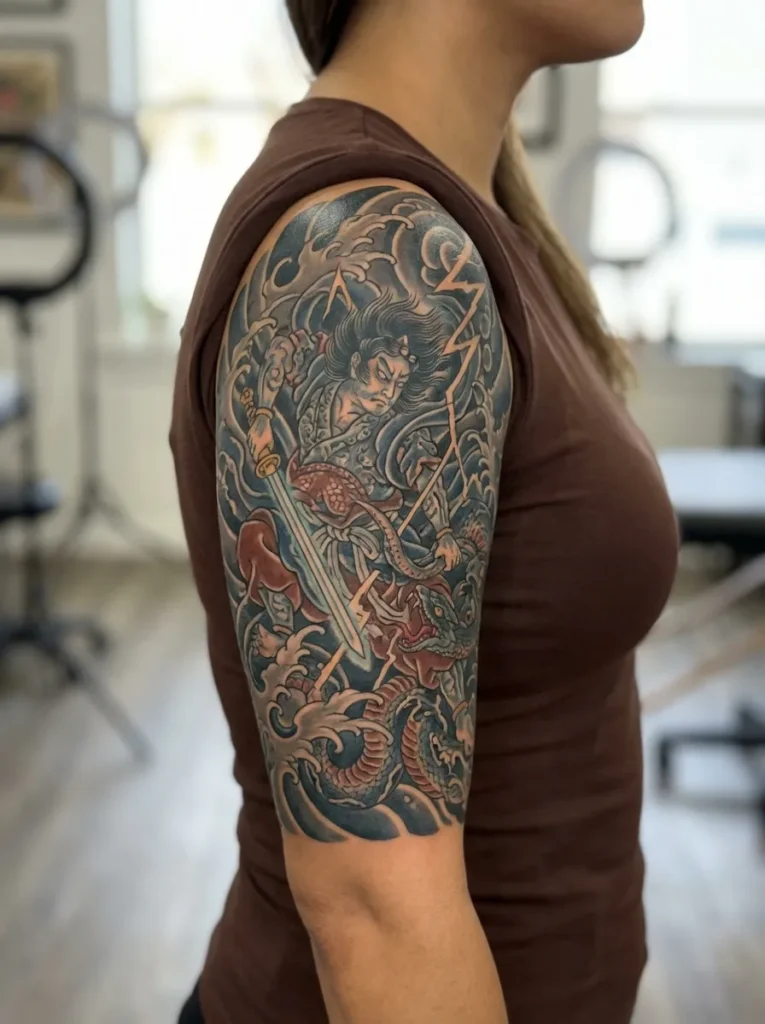
Susanoo is the storm. Not a god who controls storms from a distance but a god who is the storm, the ocean wind, the devastating force of nature at its most uncontrollable.
He was born from the nose of Izanagi and immediately began weeping so intensely for his dead mother that the seas churned, mountains shook, and rivers dried up. He was eventually banished from heaven for the destruction his grief caused.
But Susanoo also slew the eight-headed serpent Yamata no Orochi to save a young woman named Kushinadahime. Inside one of the serpent’s tails he found the legendary sword Kusanagi, one of the three imperial treasures of Japan.
He is flawed, emotional, destructive, and heroic all in one figure. A Susanoo tattoo embraces the full complexity of a god who causes devastation and performs miracles in the same lifetime.
10. Japanese Tsukuyomi Moon God Tattoo
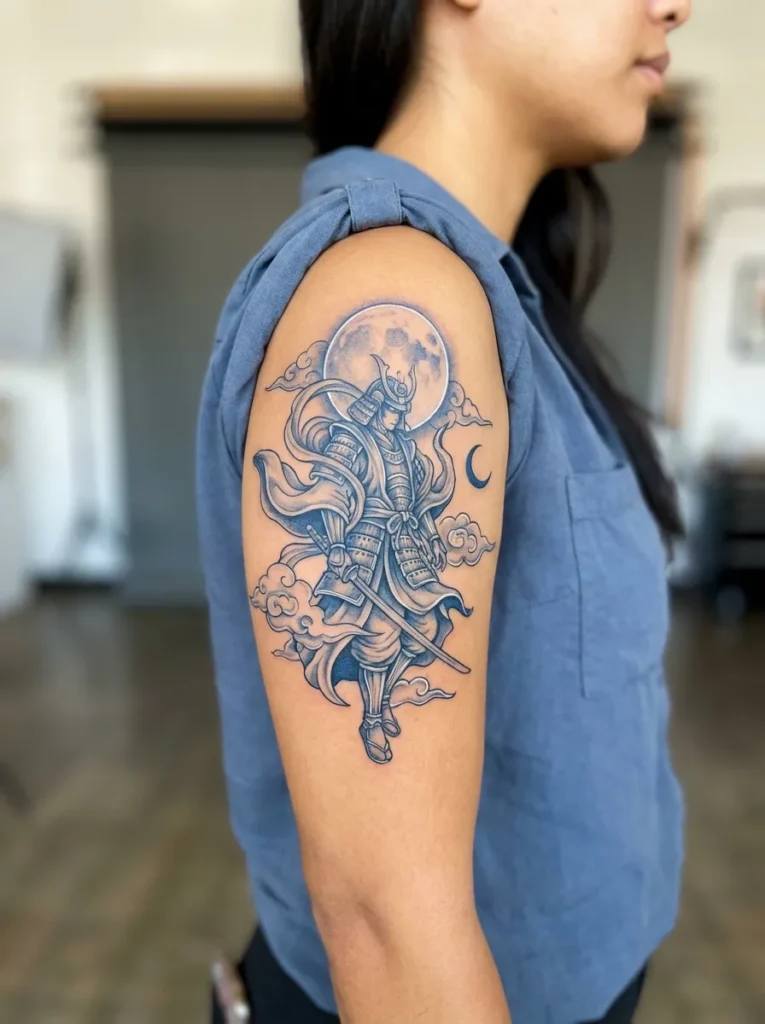
Tsukuyomi is the god of the moon and one of the most isolated figures in all of Japanese mythology. Born from Izanagi’s right eye, he was assigned to rule the night sky alongside Amaterasu in the day.
Their separation is legendary. Tsukuyomi killed Uke Mochi, the food goddess, because he found her method of producing food disgusting. Amaterasu was so appalled by his violence that she declared she would never look upon him again. That is why the sun and moon never appear in the sky together.
That mythology gives Tsukuyomi an extraordinary quality as a tattoo subject. He is powerful, isolated, and permanently separated from the one he was meant to exist beside. There is something deeply melancholic and beautiful in that.
Rendered in silver and deep blue with a full moon as the halo behind him, a Tsukuyomi tattoo is hauntingly beautiful and carries a loneliness that resonates with a lot of people on a very personal level.
11. Japanese Jizō Bosatsu Protector Tattoo
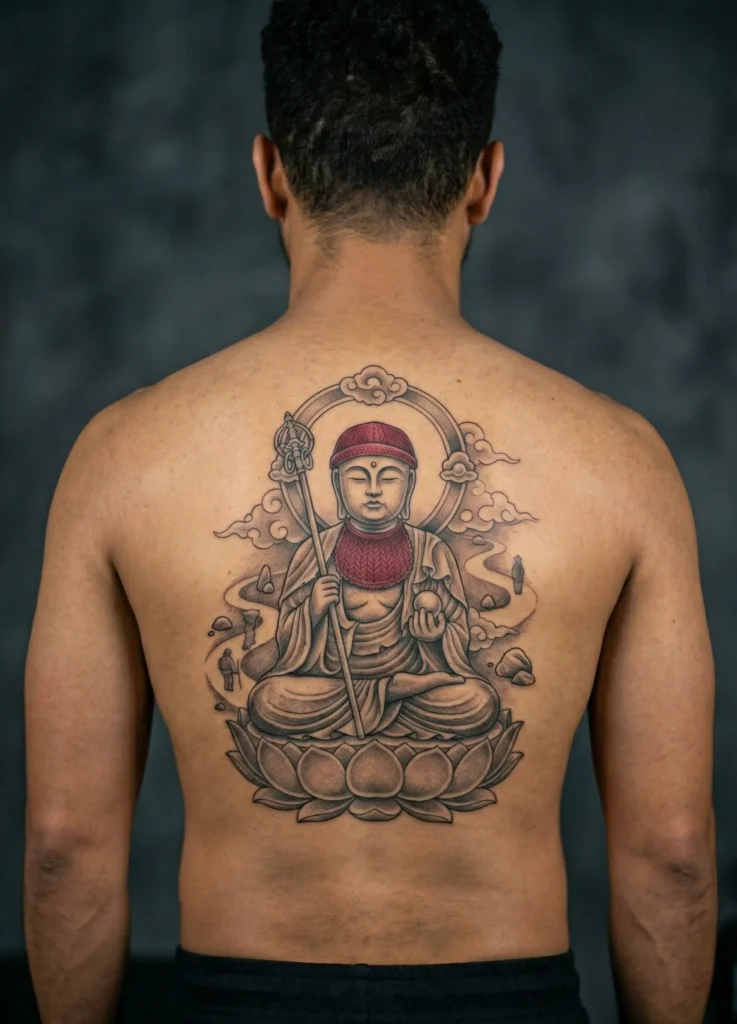
Jizō is the most beloved and gentle figure in Japanese Buddhist mythology. He is the protector of travelers, children, and the souls of the dead, especially children who die before their parents.
Small stone Jizō statues wearing red bibs are found all across Japan, in cemeteries, at roadsides, and at mountain passes. People dress them in little hats and scarves to keep them warm. The tenderness of that practice tells you everything about how deeply Jizō is loved.
He travels through all six realms of existence, including hell itself, to save suffering souls. He made a vow to refuse his own Buddhahood until all beings are liberated from suffering. That is an act of compassion so enormous it is almost impossible to fully comprehend.
A Jizō tattoo is one of the most spiritually earnest choices in Japanese mythology tattooing. It is soft, deeply meaningful, and often chosen by people who have lost someone they love.
12. Japanese Fudō Myōō Deity Tattoo
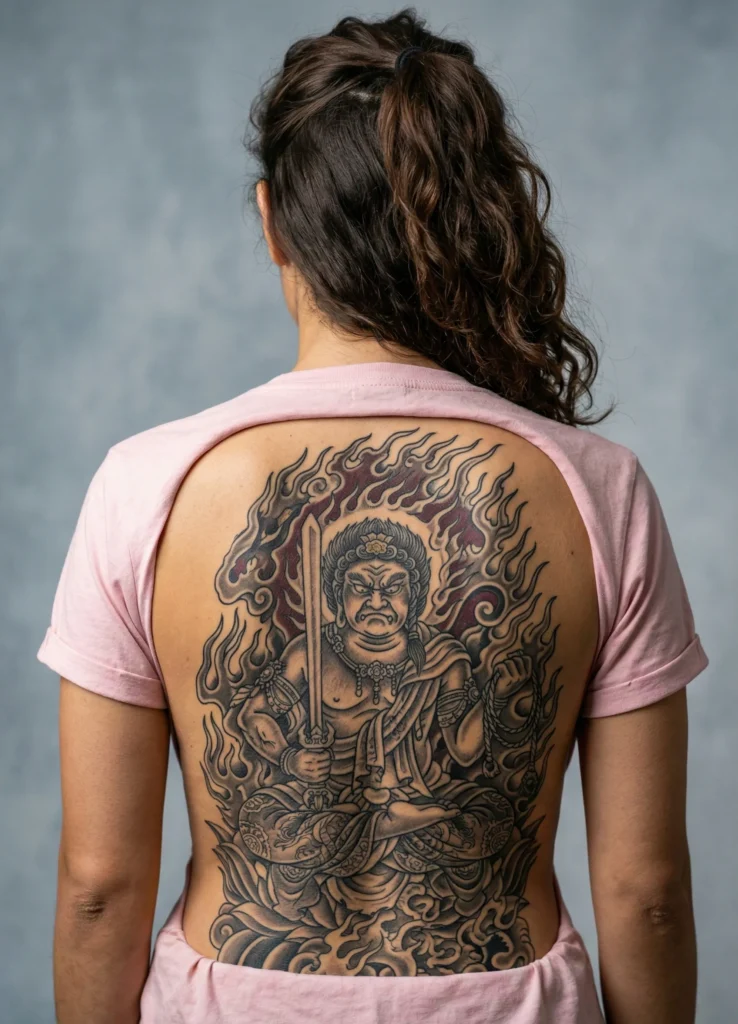
Fudō Myōō is the Immovable King, the wrathful manifestation of the cosmic Buddha Dainichi Nyorai. He sits in the flames of divine wisdom, holding a sword to cut through ignorance and a rope to bind evil.
His fearsome face, with fangs, bulging eyes, and an expression of total focused fury, is a face of compassion wearing the mask of terror. He is terrifying so that evil is terrified. His wrath is entirely in service of protection.
Devotees of Fudō Myōō include samurai, martial artists, and anyone who needs the strength to hold an immovable position against overwhelming pressure. He is the tattoo of absolute will.
The Karura flame that surrounds him represents the burning away of greed, anger, and ignorance. In black and grey those flames feel like consuming shadow. In color they look like a world on fire with divine purpose.
13. Japanese Kirin Sacred Beast Tattoo
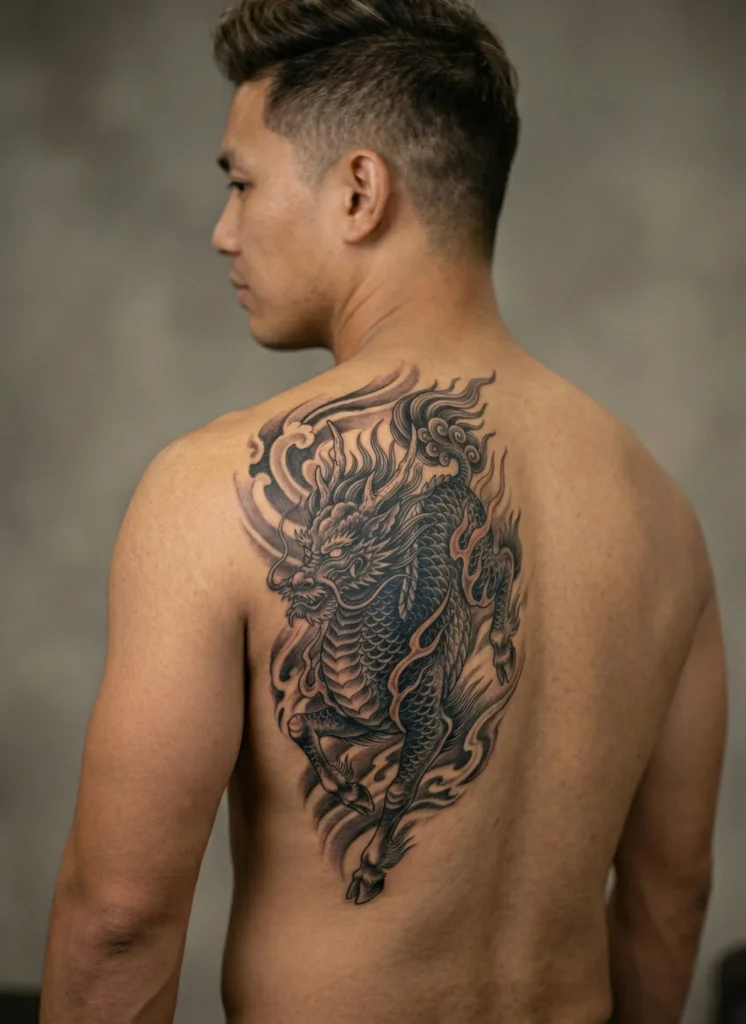
The Kirin is one of the four sacred beasts of East Asian mythology alongside the dragon, the phoenix, and the tortoise. It only appears when a truly benevolent ruler governs the land or when a great sage is born into the world.
Its body combines elements of a deer, a dragon, fish scales, ox hooves, and flames. It walks so gently that it does not bend a single blade of grass or harm any living creature beneath its feet. It eats only plants that have died naturally.
When Confucius’s mother is said to have encountered a Kirin before his birth, it deposited a jade tablet at her feet predicting the arrival of a great sage. The Kirin as a birth omen of genius and moral greatness appears repeatedly throughout East Asian historical mythology.
Seeing a Kirin was considered the single greatest omen of fortune possible. A Kirin tattoo carries that blessing with it, quietly and without announcement, like the creature itself.
14. Japanese Nekomata Mythical Cat Tattoo
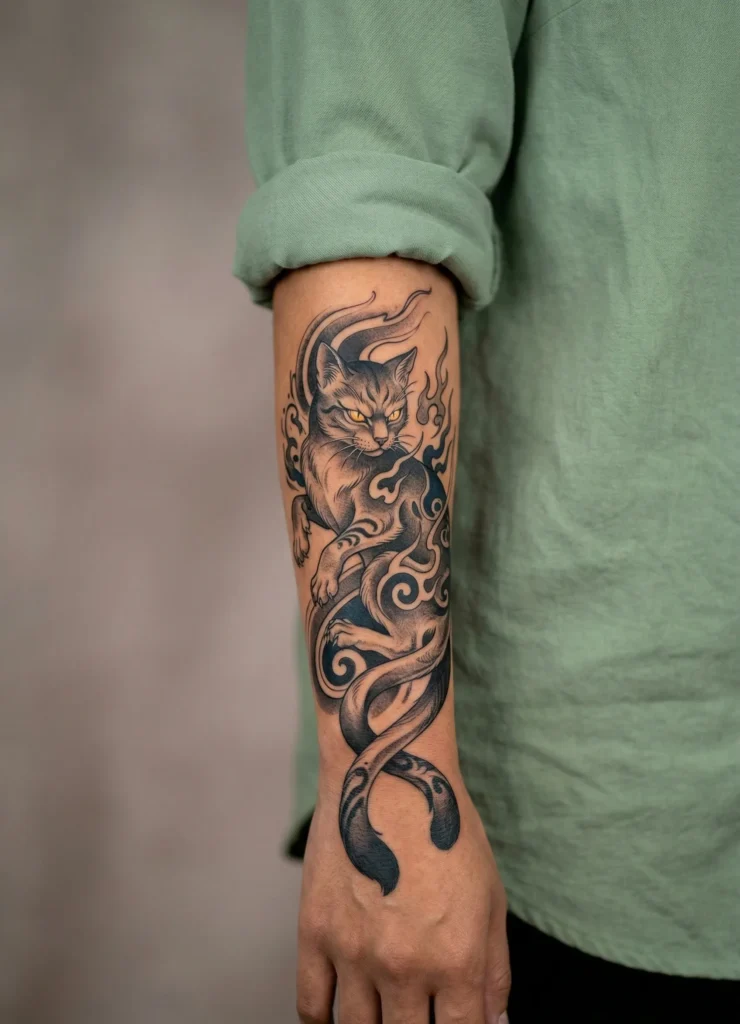
The Nekomata is what an ordinary house cat becomes after living long enough to accumulate supernatural power. When a cat’s tail splits into two, it has crossed the threshold into Yokai territory.
Ancient Nekomata could shapeshift into human form, speak human language, control the bodies of the dead, and curse those who mistreated cats in life. They were feared and respected in equal measure.
There is something darkly poetic about the Nekomata mythology. The idea that animals accumulate spiritual power over time, that mistreating something seemingly small and ordinary might come back to you in the most supernatural way possible.
The Nekomata tattoo sits at the intersection of cute and terrifying. Two tails, glowing eyes, a body caught between cat and something far older and stranger. It is the Yokai for people who understand that the most unsettling things often wear the most innocent faces.
15. Japanese Orochi Serpent Legend Tattoo
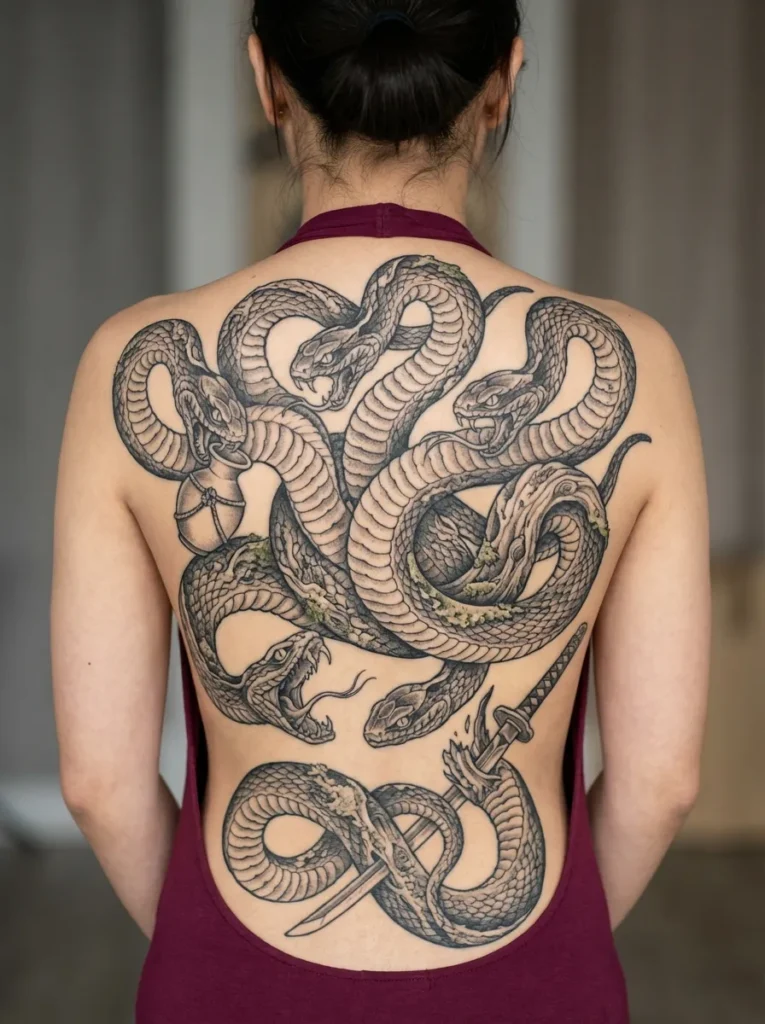
Yamata no Orochi is the eight-headed, eight-tailed serpent of Japanese mythology. Its body was so enormous that moss and trees grew on its back. Its belly was always stained with blood.
Every year it demanded a young woman as a sacrifice from a family that had already lost seven daughters to its appetite. When the storm god Susanoo arrived, he devised a plan. He brewed eight vats of sake and placed them where the serpent would find them. Orochi drank from all eight vats with all eight heads and fell into a stupor. Susanoo then cut the serpent into pieces and found the legendary Kusanagi sword hidden inside one of its tails.
The Orochi tattoo is one of the most dramatic and compositionally complex designs in all of Japanese mythology tattooing. Eight heads require a backpiece or full sleeve to do them justice.
It is a symbol of overwhelming, ancient evil and the courage required to face something that seems absolutely impossible to defeat.
16. Japanese Kappa Water Spirit Tattoo
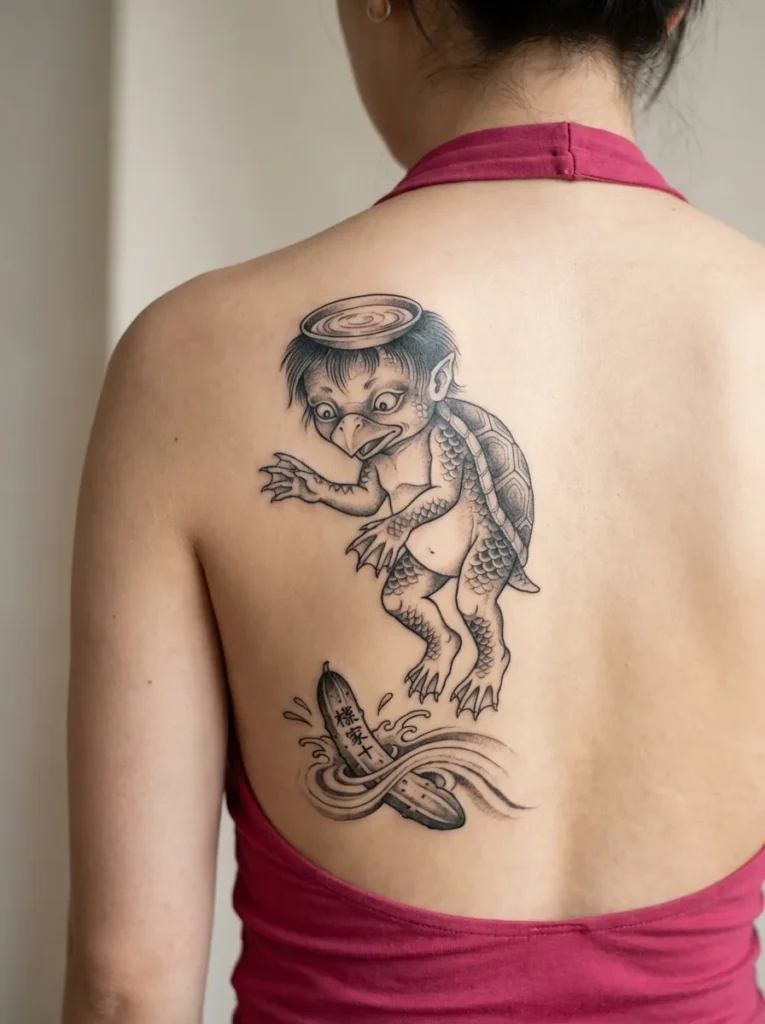
The Kappa is one of the most distinctly Japanese Yokai in existence. A water creature roughly the size of a child with a turtle shell on its back, scaled or slimy green skin, webbed hands and feet, a beak, and a dish of water on top of its head that is the source of its supernatural power.
If the dish dries out, the Kappa loses its power entirely. This weakness is embedded in Japanese folk custom. If you encounter a Kappa and bow, it will bow back out of courtesy, spilling the water from its dish and becoming helpless.
The Kappa straddles the line between dangerous water predator and comically rule-bound creature. It is said to love cucumbers so much that writing a family name on a cucumber and tossing it into a river would earn that family the Kappa’s protection forever.
As a tattoo the Kappa is a uniquely Japanese subject with a sense of humor beneath its supernatural danger. It rewards people who know their mythology.
17. Japanese Yuki-Onna Snow Spirit Tattoo
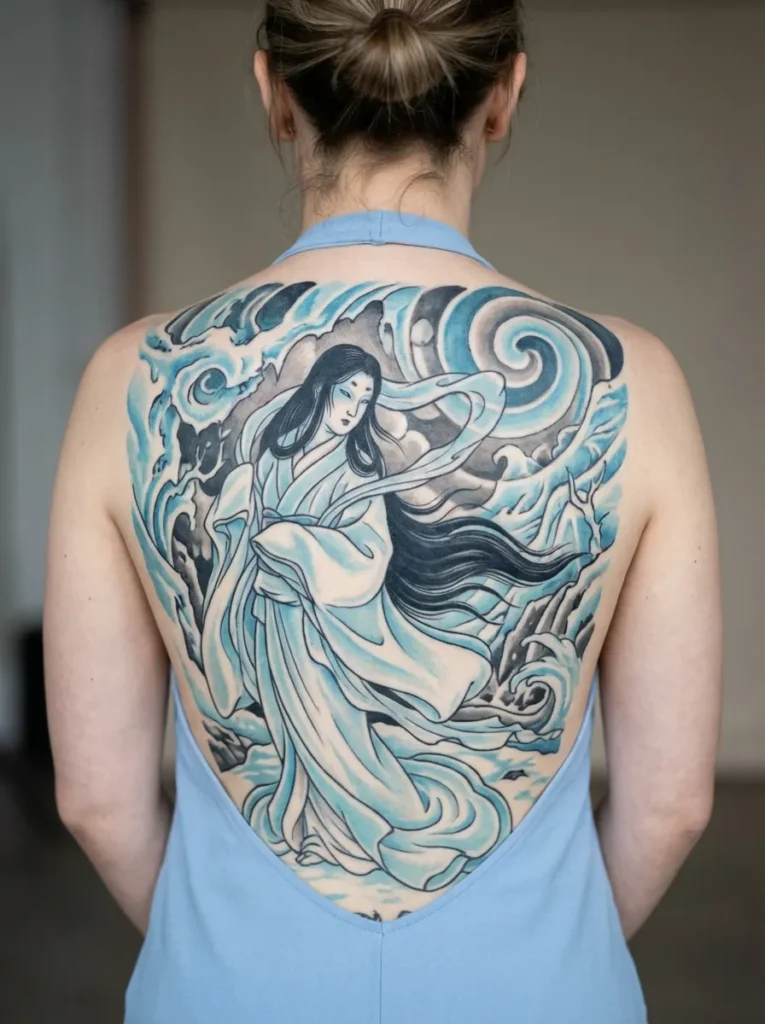
Yuki-Onna is the snow woman. She appears during blizzards, beautiful and otherworldly, with skin as white as snow, long black hair, and pale blue or white kimono. Her breath is ice. Her touch is death.
Her mythology varies across different regions of Japan. In some stories she is purely deadly, freezing travelers who encounter her in snowstorms and draining their life force. In others she spares a young man and falls in love with him, living as his wife and bearing his children before ultimately vanishing back into the winter when he breaks his promise not to speak of her.
That version of the story is the most haunting. The idea of a supernatural being choosing love and ordinary human life, knowing all along how it must end.
A Yuki-Onna tattoo is one of the most visually striking in all of Japanese mythology. Ice blue and white against black hair and a pale kimono against a winter landscape. Achingly beautiful and completely deadly.
18. Japanese Izanagi Creator God Tattoo
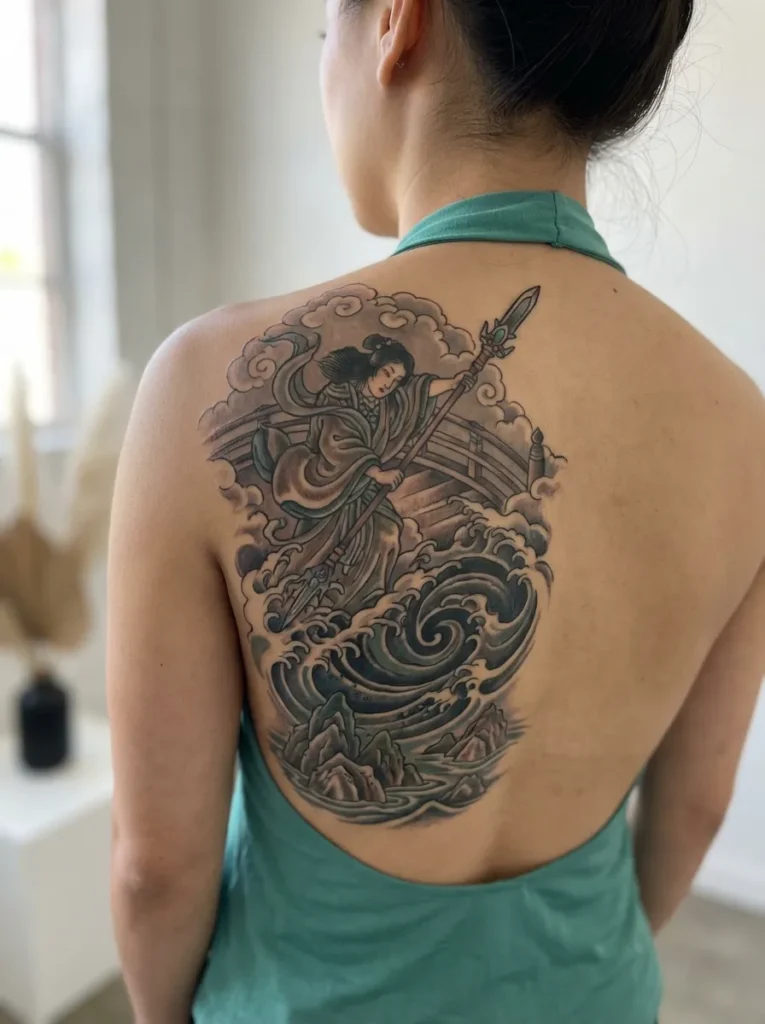
Izanagi is one half of the divine couple who created the Japanese islands and the Shinto pantheon. He and Izanami stirred the ocean with a jeweled spear from the Bridge of Heaven and the drops that fell created the first land.
His mythology takes its most dramatic turn after Izanami dies in childbirth. Izanagi descends into the underworld, Yomi, to bring her back. What he finds there destroys him. Her body is rotting, filled with thunder demons, and she is furious that he looked upon her in her death state.
He flees Yomi and blocks the entrance with an enormous boulder, severing the world of the living from the world of the dead. He then purifies himself in a river, and from that purification ritual, washing his left eye, his right eye, and his nose, Amaterasu, Tsukuyomi, and Susanoo are born.
A creator god who also witnessed the horror of death and sealed off the underworld is a figure of extraordinary mythological weight. An Izanagi tattoo carries the weight of creation and loss in equal measure.
19. Japanese Izanami Underworld Goddess Tattoo
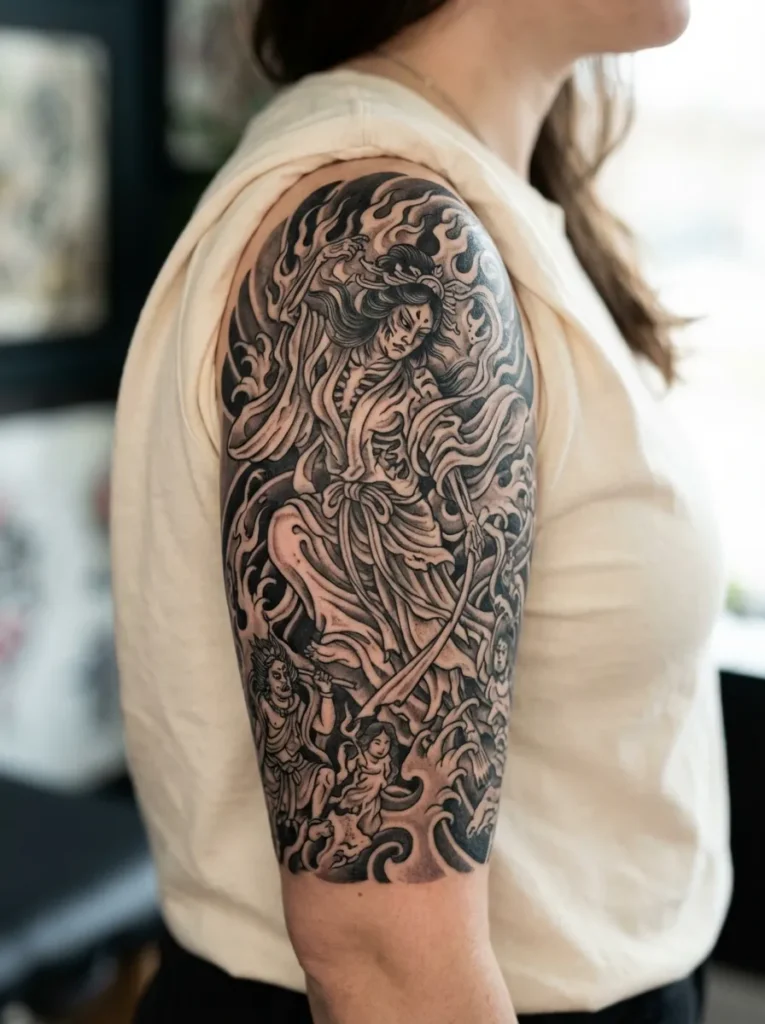
Izanami is the other half of creation, the mother of the Japanese islands and the gods, and the first being to experience death in the Japanese mythological universe.
Her transformation from creator goddess to death goddess is one of the most powerful origin stories in world mythology. She died bringing the fire god Kagutsuchi into the world. In her grief and rage at being seen decomposing by Izanagi, she became Yomotsu Ōkami, the Great Deity of Yomi, the ruler of the land of the dead.
She declared she would kill a thousand of his people every day. He replied that he would ensure fifteen hundred were born. The tension between death and birth in that exchange still governs the cycle of life.
An Izanami tattoo is extraordinarily complex in meaning. She is a creator who became death. A mother who became a destroyer. A goddess whose grief shaped the entire structure of life and death in the universe. There is nothing simple about wearing her.
20. Japanese Momotarō Folk Hero Tattoo
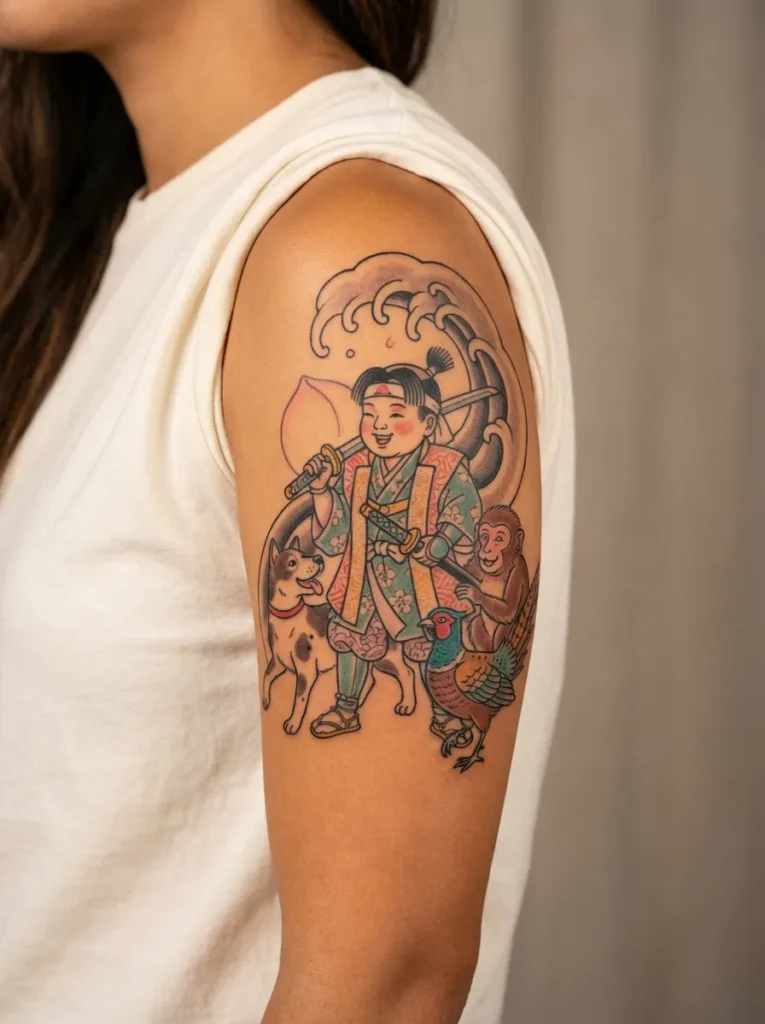
Momotarō is the Peach Boy, one of the most beloved heroes in all of Japanese folklore. He was born from inside a giant peach that floated down a river to an old childless couple. He grew up to lead a company of animal companions, a dog, a pheasant, and a monkey, to Onigashima, the Island of Demons, where he defeated the Oni king and freed the people they had terrorized.
He is cheerful, brave, generous, and completely without arrogance. He shared his kibidango dumplings with his animal companions and led them to victory through trust and teamwork rather than brute force alone.
In Japan, Momotarō represents the ideal of courage combined with kindness. He is a hero for everyone, not just the powerful, because his strength comes from his character rather than his origin.
A Momotarō tattoo brings genuine warmth and folk hero energy to Japanese mythology tattooing. It is playful, deeply cultural, and carries the kind of optimistic bravery that is rare in tattoo subject matter.
21. Japanese Kintarō Legendary Child Tattoo
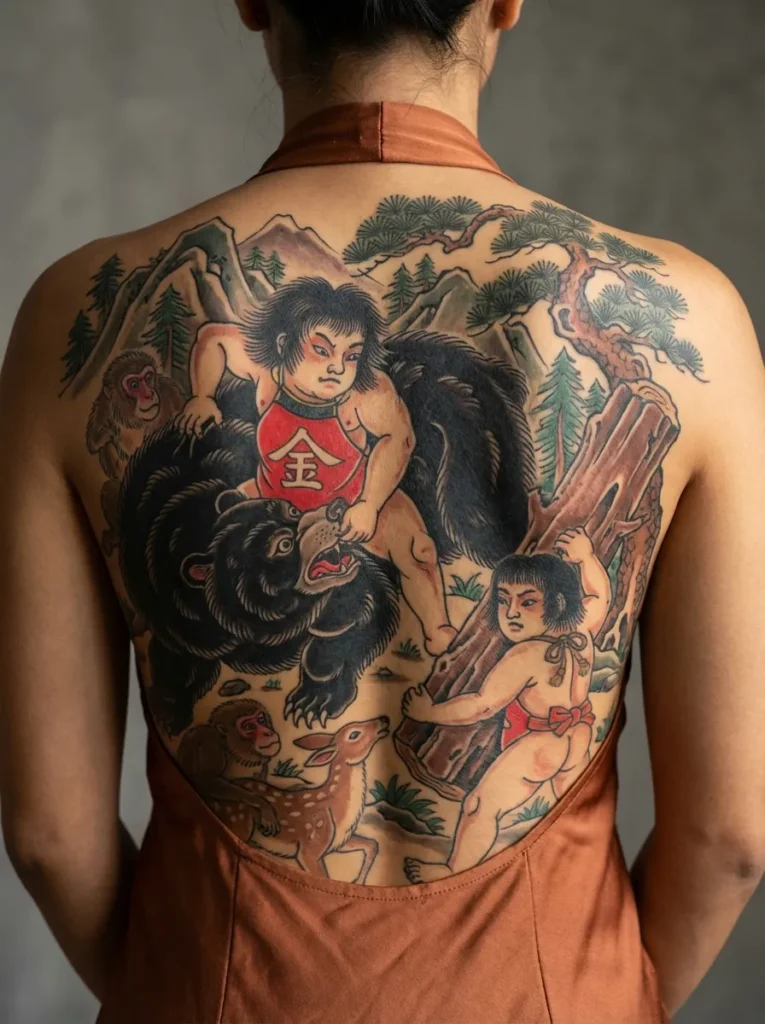
Kintarō is the Golden Boy. He was raised in the mountains by a Yamauba, a mountain witch or spirit, and grew up with supernatural strength, a wild spirit, and a deep bond with the forest animals around him.
He wrestled bears for sport. He carried massive trees on his back for fun. He befriended the creatures of the mountain as companions and equals rather than as subjects. His symbol is the red bib he wears, a nod to the sacred protective bibs of Jizō statues, marking him as a child under divine protection.
He grew up to become Sakata no Kintoki, a legendary retainer of the warrior Minamoto no Raikō, and a member of the celebrated group of heroes known as the Four Guardian Kings.
The Kintarō tattoo is full of raw, joyful power. A child who could wrestle gods and laugh while doing it. A hero whose strength was matched only by his openness and his love for the wild world he was born into.
Out of these 21 legendary figures from Japanese mythology, which one felt like it was speaking directly to something in you? Is it the cosmic tragedy of Izanami, the immovable will of Fudō Myōō, or the wild mountain joy of Kintarō that makes you think that story might deserve to live on your skin for the rest of your life?
