Geometric tattoos have a way of making people stop and look twice. There’s something about sharp lines and precise shapes that demands attention.
The dragonfly is a natural fit for geometric style. It’s already symmetrical. It already has structure. Geometry just takes what’s naturally there and makes it intentional.
These designs sit at the intersection of nature and mathematics. Organic form expressed through precise, calculated shapes. The contrast between the two is exactly what makes geometric dragonfly tattoos so visually powerful.
Whether you want something minimal and clean or complex and layered, there’s a geometric approach that works for your aesthetic. Here are 17 directions worth exploring.
1. Dragonfly with Triangle Wing Patterns
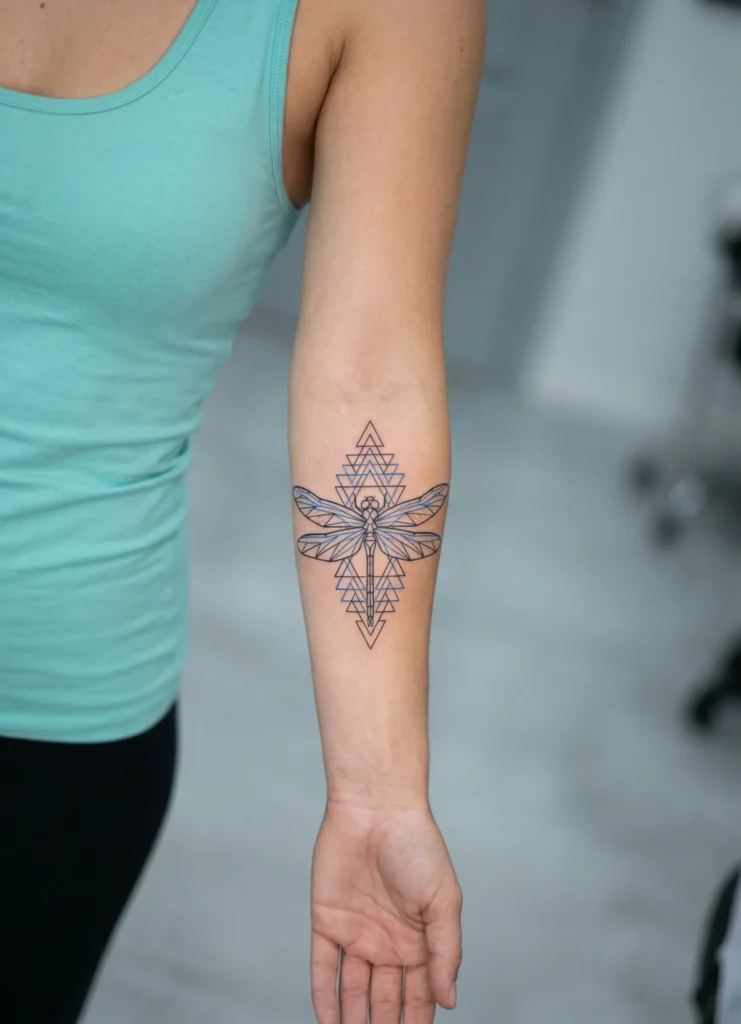
Triangles are one of the most fundamental shapes in geometric tattoo art. Strong, stable, and visually satisfying. Built into the wings of a dragonfly, they create something architectural and elegant.
Each wing section becomes a triangle or a cluster of triangles, arranged outward from the body. The result feels structured but still light.
Pointing upward, triangles traditionally represent growth and aspiration. Pointing downward, they represent flow and introspection. Your artist can orient them to carry the meaning you want.
This design reads beautifully in fine black line. No fill needed. The lines themselves do all the work.
2. Minimal Geometric Dragonfly Line Design
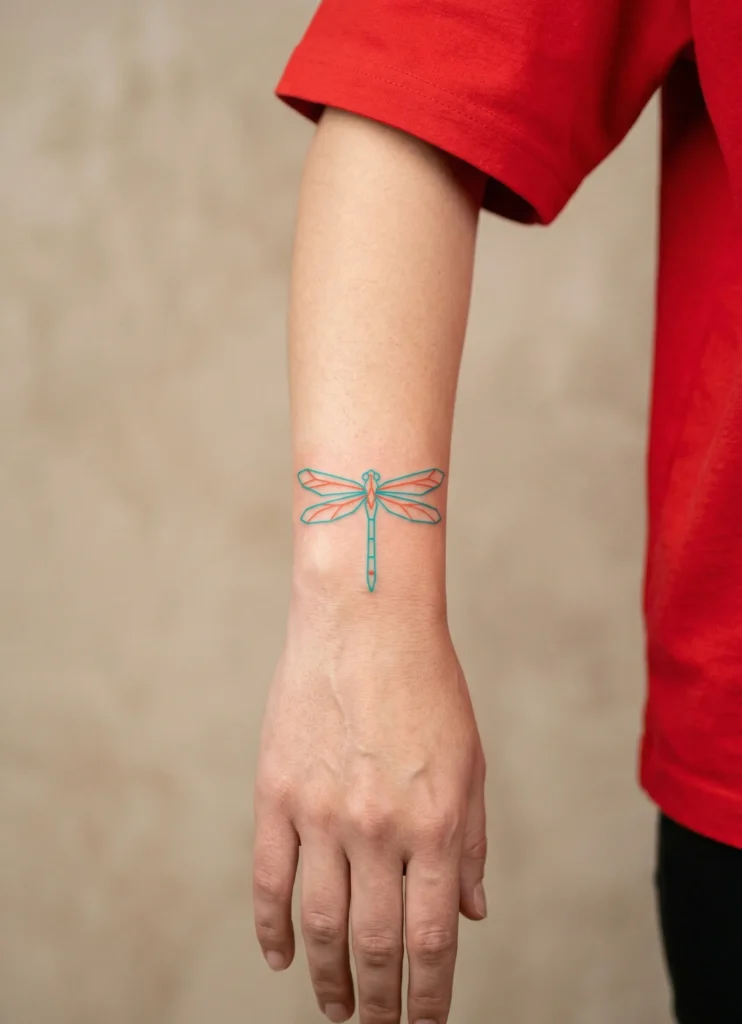
Reduction is a skill. Taking something as detailed as a dragonfly and distilling it down to its essential geometric lines requires real artistic confidence.
This style uses the fewest possible lines to suggest the full form. Wings become simple elongated shapes. The body is a clean central line with minimal segmentation.
- Works perfectly as a small tattoo on the wrist, ankle, or behind the ear
- Aging gracefully over time compared to heavily detailed pieces
- Suits people who prefer understated, considered ink
- Fine needle work keeps the lines crisp and precise
The power is in the restraint. Every line earns its place because there are so few of them.
3. Dragonfly with Polygonal Wing Structure
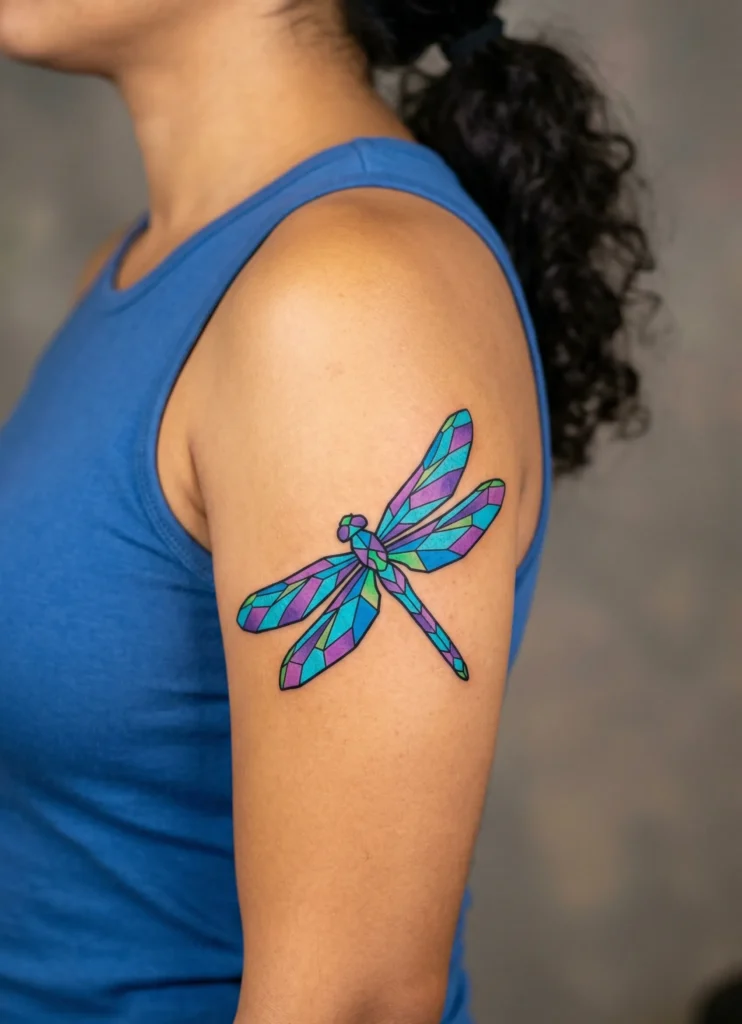
Polygons are multi-sided shapes and when used to build dragonfly wings, they create something that looks almost like a stained glass window.
Each section of the wing is its own polygon, fitted against the next like tiles in a mosaic. The overall wing shape remains recognizable but the interior is completely reimagined.
Leaving the polygons as outlines keeps it clean and graphic. Filling alternating sections with solid black creates depth and contrast. Both approaches work well depending on your preference.
This design scales beautifully. A small version on the forearm looks sharp. A larger version on the back or thigh allows the individual polygon sections to show real detail.
4. Sacred Geometry Dragonfly with Mandala Core
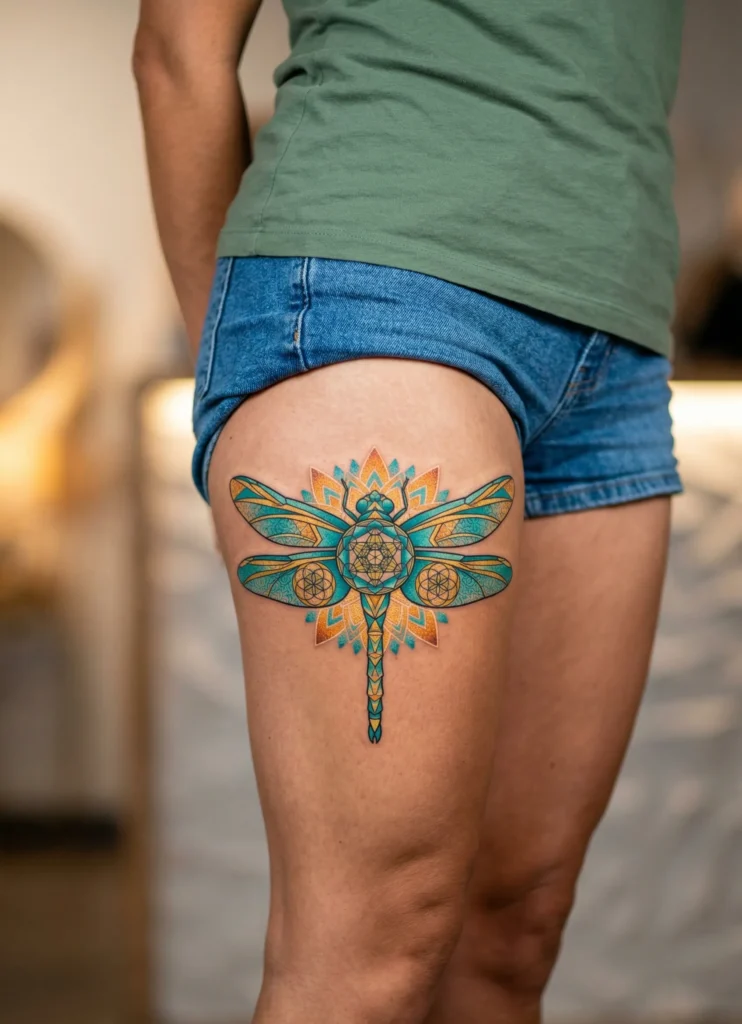
Sacred geometry operates on the idea that certain shapes and proportions carry spiritual significance. The Flower of Life, Metatron’s Cube, the Seed of Life, all built from precise mathematical relationships.
A dragonfly with a sacred geometry mandala at its core becomes something deeply intentional. The mandala sits at the body center and the geometric wings radiate outward from it.
| Sacred Geometry Element | Meaning |
| Flower of Life | Unity, creation, the interconnection of all living things |
| Metatron’s Cube | Balance, protection, the geometry underlying existence |
| Sri Yantra | Cosmic order, spiritual power, the nature of reality |
| Seed of Life | New beginnings, potential, the origin of creation |
This is meditative work in the truest sense. Both to receive and to wear.
5. Dragonfly with Hexagon Wing Sections
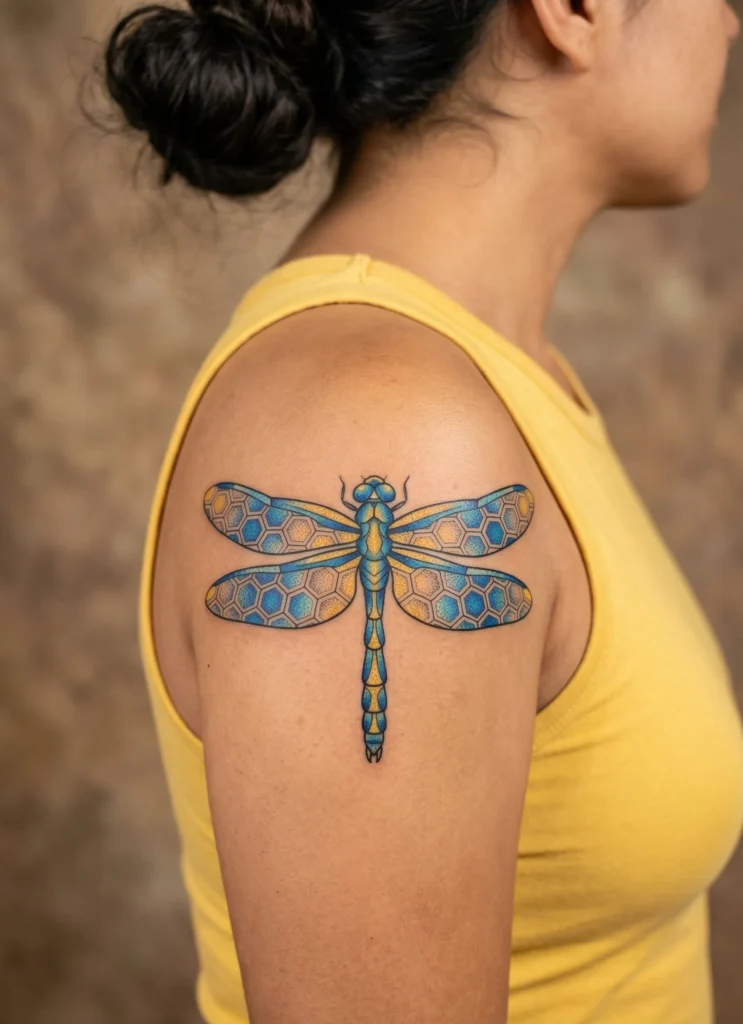
Hexagons appear throughout nature. Honeycomb cells, snowflake crystals, basalt rock formations. There’s a reason geometry keeps returning to this shape. It’s efficient and perfect.
Hexagonal sections tiling across dragonfly wings create a honeycomb effect that feels simultaneously natural and mathematical. It’s geometric but not cold.
The hexagons can be uniform in size or varied, creating a sense of perspective and depth across the wing surface. Smaller hexagons toward the wing tips and larger ones near the body gives the wing a dimensional quality.
This pairs well with fine line dotwork inside each hexagon cell for extra texture and detail.
6. Abstract Geometric Dragonfly with Sharp Angles
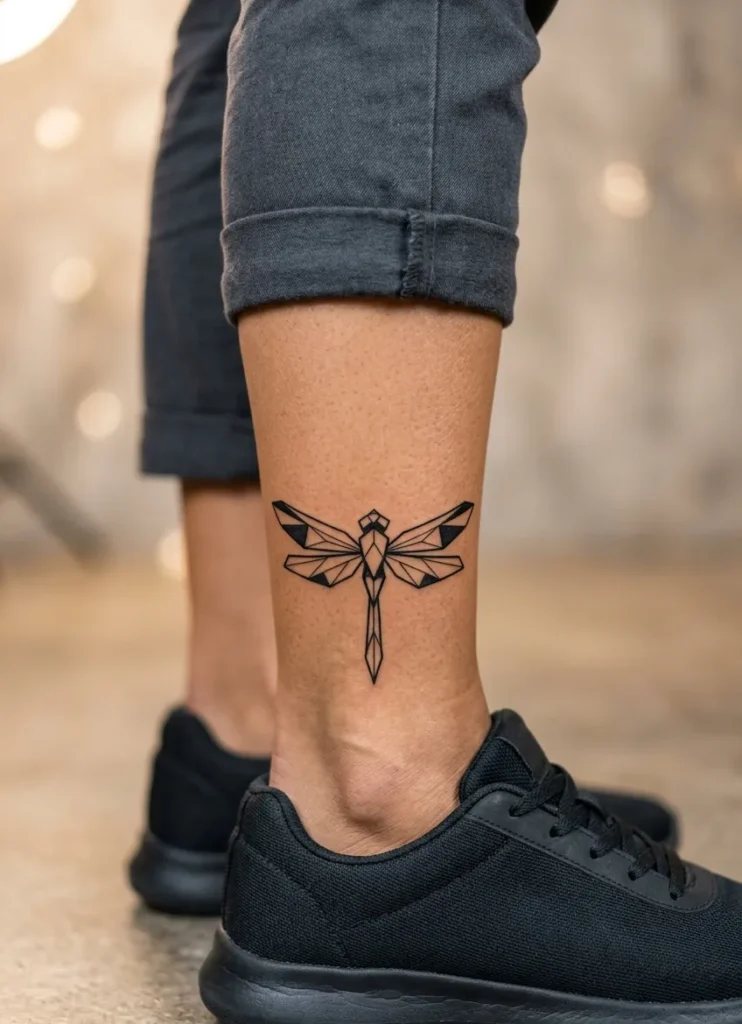
This version abandons the natural dragonfly silhouette almost entirely. The insect is reconstructed from sharp, angular shapes that suggest rather than replicate the original form.
It’s deliberately abstract. You recognize the dragonfly not from accurate anatomy but from the general arrangement of forms. Wings here, body there, the intention clear even through the abstraction.
Sharp angles carry a different energy than curves. This design feels decisive, modern, and bold. It suits people who move through the world with clarity and directness.
Black ink only tends to work best here. Color can muddy the geometric precision that makes this style work.
7. Dragonfly with Circle and Line Framework
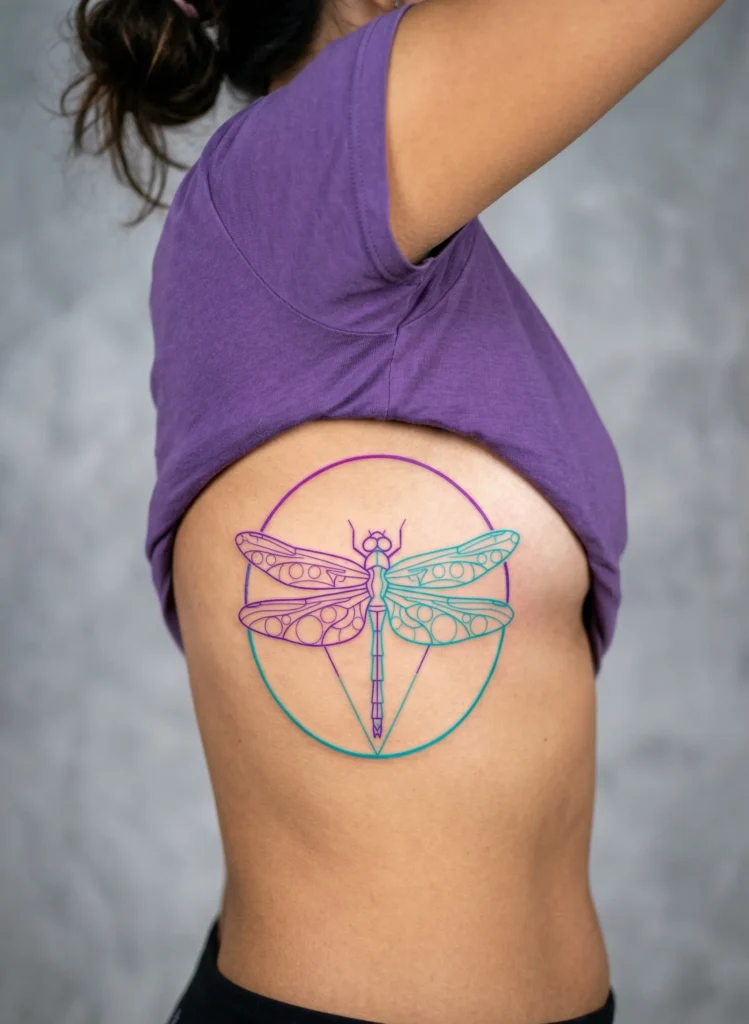
Circles combined with straight lines create a design language that feels both mathematical and organic. The circles suggest natural growth patterns. The lines suggest human precision.
In a dragonfly design, the circles can form the wing panels while straight lines define the body and structural elements. Or a large outer circle can frame the entire dragonfly like a lens focusing on the subject inside.
This framework approach gives the tattoo a finished, complete quality. It doesn’t trail off at the edges. The circle provides a natural boundary that makes the design feel considered and whole.
Fine line execution is essential here. Heavy lines would destroy the delicacy this combination needs to work properly.
8. Split Geometric Dragonfly (Half Real, Half Abstract)
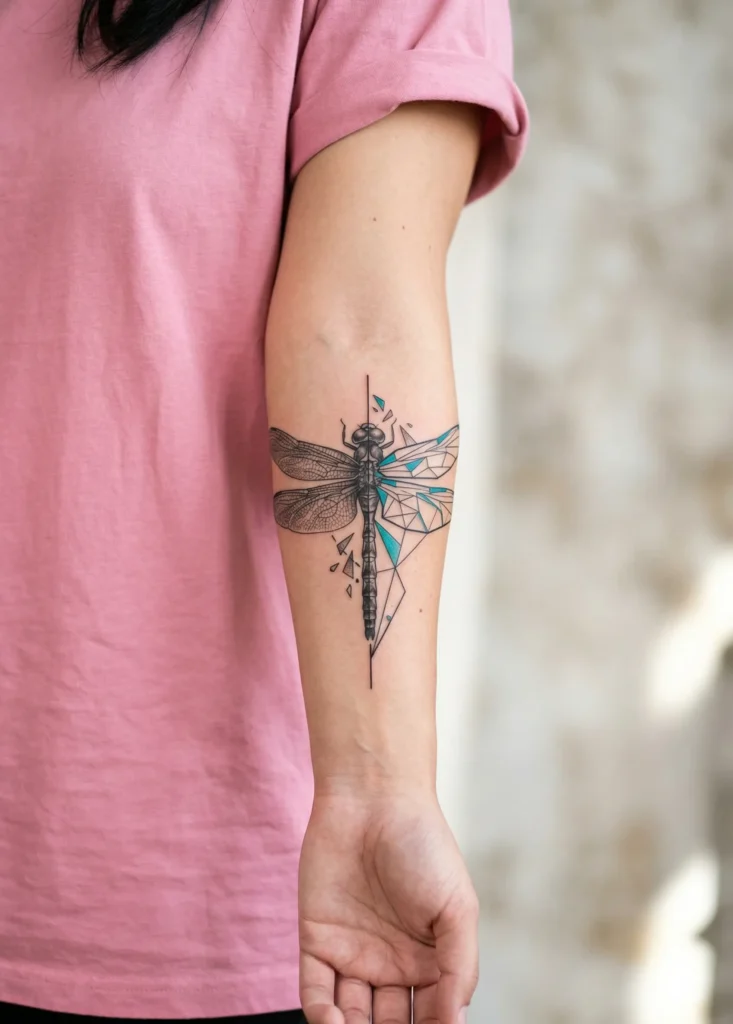
One side of the dragonfly is rendered with realistic detail. The other side breaks into clean geometric shapes. The contrast between them is the entire point.
It’s a design about duality. Nature and structure. The organic and the intentional. The felt and the understood. Many people connect with this split as a metaphor for how they see themselves.
The dividing line can run straight down the center or the transition can be gradual, with reality slowly dissolving into geometry as you move across the design.
- The realistic side should use accurate wing venation and body detail
- The geometric side should use shapes that mirror the realistic proportions
- The transition zone is where the best artists really show their skill
- This style works especially well in black and grey without color distraction
9. Dragonfly with Dotwork Geometry Blend
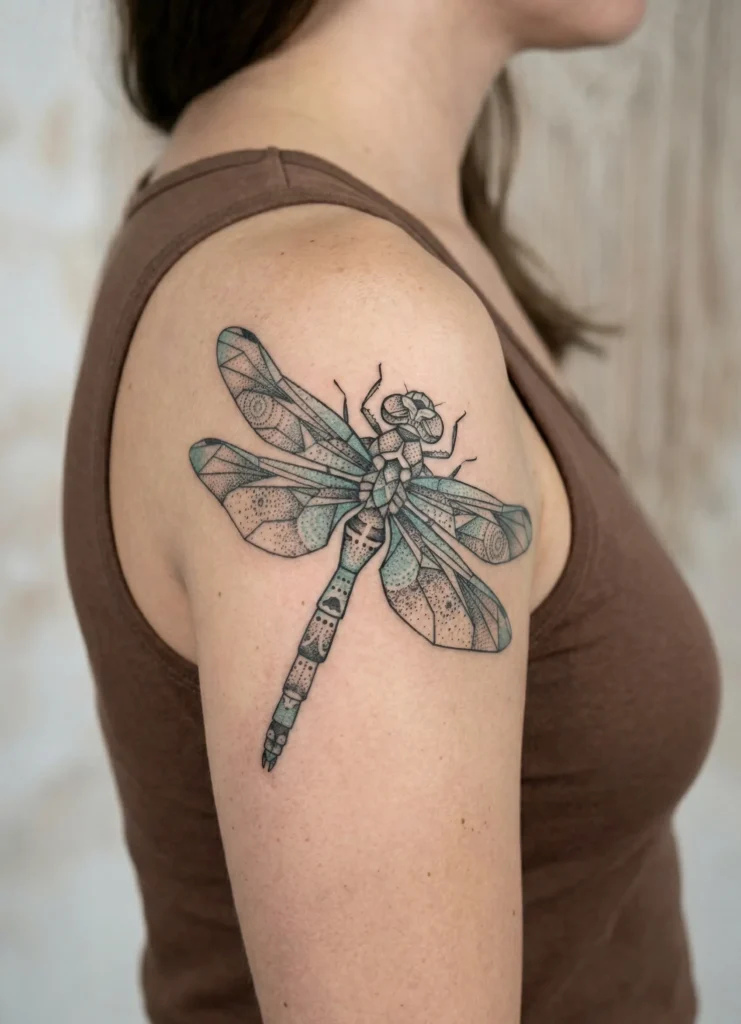
Dotwork uses hundreds of tiny individual dots to build up shading, texture, and form. When combined with geometric structure, the result is intricate in a way that rewards close inspection.
The geometric shapes provide the framework. The dotwork fills them with texture and depth. Denser dot clusters create darker areas. Sparser dots create highlights and gradients.
Inside each geometric wing section, the dotwork can create its own micro-patterns. Concentric dot rings, scattered fields, directional flows. The possibilities inside each shape are nearly endless.
This is slow, patient work. The tattoo takes time in the chair but the result has a handcrafted quality that feels genuinely unique. No machine precision here. Every dot placed by hand.
10. Dragonfly with Crystal Inspired Wings
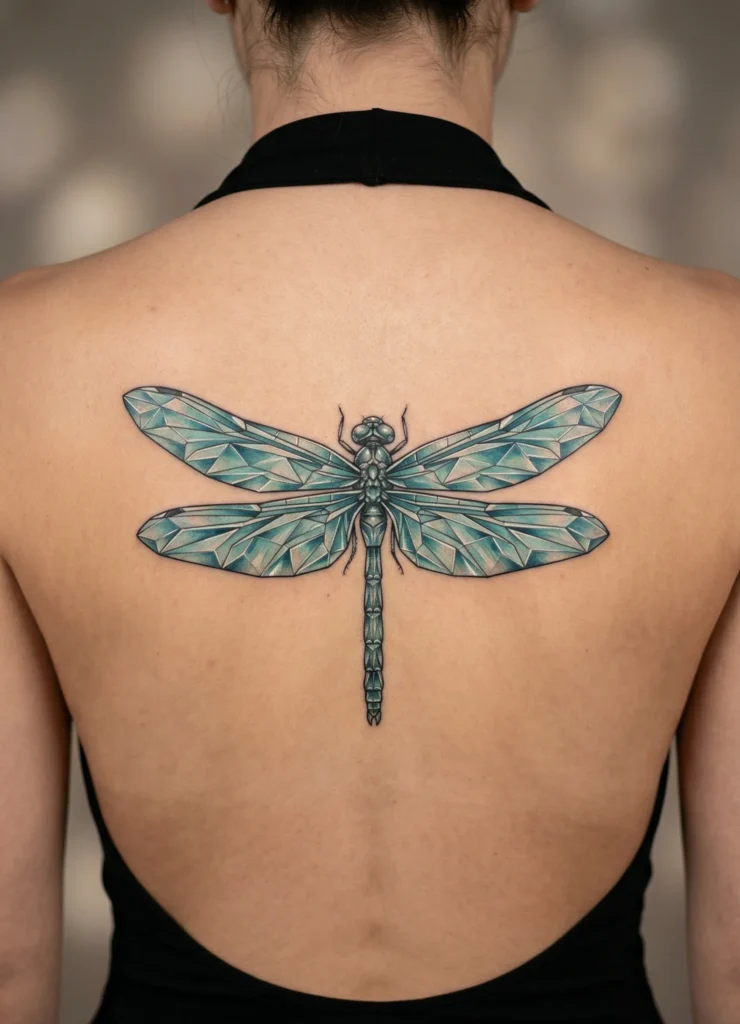
Crystal formations grow in precise geometric patterns. Faceted surfaces catching and refracting light. Wings built from crystal geometry carry that same quality of structured radiance.
Each wing panel becomes a crystal facet, angled slightly differently from its neighbors to suggest a three-dimensional surface. The overall impression is that the wings are carved from gemstone rather than grown from biology.
Color transforms this design completely. Clear crystal stays in black and grey. Amethyst goes purple. Rose quartz goes soft pink. Aquamarine goes blue-green. The crystal type you choose carries its own meaning.
| Crystal | Color | Traditional Meaning |
| Amethyst | Purple | Calm, intuition, spiritual clarity |
| Rose Quartz | Soft pink | Love, compassion, emotional healing |
| Aquamarine | Blue-green | Courage, clarity, calm communication |
| Citrine | Golden yellow | Energy, confidence, positive transformation |
| Obsidian | Deep black | Protection, truth, grounding |
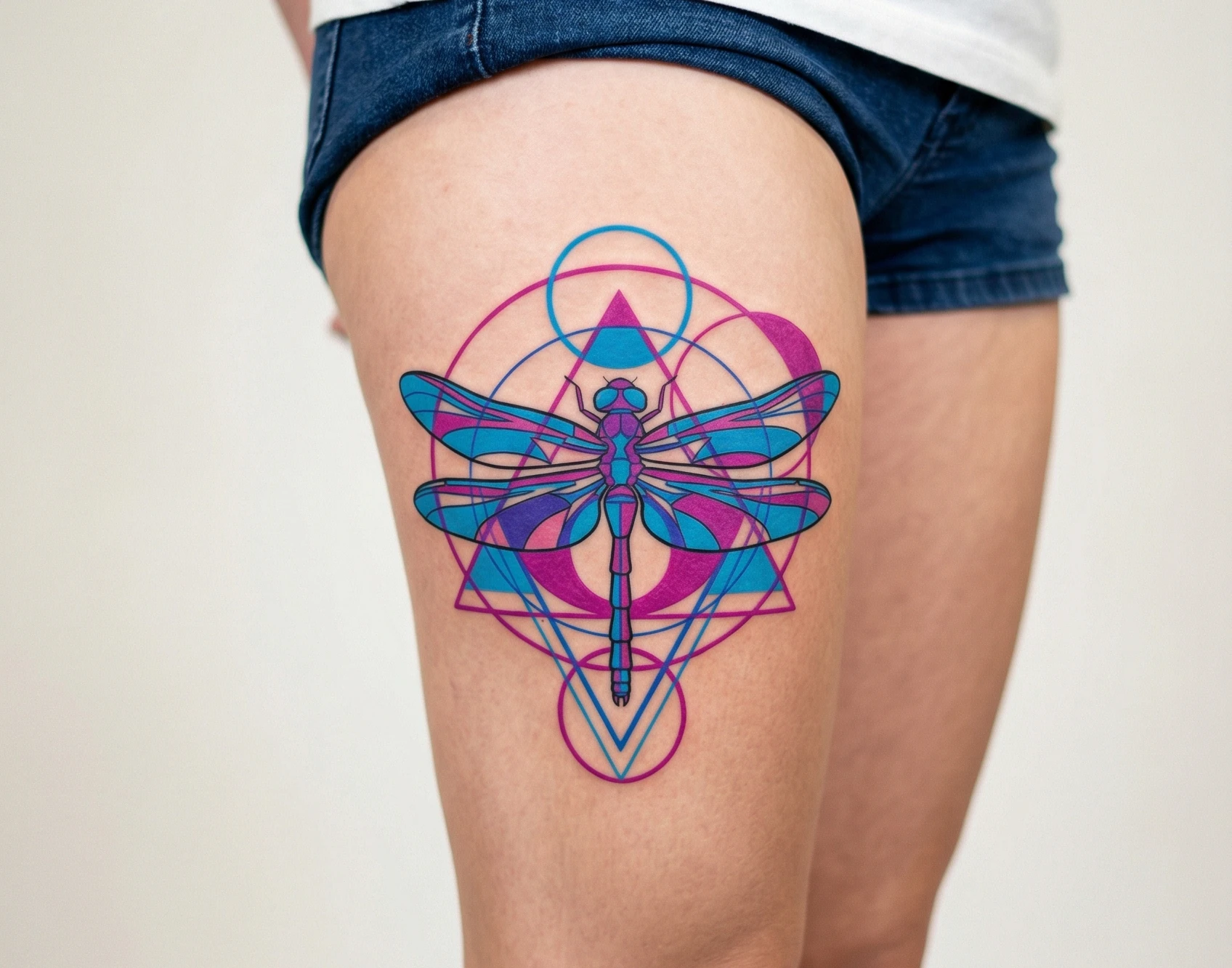
11. Geometric Dragonfly with Overlapping Shapes
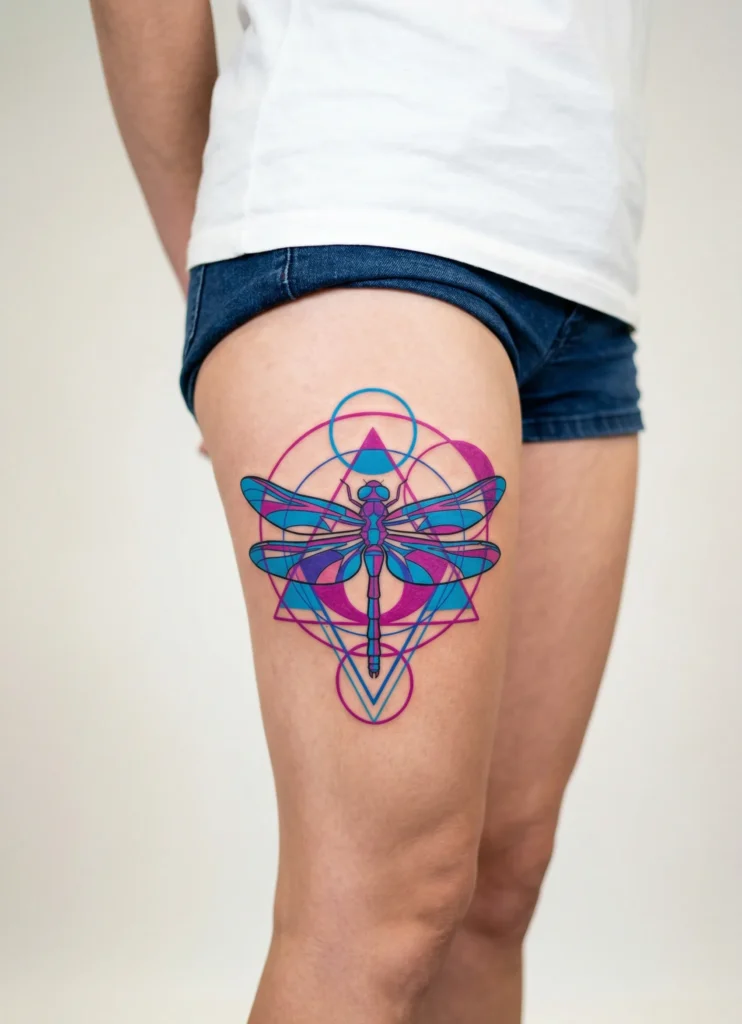
Shapes layered over each other, some solid, some outline only, create a design with real visual depth. The overlapping areas where shapes intersect become their own new zones of interest.
Circles overlapping triangles overlapping the dragonfly form itself. The layering creates a composition that keeps drawing the eye inward, always finding something new.
This style plays with the concept of transparency. An outline circle sitting over a solid wing section suggests the circle is floating above the surface. That illusion of depth is compelling without any actual three-dimensional rendering technique.
Bold and graphic in execution. This design has presence from across the room.
12. Dragonfly with Linear Grid Wing Design
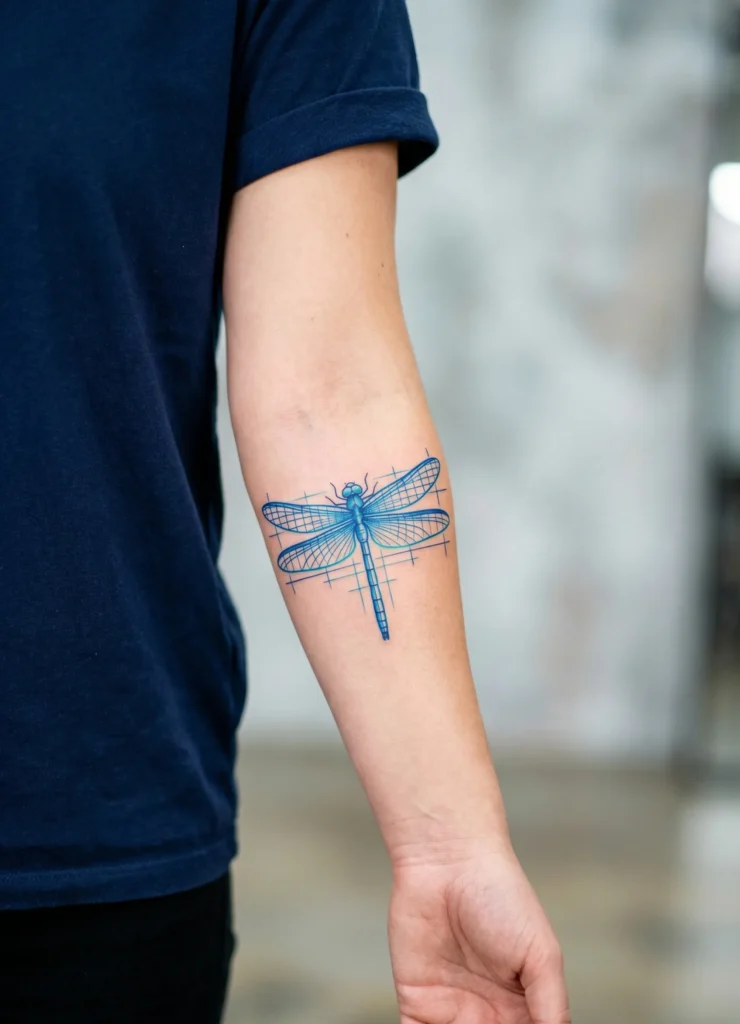
A grid of perfectly parallel lines crossing at regular intervals across the wing surface creates something that feels technical and precise. Like a blueprint or an engineering diagram.
The grid can follow the natural shape of the wing or extend beyond it in places, as if the wing is a small section of a larger structural drawing. That approach makes the wing feel like part of something vast.
Varying the line weight across the grid adds dimension. Thicker lines at the outer edges, finer lines toward the center, creates a sense of convergence that draws the eye inward.
This is a distinctly modern, architectural aesthetic. It suits people who work in design, engineering, or anyone drawn to the beauty of precision systems.
13. Dragonfly with Diamond Shape Wing Pattern
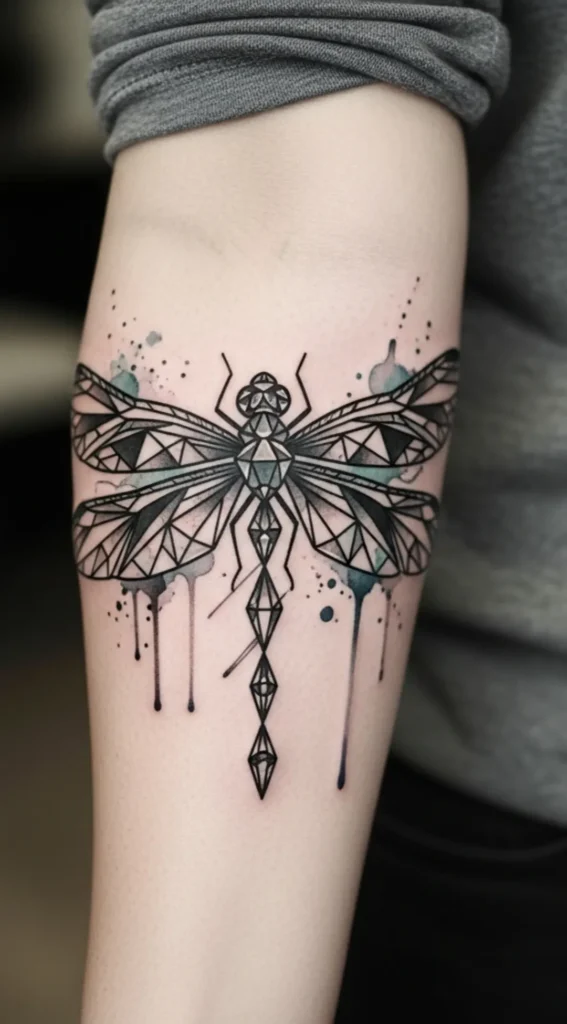
Diamonds arranged across the wing surface create a design that feels both geometric and organic. The diamond shape has natural associations with clarity, value, and light refraction.
Larger diamonds near the wing base gradually reducing in size toward the wing tips creates a natural taper that reinforces the wing shape rather than fighting it.
Some diamonds can be filled solid black while others remain as outlines. The alternating fill pattern creates a visual rhythm that moves across the wing like light through a prism.
This works particularly well with fine shading inside each diamond to suggest faceted depth. The wings start to look genuinely jewel-like without going into full color.
14. Dragonfly with Fractal Geometry Elements
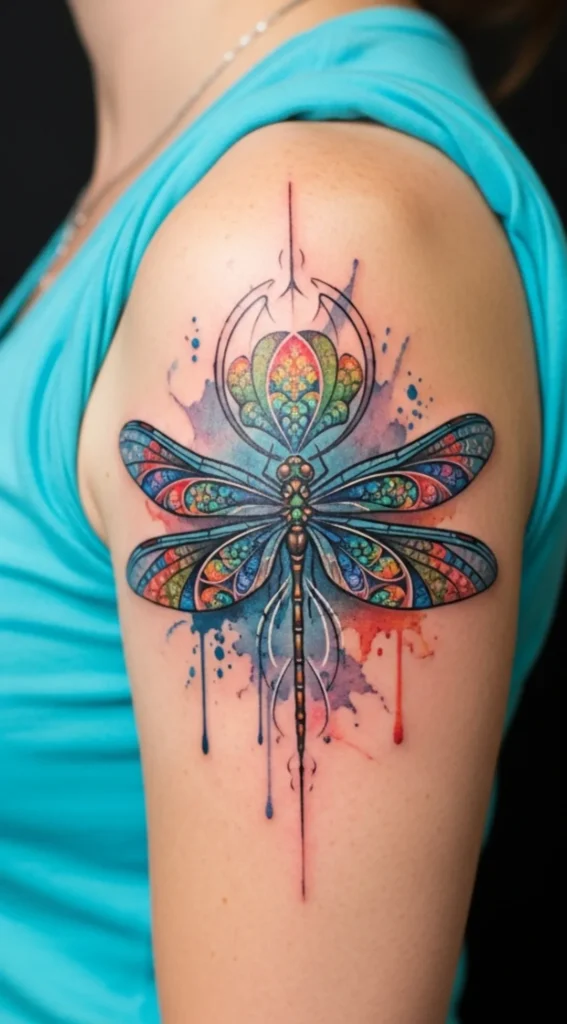
Fractals are patterns that repeat at every scale. Zoom in and you find the same pattern again. Zoom in further and it repeats once more. Infinitely, in theory.
A dragonfly with fractal wing elements carries the idea of infinite complexity within a contained form. The wing pattern at full size mirrors a section of the wing at close range.
This is conceptually one of the deepest designs on this list. It’s a tattoo about the nature of pattern itself. About how complexity and simplicity are the same thing viewed at different scales.
Execution requires an artist who genuinely understands fractal geometry. This isn’t a design to hand to someone who hasn’t worked with it before. The math needs to be right for it to work visually.
15. Dragonfly with Negative Space Geometric Style
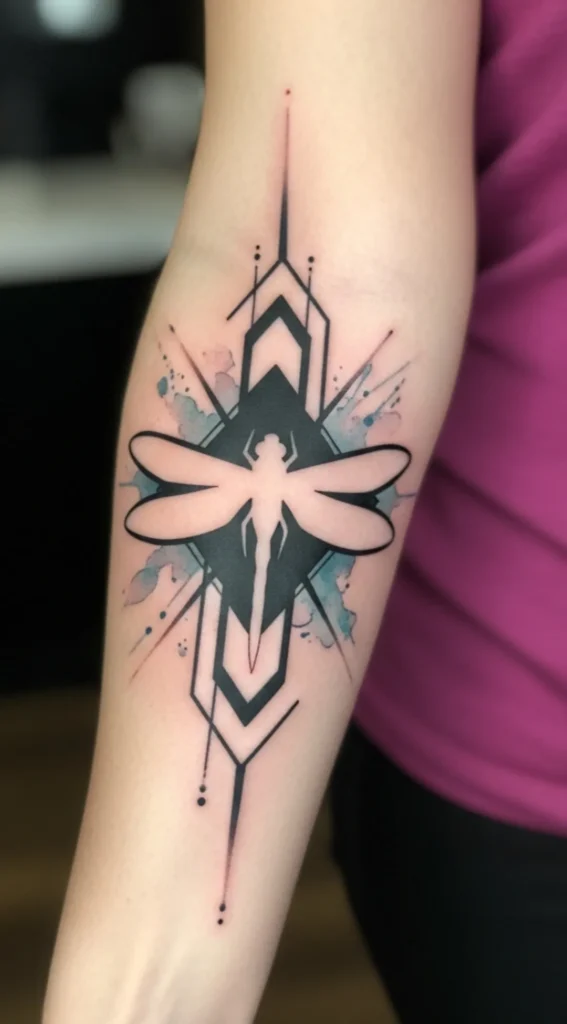
Negative space tattoos use the untouched skin as part of the design. The dragonfly isn’t drawn. It’s revealed by the shapes surrounding it.
The geometric forms are inked in solid black or bold linework. Inside those forms, the skin remains bare. The dragonfly shape emerges from what isn’t tattooed.
It’s counterintuitive and that’s exactly why it works. The eye is drawn to the absence as much as to the ink. The dragonfly exists in the space between the geometry.
- This style requires careful planning of negative space proportions
- Placement on areas with consistent skin tone works best
- The design looks dramatically different in different lighting conditions
- Simpler geometric surrounds tend to create cleaner negative space reading
16. 3D Geometric Dragonfly with Depth Lines
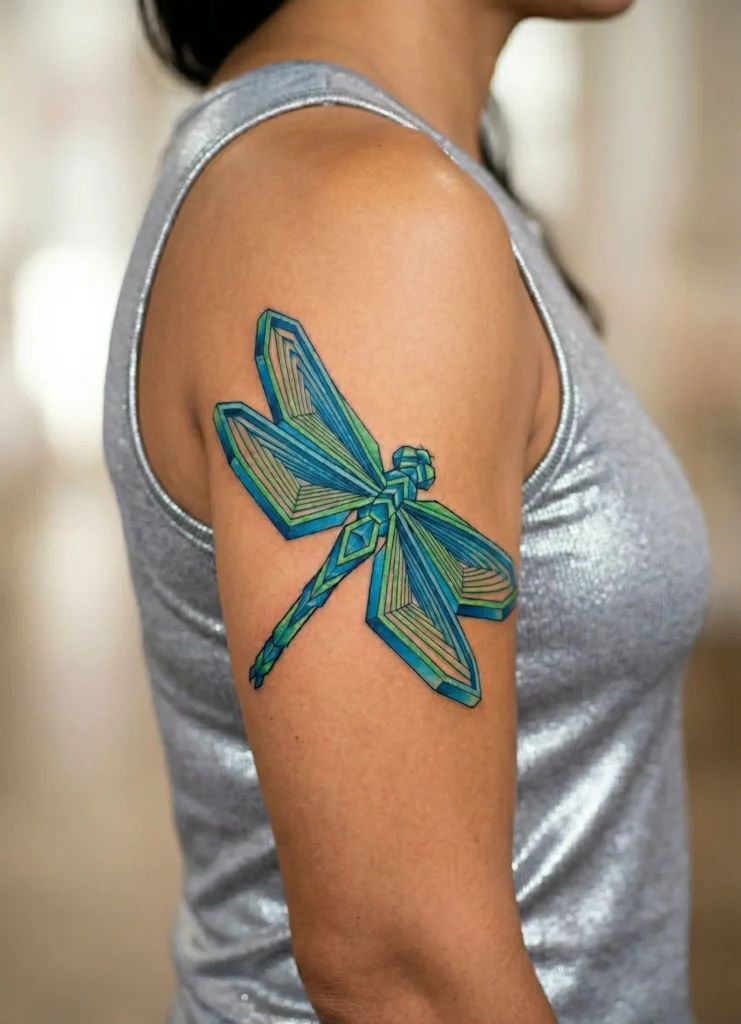
Perspective lines and careful shading make flat geometric shapes appear to exist in three-dimensional space. The dragonfly lifts off the skin visually even though it’s perfectly flat.
Parallel lines converging toward a vanishing point create the illusion of depth inside each geometric wing section. Shaded edges reinforce the impression of volume and three-dimensional structure.
The effect is almost architectural. The dragonfly looks like a model or a structure rather than a living creature. That’s the point. This version celebrates the constructed quality of geometric design.
This needs an artist with strong technical drawing ability. The perspective has to be mathematically consistent throughout or the 3D illusion collapses. Precision is non-negotiable here.
17. Geometric Dragonfly with Interlocking Line Symmetry
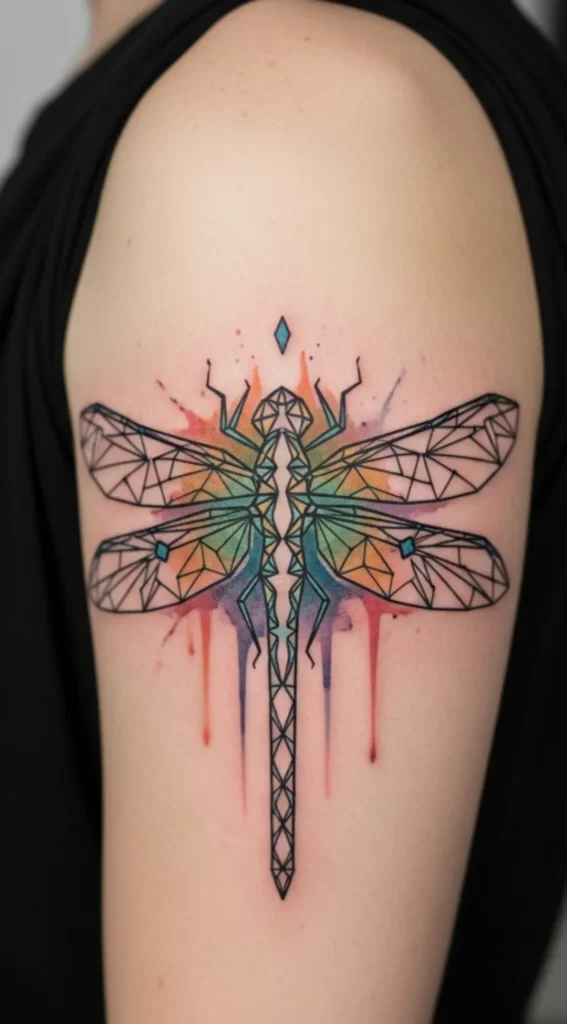
Lines that cross, connect, and interlock across the full dragonfly form create a design based entirely on the beauty of symmetrical pattern. Every line on the left is mirrored on the right.
The symmetry of the dragonfly makes this approach feel completely natural. The insect’s own bilateral symmetry invites a design language that honors that natural balance.
Where lines intersect, small geometric nodes can form. Diamonds, squares, or star points appearing organically at every crossing point. The design builds its own internal structure through the logic of the intersections.
This is the kind of tattoo that people photograph up close to really see. The full design reads from a distance but the interlocking detail only reveals itself when you get close enough to trace the lines. That kind of depth in a tattoo is worth pursuing.
Geometric dragonfly tattoos are for people who find beauty in structure. Who see the precision of a perfectly drawn line the same way others see a brushstroke or a flower petal.
What makes this style so enduring is that it doesn’t age out of relevance. Clean geometry is timeless. The designs in this list will look just as sharp in twenty years as they do on the day they’re finished.
Every design here is a starting point, not a final answer. The best geometric tattoo you can get is the one that gets refined through conversation with your artist until every line feels exactly right.
So here’s the question worth taking into that conversation: are you drawn to geometry because of how it looks, or because of what it means to you that something can be both perfectly ordered and completely alive at the same time?