Scorpions have crawled across tattooed skin since the golden age of American traditional. They’re dangerous, mysterious, and instantly recognizable.
The bold lines and dramatic shapes of traditional style make scorpions look alive and ready to strike.
That curved tail, those menacing claws, the segmented body create perfect tattoo geometry. Every element translates beautifully into thick black outlines and solid color fills.
These aren’t delicate creatures. Scorpions represent survival, protection, and the power to defend yourself when threatened.
They thrive in harsh environments and strike without warning. That energy resonates with people who’ve had to be tough to survive.
American traditional scorpion tattoos age incredibly well. The strong shapes and limited palette stay crisp for decades. Ready to explore designs that capture this desert warrior’s essence?
1. Classic Scorpion Tattoo

A straightforward scorpion with no extras never goes out of style. The creature itself provides all the visual punch you need.
Eight legs spread wide, pincers raised, tail curved overhead in strike position. Traditional artists emphasize the segmented body with bold black sections. The stinger gets special attention with a sharp point that looks genuinely threatening.
Black and red is the classic color combo. Some artists add yellow or orange accents for extra pop without straying from traditional roots.
2. Raised Stinger Scorpion Tattoo

The tail arched high and ready creates instant tension. This pose shows the scorpion at its most dangerous moment.
The stinger curves forward over the body, aimed and loaded with venom. Traditional artists make the tail segments clear and defined with thick outlines between each section. The raised position creates great negative space and dynamic composition.
This stance captures pure threat. Your scorpion isn’t just existing, it’s actively ready to defend itself.
3. Scorpion and Skull Tattoo

Death meets danger when scorpion and skull combine. Both symbols embrace mortality without fear.
The scorpion might crawl across the skull’s surface, emerge from an eye socket, or perch on top like a crown. Traditional skull work with clean lines and bold teeth contrasts beautifully with the scorpion’s segmented body. Both creatures represent what most people fear.
Common composition styles:
- Scorpion centered on skull forehead
- Claws gripping skull from behind
- Scorpion crawling through eye socket
- Skull and scorpion side by side, equal focus
This pairing doesn’t apologize for being dark. It owns it completely.
4. Scorpion with Flames Tattoo

Fire and venom create a double threat. Flames add movement and intensity to the scorpion’s natural danger.
Traditional flames with bold curves and sharp points rise around the scorpion. Orange, red, and yellow fills make the fire feel hot. The scorpion might be emerging from flames or surrounded by them. Black scorpion against bright fire creates strong contrast.
The combination suggests something that can’t be contained or controlled. Pure elemental danger.
5. Scorpion and Rose Tattoo

Beauty and danger side by side make surprising sense together. The rose’s softness plays perfectly against the scorpion’s threat.
A traditional red rose with layered petals might bloom near the scorpion’s claws or beneath its body. Thorned stems echo the scorpion’s defensive nature. Both the rose and scorpion protect themselves, just in different ways. Green leaves add a third color to the black and red palette.
This design appeals to people who contain multitudes. Soft and sharp, beautiful and dangerous.
6. Scorpion Forearm Tattoo

The forearm gives scorpions room to stretch out naturally. The long canvas suits their horizontal body shape perfectly.
A scorpion traveling from wrist toward elbow uses the space efficiently. The forearm’s visibility means you’ll see this piece constantly. Traditional bold lines read clearly on this relatively flat surface.
Placement here makes a statement. Your scorpion is front and center, not hidden away.
7. Scorpion and Dagger Tattoo

Two weapons crossed or paired create doubled symbolism. Both can defend and both can strike.
The dagger might pierce through the scorpion, rest behind it, or stand blade-up beside it. Traditional dagger work has clean blade lines and detailed handle wrapping. Some designs show the scorpion gripping the dagger in its claws.
| Design Element | Symbolism | Traditional Treatment |
| Scorpion | Natural defense, survival | Segmented body, curved tail |
| Dagger | Human weapon, precision | Clean blade, wrapped handle |
| Skull | Mortality, fearlessness | Bold eye sockets, defined teeth |
| Flames | Uncontrollable power | Sharp points, warm colors |
This pairing speaks to people who believe in being armed and ready.
8. Scorpion and Snake Tattoo
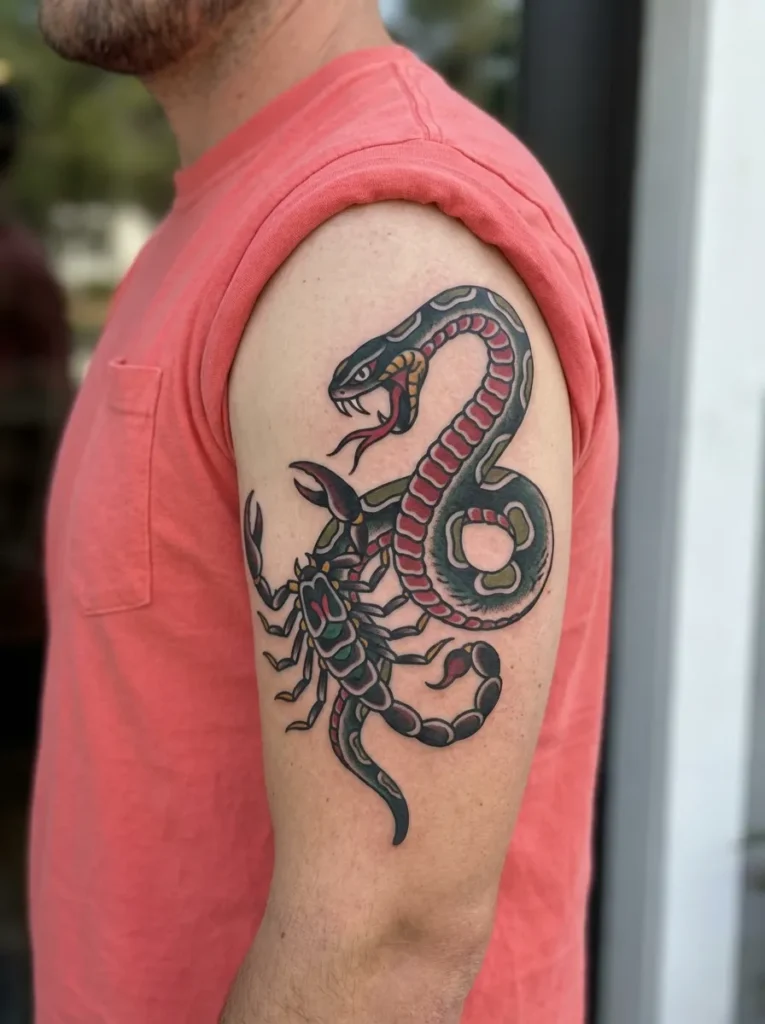
Two desert predators make an intense combination. Snake and scorpion both strike fast and pack serious venom.
The snake might coil around the scorpion or face off against it. Traditional snake work has scaled sections and forked tongue details. Some designs show them as enemies while others present them as allies in danger. Both creatures command respect.
This creates visual tension even when the design is still. You’re looking at a standoff between two forces.
9. Scorpion with Banner Tattoo

A ribbon banner adds space for personal meaning. Names, dates, or words that matter become part of the scorpion design.
The banner might drape across the scorpion’s body or flow beneath it. Traditional banner folds and shadows make it look three-dimensional. Black text in classic fonts ensures readability. The banner grounds the scorpion with your specific story.
Words and image work together to tell a complete tale.
10. Scorpion in Desert Scene Tattoo

Setting your scorpion in its natural habitat creates a full environment. Sand dunes, rocks, and desert plants complete the picture.
The scorpion becomes the centerpiece of a larger landscape. Traditional scene work keeps background elements simple with bold outlines. Cacti, rocks, or sandy hills frame the scorpion without competing for attention. Warm earth tones for the desert contrast with the scorpion’s blacks and reds.
This approach puts the creature in context. It’s not just dangerous, it’s a survivor in brutal conditions.
11. Scorpion with Lightning Tattoo

Electric bolts add supernatural energy to natural danger. Lightning suggests the scorpion’s strike is as sudden and powerful as a storm.
Traditional lightning has sharp zigzag lines in bold yellow or white. The bolts might strike around the scorpion or emanate from its stinger. This combination takes physical threat and adds elemental force. The scorpion becomes almost mythological.
Speed and shock combine in one explosive image.
12. Scorpion with Star Accents Tattoo

Stars scattered around the scorpion add celestial dimension. They suggest night hunting and desert skies.
Traditional stars have clean geometric points with solid fills. They might surround the scorpion or concentrate near the tail. Some designs use stars to fill negative space and balance the composition. The stars keep it from feeling too heavy or dark.
This adds a touch of magic without softening the scorpion’s edge.
13. Scorpion and Hourglass Tattoo

Time and danger merge in this symbolic pairing. The hourglass warns that time’s running out while the scorpion represents life’s fragility.
The hourglass might stand beside the scorpion or the scorpion might wrap around it. Traditional hourglass designs have clean glass outlines and visible sand flow. Both symbols remind us that everything is temporary. The message deepens when they’re combined.
This design appeals to people who understand mortality and don’t waste their time.
14. Scorpion and Flames Scene Tattoo

Flames creating a full background scene turn up the intensity. This isn’t just accent fire, it’s an inferno.
The scorpion crawls through or emerges from complete fire coverage. Traditional flame work fills the background with oranges, reds, and yellows. The black scorpion stands out dramatically against the bright, hot backdrop. This creates a hellish or apocalyptic vibe.
Your scorpion doesn’t just survive the fire. It thrives in it.
15. Scorpion in Rocky Landscape Tattoo

Boulders and rocky terrain show the scorpion’s harsh environment. Sharp stones and rough textures create a rugged scene.
The scorpion navigates between or over traditional boulder shapes. Rocks get angular treatment with bold shadows that make them feel solid and heavy. The landscape frames the scorpion while reinforcing its toughness. Nothing about this creature’s life is soft or easy.
This grounds the design in the scorpion’s actual desert home.
16. Scorpion in Sandstorm Scene

A whirling sandstorm adds chaos and movement. Wind-blown sand suggests the scorpion endures conditions that would destroy others.
Swirling lines and scattered dots represent the storm using traditional techniques. The scorpion remains clear and solid while everything around it blurs. This shows strength in adversity. The creature stays focused while the world whips around it.
Sandstorms are brutal, but your scorpion doesn’t flinch.
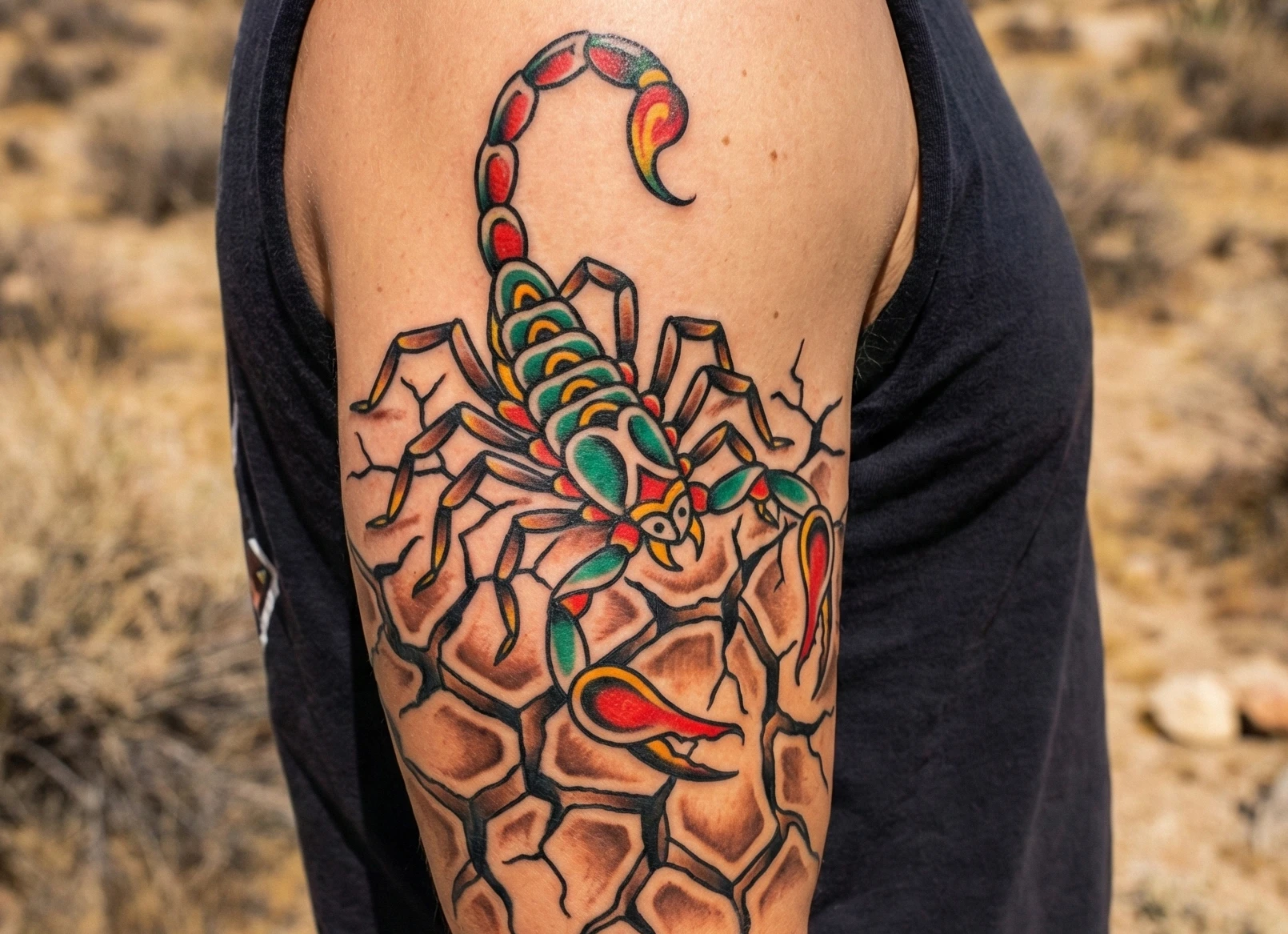
17. Scorpion with Cracked Earth Tattoo

Dry, split ground beneath the scorpion emphasizes the desert’s harshness. Deep cracks show extreme drought and hostile conditions.
Traditional cracked earth has bold line patterns that look like puzzle pieces. The scorpion sits on or moves across this broken surface. The cracking might extend across the whole piece or concentrate under the creature. This reinforces that the scorpion survives where nothing else can.
Life finds a way even when the earth itself breaks apart.
18. Scorpion and Desert Cactus Tattoo

Saguaro cacti or prickly pear complete the classic desert tableau. Both scorpion and cactus defend themselves with sharp points.
Traditional cactus designs have clean paddle shapes or tall columns with minimal spines. The cactus might frame one side while the scorpion occupies the other. Green cactus against red and black scorpion creates nice color balance. Both organisms are perfectly adapted to survive with minimal water.
This pairing celebrates desert toughness in two very different forms.
19. Scorpion in Moonlight Scene
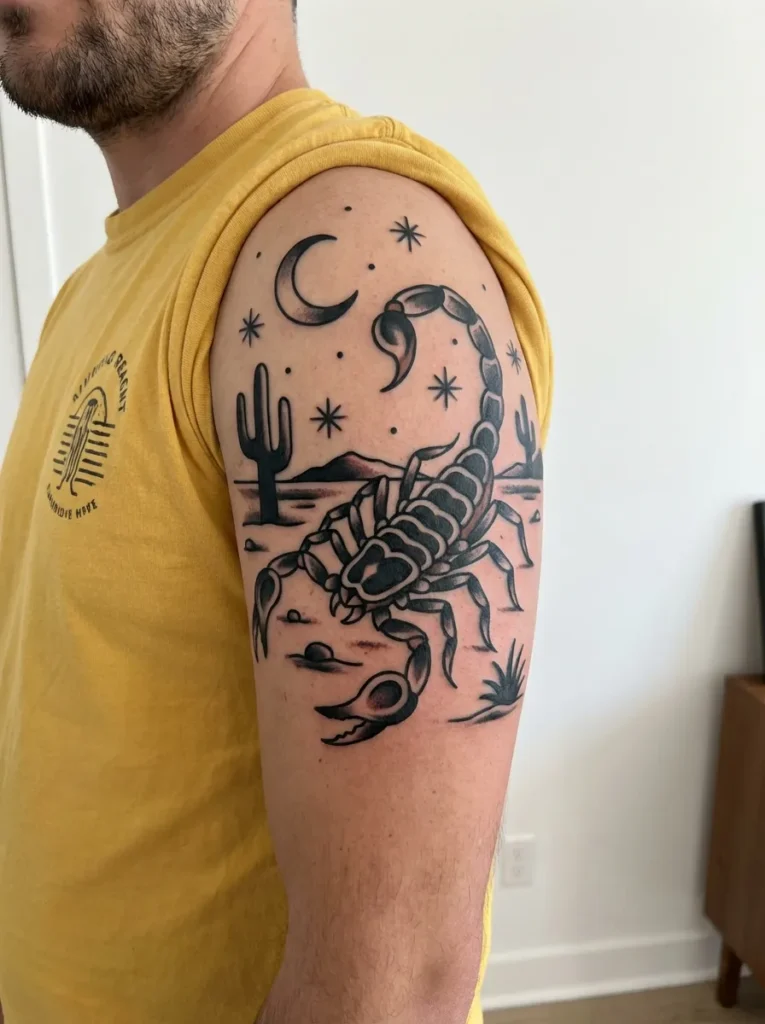
A desert moon overhead sets a nocturnal hunting scene. Scorpions are night creatures, most active when the sun goes down.
The moon might be full and bold behind the scorpion or a crescent hanging above. Traditional celestial work keeps the moon simple with clean outlines. Stars might dot the night sky. The scorpion becomes a creature of darkness and mystery.
Night is when the scorpion rules its territory. This design captures that after-dark power.
20. Scorpion on Sun-Bleached Skull

A weathered skull sits in the desert while the scorpion makes it home. Nature reclaiming what’s left behind.
The skull shows age with cracks and missing teeth. The scorpion crawls across or through it, claiming the remains as territory. This creates layers of symbolism about death, survival, and the desert’s harsh reality. Traditional skull and scorpion work blend seamlessly.
Which scorpion design matches your survival story?