There’s something timeless about American traditional horse tattoos. Bold lines, vivid colors, and designs that look as good today as they did decades ago on sailor’s arms and biker’s chests.
These aren’t delicate watercolor horses or photorealistic portraits. We’re talking classic flash art.
The kind you’d find hanging in old-school tattoo parlors, drawn with confidence and zero apologies.
Horses have always represented freedom, strength, and untamed spirit. In traditional tattooing, they carry that same energy but with the signature look: thick black outlines, limited color palettes, and designs built to last a lifetime.
Whether you want a single powerful image or something more elaborate, American traditional style keeps it clean and striking.
Let’s explore some iconic horse tattoo ideas rooted in this legendary art form.
1. Rearing Horse Tattoo

A horse on its hind legs commands attention. This pose captures pure power and defiance, frozen in a moment of wild energy.
The rearing position works perfectly for American traditional style. Those strong vertical lines and dramatic angles fit the bold aesthetic naturally. It’s dynamic without being complicated.
This design usually features solid black shading with pops of brown or red. The mane flows backward, adding movement to the static image.
Great for placement on the outer arm, thigh, or calf where the vertical composition really shines.
2. Running Horse Tattoo

Nothing says freedom like a horse at full gallop. Legs extended, mane flying, hooves barely touching the ground.
Traditional artists nail this with simplified shapes that still convey serious speed. You don’t need a hundred details when the silhouette tells the whole story. The pose itself does the heavy lifting.
These often include minimal background elements. Maybe a few ground lines or dust clouds rendered in classic stipple shading. The focus stays on the horse’s motion and muscular form.
3. Horse Head Portrait Tattoo

When you want to showcase the horse’s noble features, a head portrait delivers. Strong profile, alert ears, intelligent eyes.
This design zooms in on character rather than action. Traditional style keeps it graphic with bold facial features and pronounced shading. No soft gradients here, just confident blacks and strategic negative space.
The bridle or halter often gets included, adding those essential decorative elements. Studs, buckles, and leather straps give the piece extra visual interest without cluttering the composition.
Popular spot? Upper arm or chest where the portrait format fits naturally.
4. Wild Stallion Tattoo

A wild stallion represents untamed nature and masculine energy. No saddle, no rider, no rules.
These designs emphasize the horse’s powerful build and free-spirited attitude. Thick neck, muscular chest, and that look in the eye that says nobody’s breaking this one. Traditional artists capture this through exaggerated proportions and aggressive linework.
Often depicted mid-movement with dust or sparse landscape elements. The color palette stays earthy: blacks, browns, maybe some red or yellow accents.
Perfect for someone who identifies with that rebellious, independent spirit.
5. Horse with Flowing Mane Tattoo

The mane becomes the star of the show here. Long, windswept, almost flame-like in its movement.
Traditional tattooers love this because it gives them room to play with line weight and flow. Thick outer lines with thinner internal details create depth and texture. The mane can curl, wave, or whip backward in dramatic swoops.
This style often pairs the flowing mane with a simplified body. The contrast between the ornate hair and solid horse form creates visual balance. It’s flashy without being busy.
Great for larger pieces where that mane has space to really cascade and curl.
6. Horse and Rose Tattoo

Strength meets beauty in this classic combination. The horse brings power, the rose adds elegance and symbolism.
Roses appear in almost every traditional tattoo collection, so pairing them with horses feels natural. They might frame the horse’s head, wrap around its neck, or bloom beside its hooves. Either way, they soften the design without weakening it.
- Red roses for passion and courage
- Yellow roses for friendship and loyalty
- Pink roses for grace and gentleness
The bold petals and leaves integrate seamlessly with the horse’s features. Both elements share that traditional aesthetic of clear shapes and solid colors.
7. Horse with Banner Tattoo

Banners add a personal touch to any traditional piece. Scroll ribbons flowing above, below, or around the horse create space for names, dates, or meaningful phrases.
The banner’s curves complement the horse’s organic shapes. Traditional banners have that distinctive wave and fold, shaded to look three-dimensional despite the flat style. “Wild & Free,” “Unbroken,” family names, memorial dates… whatever matters to you.
This combination works especially well for tribute tattoos. The horse symbolizes the person’s spirit while the banner states it plainly.
Placement-wise, think about leaving enough room for readable text. Larger areas like the thigh, back, or chest work best.
8. Charging Horse Tattoo

All fury and forward momentum. A charging horse comes straight at you with nothing held back.
This frontal view is bold as hell in traditional style. The chest broadens, the head lowers slightly, the expression intense. It’s confrontational in the best way, like the tattoo itself has attitude.
Shading creates depth so the horse appears to burst from the skin. Heavy blacks around the edges, lighter tones in the center. Dust clouds or motion lines might frame the bottom, but often the horse alone makes the statement.
For people who face challenges head-on, this design resonates. It’s not subtle, and it’s not trying to be.
9. Horse Forearm Tattoo

The forearm offers prime real estate for traditional horse tattoos. Visible when you want, coverable when needed.
Vertical designs like rearing or standing horses fit this placement perfectly. The natural taper from elbow to wrist mirrors the horse’s proportions. When you move your arm, the tattoo moves with it, adding life to the image.
A full forearm horse usually runs from just below the elbow to above the wrist. Medium-sized pieces work well centered on the outer forearm. Either way, this spot shows off clean linework and bold color beautifully.
10. Horse Back Tattoo

Want to go big? The back provides a massive canvas for elaborate horse scenes.
| Placement | Best For | Visibility |
| Upper back | Horse portraits, head focus | Low (easily covered) |
| Full back | Running horses, landscape scenes | Low (special occasions) |
| Lower back | Horizontal designs, multiple horses | Medium (depends on clothing) |
The back’s flat surface lets artists work without worrying about body contours distorting the design. Colors stay vibrant, lines stay clean. It’s also among the less painful spots for the amount of coverage you get.
Large back pieces can incorporate multiple elements. A prairie scene, several horses, decorative borders… there’s room to build something truly impressive.
11. Horse with Flames Tattoo

Fire and horses together create intense symbolism. Speed, danger, transformation, untamable energy.
The flames might lick up from the horse’s hooves, swirl through its mane, or surround the entire figure. Traditional flame designs have that characteristic pointed, layered look. Yellow cores, orange middles, red tips, all outlined in thick black.
This combination amps up the aggression factor. It’s not just a horse anymore, it’s a force of nature. The colors pop against each other: warm flame tones contrasting with the horse’s cooler browns and blacks.
Perfect for someone who wants their tattoo to have extra visual punch and symbolic heat.
12. Horse with Rope Frame Tattoo

A rope border gives the design that authentic Western feel. Lasso coils, twisted hemp, the tools of ranch life.
The rope frames the horse in a circle, oval, or custom shape that follows the body’s contours. It grounds the piece and adds another layer of that Old West aesthetic. Traditional rope shading shows the twisted texture clearly without overcomplicating things.
Some designs show the rope loose and flowing, others tie it in specific knots. Either way, it reinforces the cowboy connection and gives the tattoo a finished, contained look.
Works especially well for shoulder caps, thighs, or anywhere you want a self-contained piece rather than something that bleeds into other designs.
13. Horse and Western Star Tattoo

Stars appear constantly in traditional tattooing, and Western stars bring specific cowboy flair. Five-pointed, often with shading that makes them pop off the skin.
These stars might sit above the horse, scatter around it, or replace traditional background elements. They add celestial symbolism to the earthly power of the horse. Navigation, destiny, ambition… stars carry their own weight.
The geometric star shapes contrast nicely with the horse’s organic curves. It’s another example of traditional style balancing different elements into one cohesive piece. Colors typically include black outlines with white, yellow, or gold fill.
14. Twin Horses Tattoo

Two horses create interesting composition possibilities. Facing each other, running together, or mirrored in perfect symmetry.
Twin designs work great for chest pieces, spreading across both pecs with something centered between them (heart, star, initial). They also suit the back, thighs, or as matching pieces on both arms. The symmetry appeals to people who appreciate balance and partnership symbolism.
Color options:
- Matching colors for unity
- Contrasting colors (black/brown) for duality
- One colored, one pure black for yin-yang effect
Traditional artists can make twins look connected without being identical. Similar poses, different details. It keeps the eye moving across the entire piece.
15. Horse with Shield Tattoo

Medieval meets Western in this mashot blend. The shield adds protection symbolism and gives another surface for personal emblems.
Shields in traditional tattooing have that classic shape: rounded top, pointed bottom, bold border. They might display family crests, initials, meaningful symbols, or stay plain with decorative shading. The horse appears behind, beside, or rearing above the shield.
This combination suggests both strength and defense. The horse provides the power, the shield represents protection of what matters. It’s meaningful for military folks, first responders, or anyone who values that guardian symbolism.
The shield also breaks up the composition in interesting ways, adding geometric stability to the horse’s flowing lines.
16. Horse and Prairie Scene Tattoo

Setting the horse in a landscape tells a bigger story. Rolling plains, distant horizons, wide-open spaces.
Traditional landscape elements stay simple: a few ground lines, suggested hills, maybe some basic vegetation. The point isn’t photorealism but creating context. The horse runs through its natural habitat, free and powerful.
These scenes often include minimal color in the background, letting the horse remain the focal point. Browns and greens for the land, perhaps some blue or yellow for sky. Everything serves the main subject without competing for attention.
Larger formats work best here. You need space to establish the setting and still give the horse proper detail.
17. Horse in Motion Tattoo

Pure kinetic energy. Legs blurred, mane streaming, every line suggesting movement.
Traditional artists capture motion through specific tricks: repeated outlines showing the path of movement, strategic placement of action lines, poses that freeze the horse mid-stride. It’s not about realism but about conveying that sense of speed and power.
These designs often feel more dynamic than technically accurate, and that’s the point. The emotion of motion matters more than perfect anatomy. Bold choices, confident execution, maximum impact.
Great for people who live active lifestyles or identify with constant forward movement. The tattoo captures that restless energy permanently.
18. Horse in Mountain Valley Scene

Mountains add dramatic backdrop and elevation symbolism. The horse stands strong against massive peaks, matching nature’s grandeur.
Traditional mountain designs use simplified triangular shapes with minimal shading to suggest distance and scale. Maybe some snow caps in white, some basic clouds. The composition creates depth without detail overload.
This scene works well for vertical placements like the outer thigh or full sleeve sections. The mountains rise behind while the horse occupies the foreground. It’s aspirational imagery: reaching heights, conquering challenges, standing firm in wild territory.
19. Horse with Storm Clouds

Dark skies and a powerful horse create serious drama. Storm clouds bring tension, conflict, and that feeling before everything breaks loose.
Traditional cloud shading uses dense stippling or solid blacks with swirling outlines. Lightning might crack through in yellow or white. The horse appears either calm against the chaos or equally wild, matching the storm’s energy.
This combination speaks to people who’ve weathered hard times or embrace life’s turbulent moments. The horse doesn’t run from the storm. It stands in it, moves through it, or even seems part of it.
The contrast between dark clouds and the horse’s form creates strong visual impact. It’s moody without being depressing, powerful without being aggressive.
20. Horse in Desert Canyon Scene

Red rocks, vast spaces, harsh beauty. Desert canyons provide a distinctly American backdrop for traditional horse tattoos.
The layered canyon walls work well in traditional style: stacked horizontal lines suggesting depth and distance. Colors shift from red-orange foreground to lighter background. Minimal detail maximum atmosphere.
The horse navigates this tough terrain, representing endurance and adaptation. It’s cowboy country, outlaw territory, places where only the strong survive. The symbolism runs deep for Western enthusiasts or anyone who identifies with desert landscapes.
These scenes often include some basic desert vegetation. A cactus or two, some scrub brush, just enough to establish location.
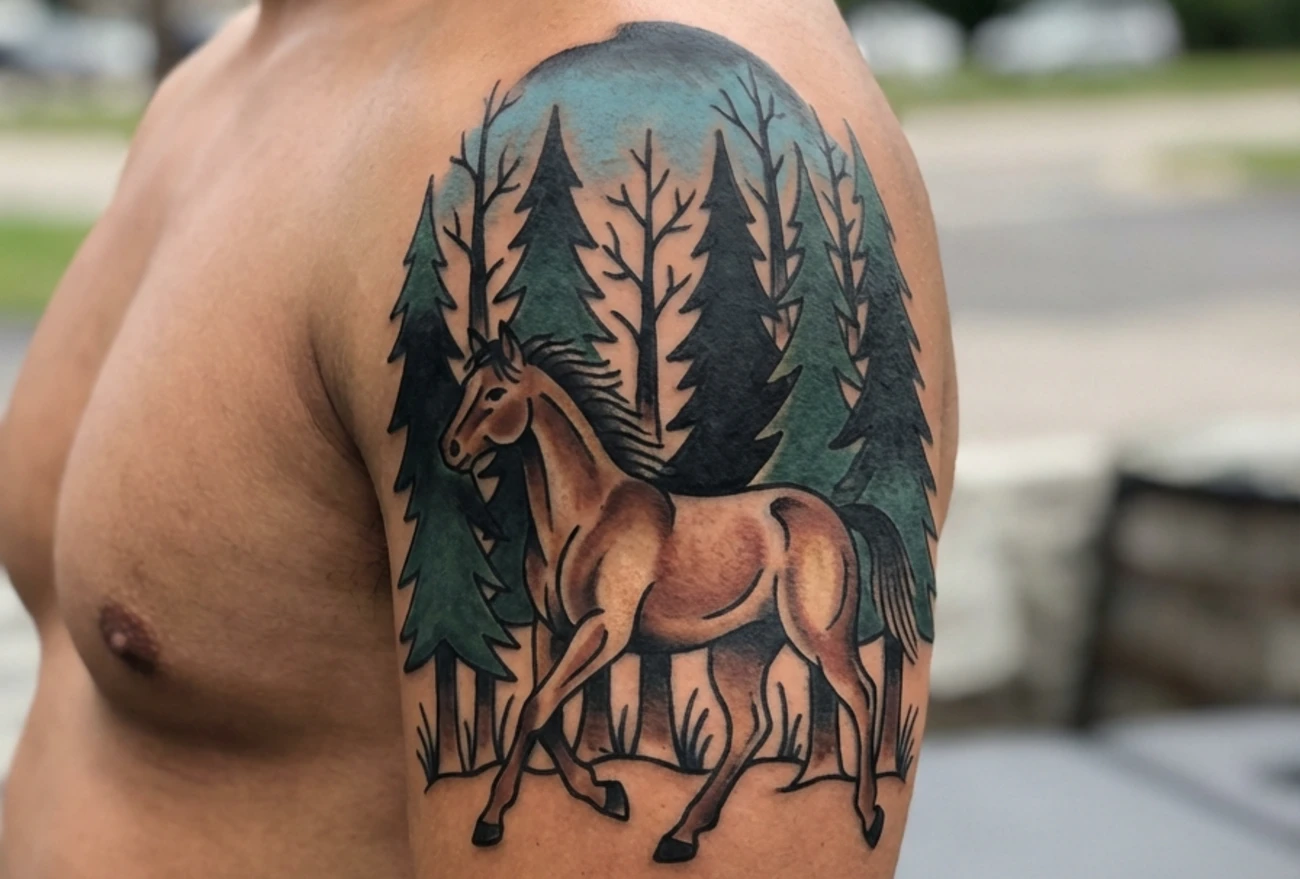
21. Horse in Pine Forest Scene

Trading desert heat for mountain cool. Pine forests create a completely different mood: quieter, more mysterious, almost spiritual.
Traditional pine trees use simplified shapes: triangular evergreens with minimal branch detail. They might frame the horse on both sides or create a backdrop of dark silhouettes. The forest feels dense without being cluttered.
This setting suggests different symbolism: solitude, natural wisdom, ancient lands. The horse moves through timeless woods, connected to something older than civilization.
Color palette shifts cooler: dark greens, blacks, maybe some blue tones. The horse often appears in warmer browns and tans, standing out against the forest’s shadows. It’s contemplative imagery compared to the action-heavy desert or prairie scenes.
Which horse tattoo speaks to your spirit: the wild stallion running free, or the noble portrait frozen in time?