
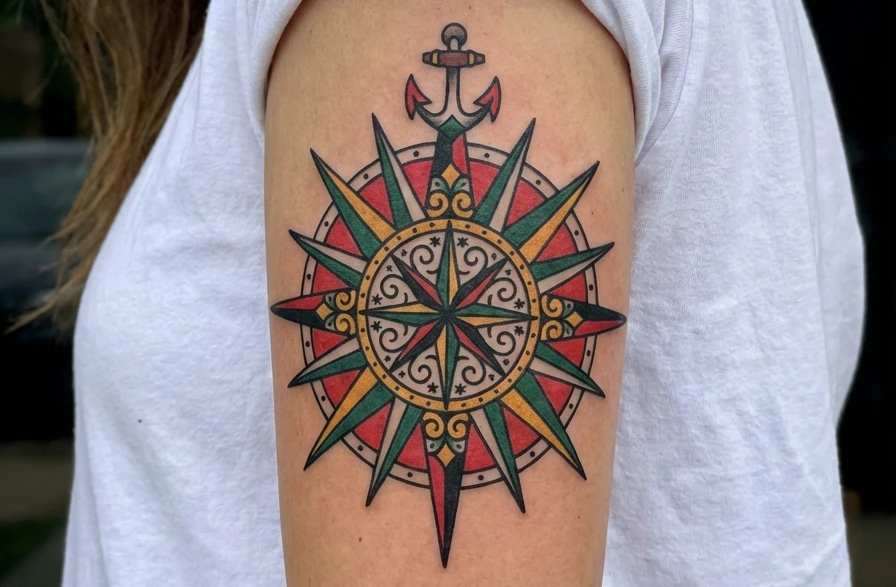
Sailors tattooed compasses on their skin long before GPS existed. These weren’t just decorations, they were prayers for safe passage and symbols of finding your way home.
American traditional compass tattoos carry centuries of meaning. Direction, guidance, protection, and the courage to explore unknown waters. Bold lines and clean geometry make compasses perfect for traditional style.
The circular shape creates natural balance while cardinal points provide structure. North, south, east, west marked clearly in thick black ink.
These designs work equally well small and detailed or large and bold.
Whether you’re literally traveling the world or navigating life’s uncertain paths, a compass tattoo reminds you to trust your direction. Let’s explore 15 styles that blend heritage with adventure.
1. Classic Compass Tattoo
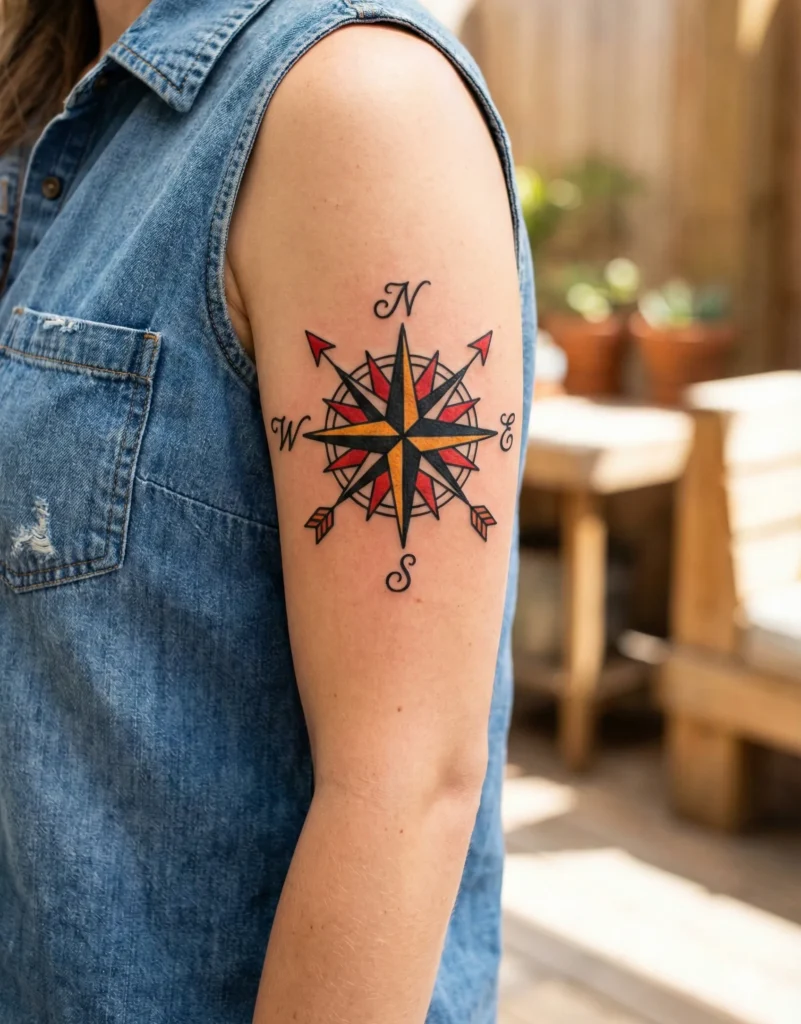
A straightforward compass with cardinal directions needs nothing extra. The symbol speaks for itself.
Four main points marked N, S, E, W in traditional lettering. The center star or circle anchors the design while directional arrows point outward. Bold black outlines define each element. Some artists add degree markings around the edge while others keep it minimal.
This design scales beautifully. Tiny on your wrist or large across your chest, the classic compass stays readable and powerful.
2. Compass Rose Tattoo
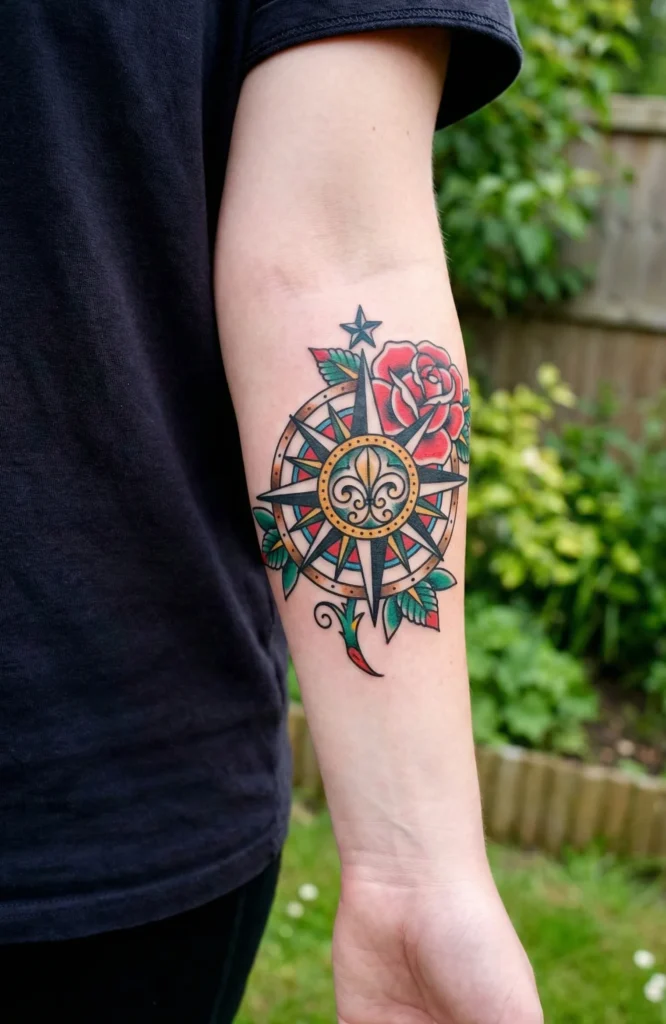
The ornate compass rose adds decorative flair to functional navigation. Elaborate points create a star-like pattern that’s stunning in traditional style.
Eight or sixteen points radiate from the center with alternating lengths. Traditional compass roses have intricate interior details while maintaining bold outlines.
North might be emphasized with a longer point or special symbol. The rose combines beauty with purpose, decoration with direction.
This version appeals to people who want their compass to be as artistic as it is meaningful. Navigation doesn’t have to be plain.
3. Compass with Map Lines Tattoo
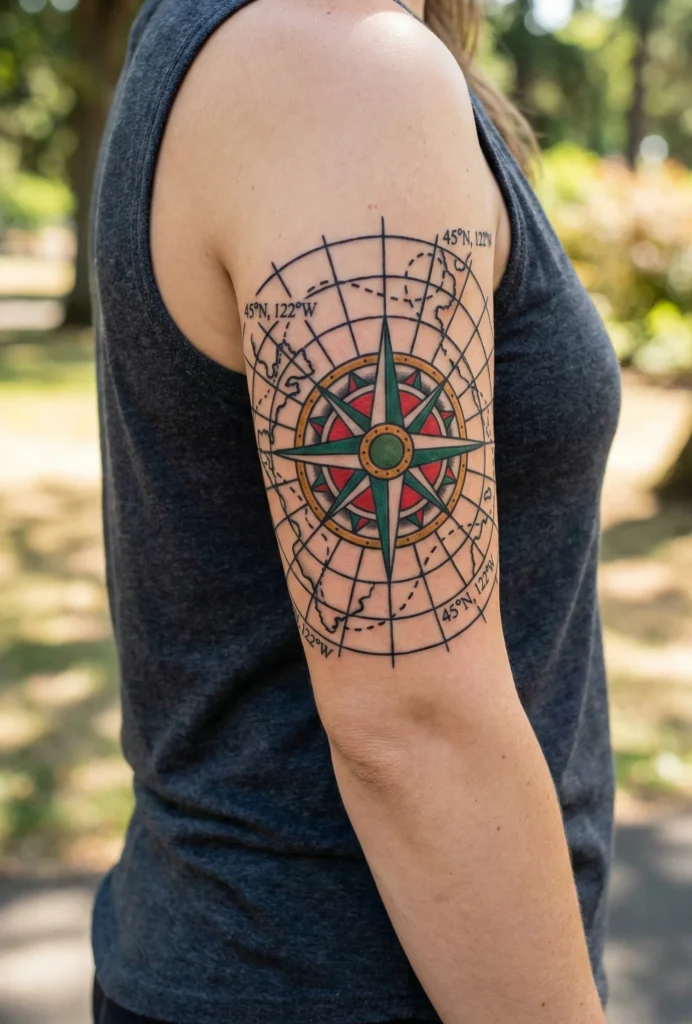
Latitude and longitude lines create a cartographer’s dream. The compass sits atop or within a grid that suggests global reach.
Map lines extend outward from the compass in traditional bold strokes. They might cover the entire background or concentrate in specific areas.
Some designs show partial continents or coastlines within the grid. The combination transforms a simple compass into a complete navigation system.
Common map elements:
- Latitude and longitude grid patterns
- Simplified continent outlines
- Dotted sea routes or travel paths
- Coordinate numbers in traditional fonts
This design says you’re not just finding direction, you’re charting entire journeys.
4. Compass with Anchor Tattoo

Two classic sailor symbols merge perfectly. The anchor represents stability while the compass shows the way forward.
The anchor might rest behind the compass, cross through it, or stand beside it as a companion piece. Traditional anchor designs have bold curved arms and detailed rope or chain.
Together they balance wanderlust with the need for home. You can explore knowing you have something solid to return to.
Sailors originally got these tattoos hoping to find their way home and drop anchor safely. That meaning still resonates.
5. Compass and Ship Tattoo
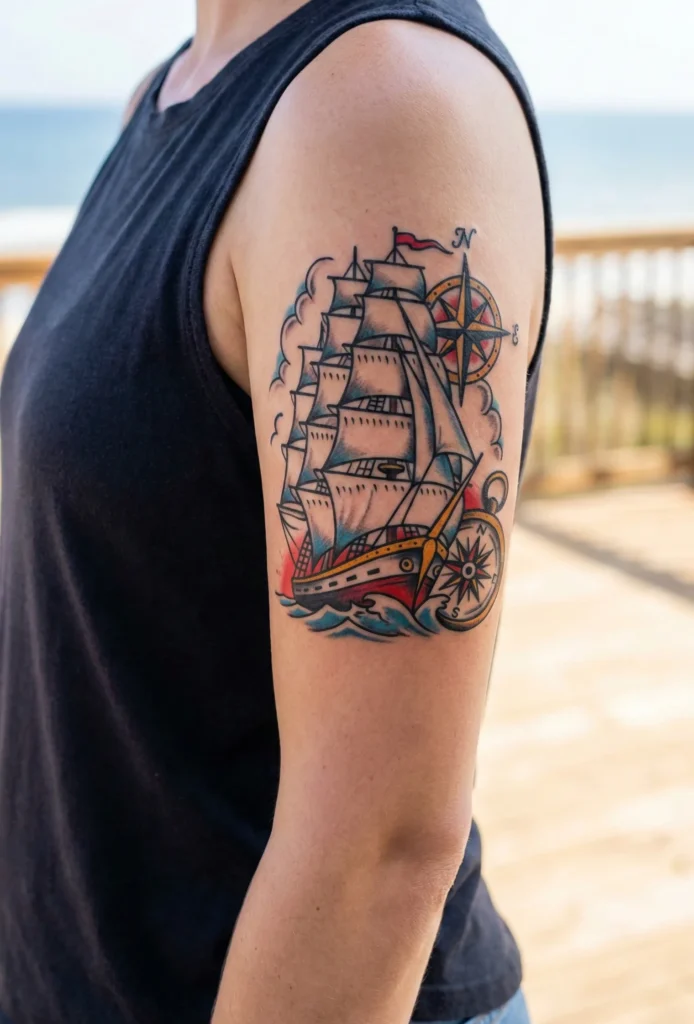
A sailing vessel paired with navigation tools tells a complete adventure story. The ship goes where the compass points.
Traditional ships have billowing sails, clean hull lines, and maybe flying flags. The compass might appear on the sail itself, float beside the ship, or position below it.
Some designs show the ship sailing toward a specific compass direction. Both symbols represent exploration and trusting your path across unknown waters.
This combination captures the romance of ocean travel in the age of sail.
6. Compass Forearm Tattoo
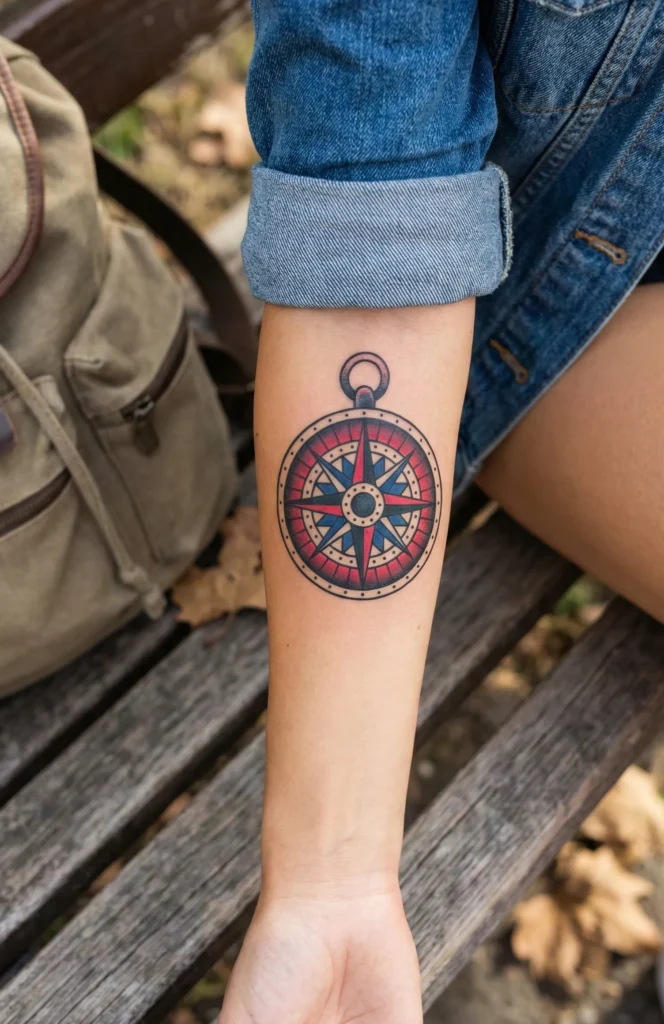
The forearm offers excellent real estate for circular compass designs. The shape fits naturally on this canvas.
A compass centered on the inner or outer forearm creates a bold statement. The relatively flat surface lets intricate details shine. You can glance down and check your direction whenever needed. Traditional bold lines read clearly on the forearm’s visible placement.
This spot makes your compass accessible. A constant reminder to stay true to your path.
7. Compass Chest Piece Tattoo

Centered on the chest, a compass sits right over your heart. The placement adds emotional weight to directional symbolism.
Large compass designs spread across the pectoral muscles with room for elaborate details.
The chest provides space for additional elements like banners, coordinates, or surrounding imagery. Some people place it directly over the heart as a literal guide for life decisions.
Your compass becomes part of your core. Direction comes from within, marked permanently on your chest.
8. Compass Back Tattoo

The back’s broad canvas allows for massive, detailed compass work. This placement creates a centerpiece design.
A compass between the shoulder blades or lower back becomes a focal point. The back’s size permits elaborate compass roses with extensive detailing.
You can add surrounding elements without crowding. The placement also means the compass guides you from behind, pointing the way forward.
| Placement | Size Potential | Visibility | Symbolic Meaning |
| Forearm | Medium | High | Constant guidance, accessible direction |
| Chest | Large | Personal choice | Heart-centered navigation, core values |
| Back | Very Large | Low (to wearer) | Guidance from behind, pushing forward |
| Hand/Wrist | Small to Medium | Very High | Always present, visible reminder |
Back pieces make statements even when covered. You know it’s there, guiding you.
9. Compass with Banner Tattoo

A ribbon banner flowing around the compass gives space for coordinates, dates, or meaningful phrases. Personal details make the compass uniquely yours.
The banner might wrap around the compass edge, drape across the middle, or flow beneath it. Traditional banner work has dimensional folds and shadows.
Text could be actual coordinates of important places, travel dates, or phrases like “Not All Who Wander Are Lost” or “True North.”
Your specific journey gets documented alongside universal navigation symbolism.
10. Compass and Waves Tattoo

Ocean waves surrounding or beneath the compass reinforce maritime heritage. Water and navigation go hand in hand.
Traditional waves have bold curved lines with white caps and deep troughs. They might crash around the compass base or provide a watery background.
The waves remind us that compasses were essential tools for crossing dangerous seas. Movement and stability combined in one image.
The ocean tests you, but the compass keeps you oriented through the storms.
11. Compass with Mountains Tattoo

Jagged peaks replace or surround the traditional compass rose points. Land navigation meets wilderness exploration.
Mountain shapes integrate into the compass design as directional markers. Traditional angular mountain work with bold outlines creates the peaks.
This version appeals to hikers, climbers, and land adventurers rather than sailors. The mountains suggest rugged terrain and challenging paths.
Not everyone navigates by stars and sea. Some of us follow mountain ranges and wilderness trails.
12. Compass and Skull Tattoo
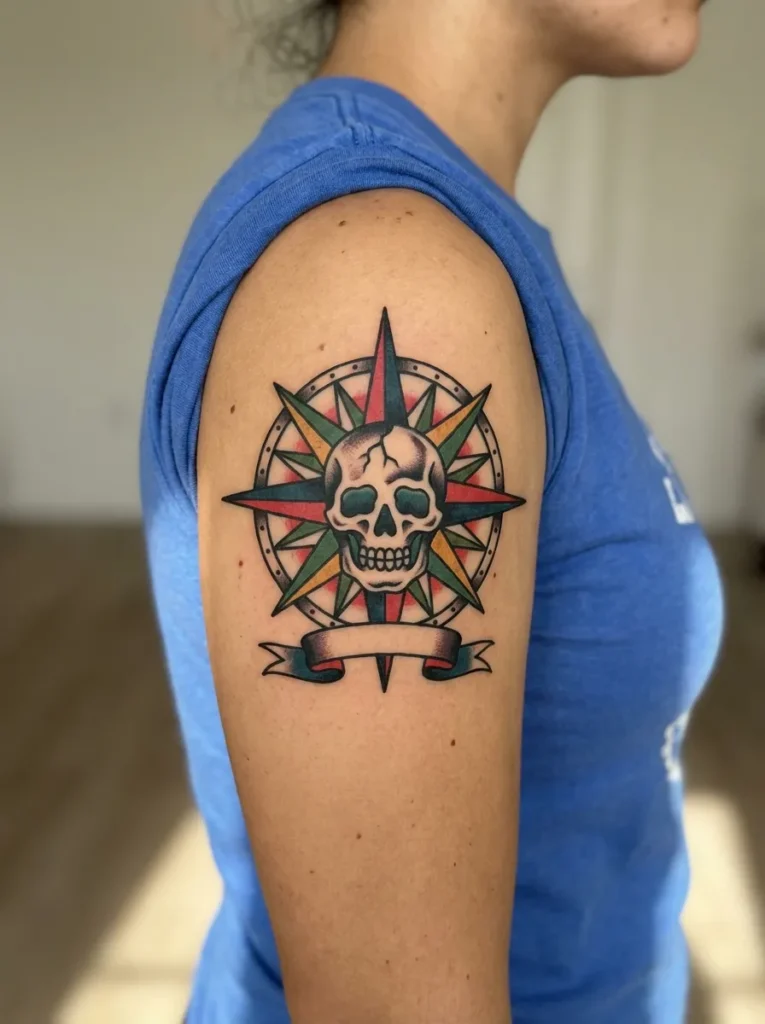
Death and direction create philosophical depth. The skull reminds us that time is limited, making navigation choices matter more.
A traditional skull might appear behind the compass, beneath it, or integrated into the design. Clean skull work with defined eye sockets and teeth contrasts with the compass’s geometric precision.
The pairing suggests that even knowing death comes, we still choose our direction. Mortality makes the journey meaningful.
This isn’t dark for darkness’s sake. It’s honest acknowledgment that our navigation through life has stakes.
13. Compass with Globe Tattoo
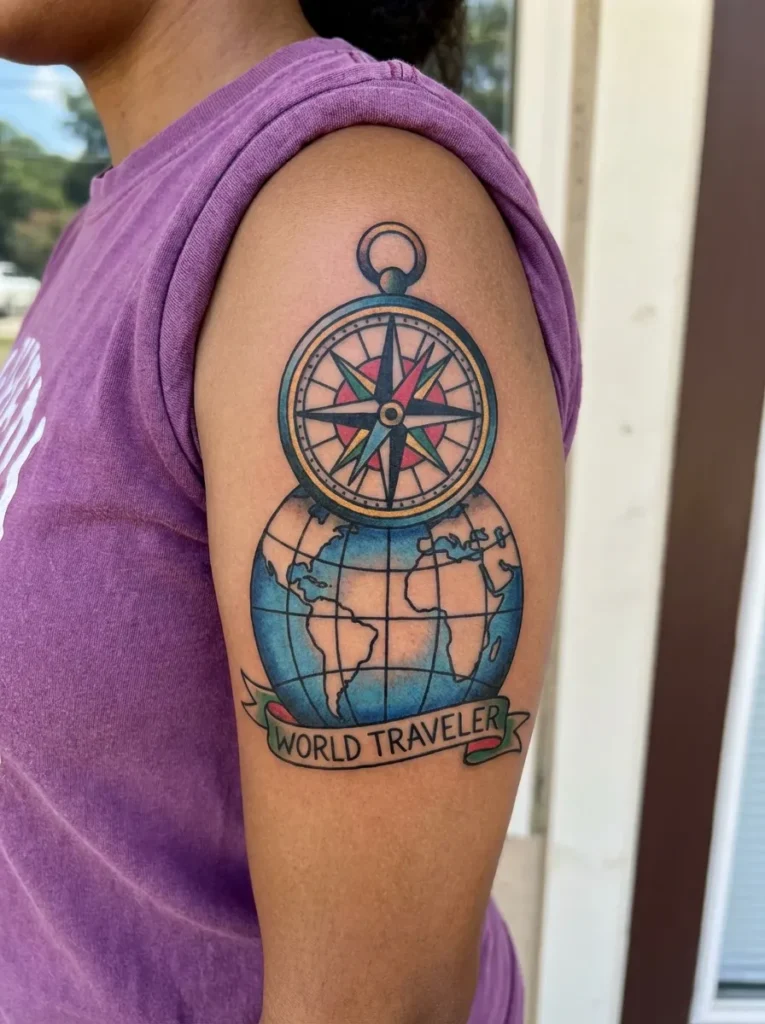
The full earth adds global perspective to personal direction. Your compass doesn’t just point locally, it encompasses the entire world.
A traditional globe with simple continent outlines might appear behind or beneath the compass. Latitude and longitude lines wrap around the sphere.
The compass could sit atop the globe like a crown or integrate with it as one unified piece. This design speaks to world travelers and those with international connections.
Your direction isn’t confined by borders. The whole planet is your territory.
14. Compass and Lantern Tattoo

Light and direction merge beautifully. The lantern illuminates the path while the compass shows which way to go.
A traditional lantern with bold frame lines and visible flame sits beside or behind the compass. Yellow or orange flame color adds warmth to the black and gray composition.
Both tools helped sailors navigate, the lantern for seeing and the compass for knowing. Together they represent finding your way even in darkness.
You need both light to see and direction to follow. This design provides both.
15. Compass and Mountain Range Tattoo

Multiple peaks create a dramatic landscape background for compass navigation. This is wilderness adventure on a grand scale.
A range of traditional mountains stretches behind or around the compass. Each peak has bold outlines with minimal shading suggesting distance.
The compass might overlay the mountains or sit prominently in front. This design captures the spirit of backcountry exploration and high-altitude adventure.
The mountains challenge you to find your way through difficult terrain. Your compass ensures you don’t get lost in the wilderness.
Where does your compass point?